Two households in the same city might need very different settings for a side-table ad. One person wants to move a laptop off the dining table after work. Another needs to preserve a walking route through a shared living room. Their wall colors could be similar; the product’s reason for being there would not. These are creative hypotheses, not findings about any city’s residents.
Location matters in global home product advertising. But asking which country a room belongs to answers only part of the question. Who shares it? What activity is happening? What must be put away before the next activity begins? Without those relationships, even an accurate local interior reference may do little more than make a room look geographically plausible.
Location is not the only index in IKEA’s home-visit material
IKEA Museum’s Home visits for knowledge and insights, headed “Home sweet homes,” describes organizing Open Home material using geography alongside household size and income, and comparing activities such as laundry, cooking, sleeping and spending time together. It also says the platform was then internal to IKEA. No publication date is displayed; the page was checked on October 20, 2026.
The useful creative lesson is not that every brand needs to replicate that platform. It is to ask where a task happens, who performs it and under what conditions. We did not access Open Home, conduct its visits or infer a uniform national lifestyle from its public description.
Gapminder’s About Dollar Street describes arranging household imagery by income. Its explanation says the figures seek to measure consumption resources rather than wages alone, accounting for household members and purchasing-power differences. The undated page was checked the same day. A displayed value should therefore not be read directly as an advertising prospect’s monthly salary, nor one household as an entire market.
These are ways to frame inquiry, not ready-made consumer profiles. Is a proposed scene responding to resource constraints, the arrangements of a shared space or personal preference? Bundle everything into “people there like this” and the reason for the setting becomes difficult to examine.
One side table can participate in two different tasks
Assume a fictional side table without a special mechanical structure. No actual dimensions, load capacity or performance are asserted. The creative question is why it belongs in the scene, not how a camera can invent a function for it.
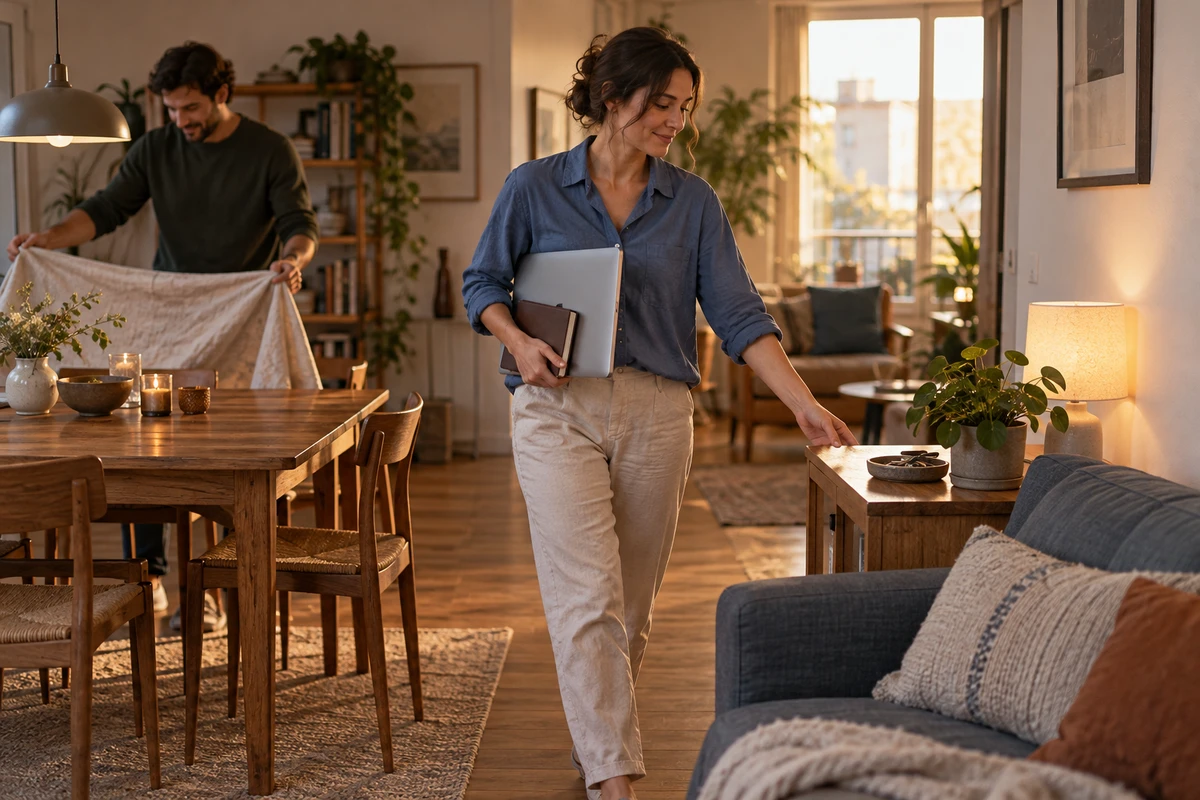
The first idea is putting the working day aside. Someone closes a laptop, removes work objects from the dining table and puts them in a suitable place nearby. The dining table becomes available for the evening. The important relationship is not a vaguely Western apartment: one surface has successive uses. Show where the objects came from, where they go and who will use the cleared space.
If art direction removes every trace of work before filming, the action loses its reason. Equally, busyness need not mean excessive clutter. A notebook in use and a closed laptop might establish the activity. The scene should determine what is needed, not an assumption that mess automatically creates authenticity.
The second idea concerns different activities sharing a living room without obstructing one another. The table’s position needs to relate to the sofa, entrances and movement. One person might continue an activity while another passes through, rather than repeating the work-to-dinner story. Decoration could remain similar while the product’s relational task changes.
This does not establish that a side table solves crowding or that a particular arrangement guarantees safety. Check the actual sample, room dimensions and circulation conditions separately. If the object occupies the space the idea needs to preserve, acknowledge that mismatch instead of using a wide lens and editing to make the room seem larger.
Generating a room is not discovering a household
Whether a reference is photographed, rendered or AI-generated, ask the same questions: what has this person just finished, what happens next, and which step does the product’s position help? Warm-white walls, a gray sofa and beautiful daylight define a visual direction, not a household insight.
A generated image can help explore an arrangement. It is not, by itself, an observation of a target household. Naming a country in a prompt cannot substitute for understanding specific conditions of use. This article’s original AI-generated cover illustrates an activity transition; it is not a local household sample or proof that the depicted furniture is suitable in practice.
Localization need not erase a Chinese brand’s own aesthetic either. Reconsider details that impede understanding or conflict with real use; retain deliberate brand expression where it belongs. Advertising can also portray an aspirational home, provided the creative vision is not presented as the life target consumers generally already have.
Between observation and a filmable action sits a reason
A photograph showing work objects on a dining table establishes a state at the time of capture. It could be a permanent arrangement, a temporary move or something done for the photograph. Turning it immediately into “this market lacks separate home offices and therefore needs our product” skips an unexamined explanation.
Separate three things in material you are authorized to use: what was observed; how the person explained the arrangement; and the filmable action the creative team proposes in response. If the first two remain uncertain, label the third a hypothesis. A visually attractive photograph cannot establish the situation, its cause and the product need simultaneously.
Group references differently too. Compare households within a region but with different household structures to examine how similar activities are arranged. Then consider households across regions with comparable tasks to explore possible shared difficulties. This does not make culture irrelevant or income all-determining. It prevents a country name from doing all the explanatory work. Retain dates, observation scope and missing conditions as well.
In the storyboard, check whether the action can occur in the space: how the dining table changes from work to shared use, where the side table sits relative to actual movement, and whether art direction has removed necessary objects. The discussion becomes “why does this situation need the product?” rather than “does this room look sufficiently overseas?” It can produce a clearer creative hypothesis, not replace audience research or verification of the actual product.
For global home-product content, bring the real sample, a defined target household and use material you are authorized to discuss. Explore how everyday tasks translate into settings and shots through ONCE ecommerce product video production.
Walls and furnishings shape what we notice first. Everyday tasks help explain why we should continue watching. The side-table film may not need a more international-looking room. It needs a particular household able to get on with something that matters to it.
Source note: The IKEA Museum and Gapminder texts were checked on October 20, 2026. Only their public methodological descriptions are used, not sample totals, market shares or sales outcomes. No home visits, image-by-image household comparisons, film viewing or audience tests were conducted for this article. The two side-table ideas and cover are fictional, not ONCE client work. The Chinese edition names the same sources without overseas links whose mainland-China accessibility has not been tested.