A younger person chooses the route, packs the bag and explains what the trip means. The older person smiles gratefully at the end. An ad like this may be warm, but it leaves a question about the relationship: is the person receiving care the protagonist, or the recipient of someone else's kindness?
The issue is not whether advertising can show help. It is whether the person still has intentions of their own once help arrives. Accepting assistance is not the same as handing over decisions. An older character can ask for support, decline an arrangement, change a plan or care deeply about something another person considers unimportant.
Ordinary life exists between the extremes
WHO's Quick guide to avoid ageism in communication, published on June 11, 2021, cautions that sharing an age does not make people the same. Its guidance rejects presenting an age group as uniformly frail and dependent, or invincible and active, and encourages more diverse portrayals of different lives. This is communication guidance, not a health assessment or advertising-effectiveness study.
In The Depiction of Older People in Advertising, dated June 19, 2025, the ASA outlined research involving focus groups and a survey of UK adults. Its public summary describes participants wanting ads to focus on individuals and varied later-life experiences rather than age labels. This article uses that UK research overview, not a representative conclusion about Chinese consumers or a compliance ruling on any particular ad. Both sources were checked again on October 19, 2026.
The creative task is therefore not simply to make every older performer look more capable. If characters deserve attention only when exercising, keeping up with trends or mastering technology, the script may still treat youthfulness as the only good answer. Someone needing assistance can have clear preferences, expertise and humour. Someone energetic can hesitate, make mistakes or decline to join in.
A character description can begin with what the person wants to do now, rather than “kindly grandmother” or “fashionable senior.” Being a grandparent may be part of their life without explaining all of it. The ad need not speak for every older person. It needs to make this particular person specific.
Separate the assistance from the purpose
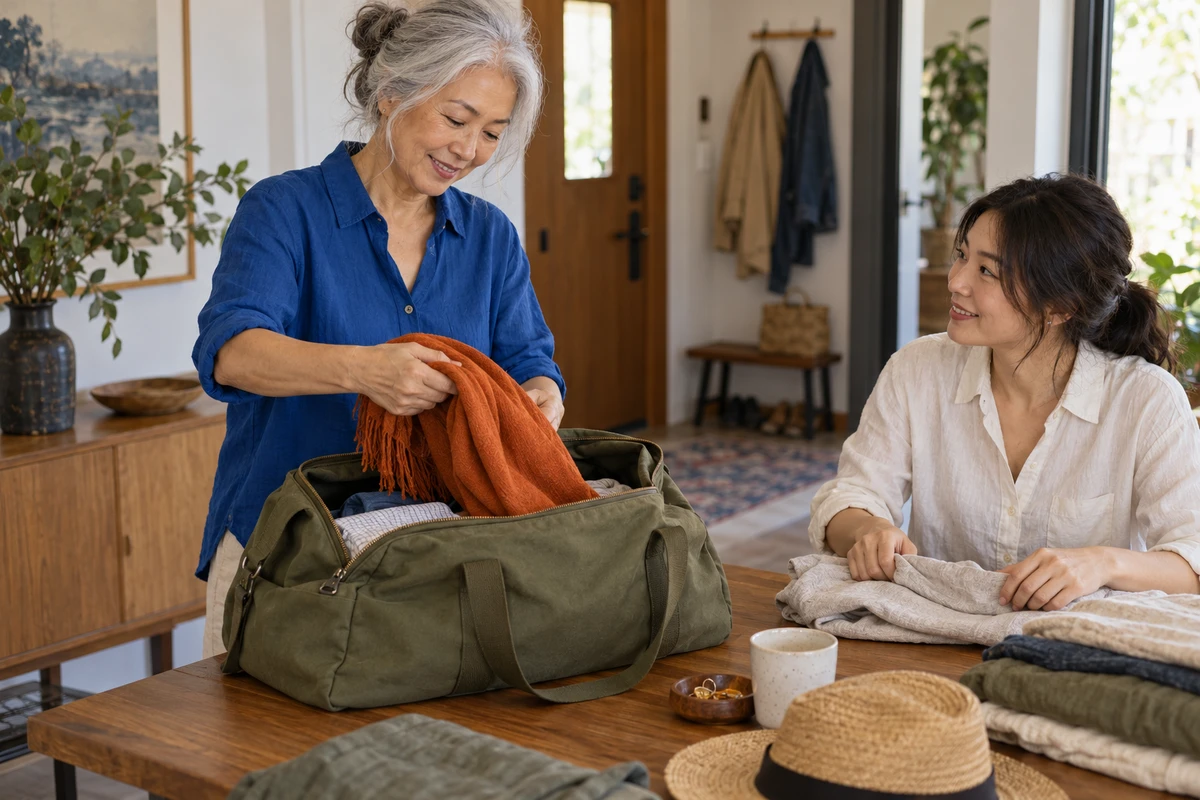
Consider an original, fictional travel-bag ad. An older woman is preparing for a short trip while an adult companion helps fold clothes at the table. The companion picks up a bright scarf and thinks it need not come along. The woman takes it back, puts it in the bag and says she wants to wear it to meet an old friend. They then continue packing together. This is not an ONCE client project, and no actual product, casting or filming test underlies it.
The assistance has not disappeared. The companion can still fold and organise, while the protagonist decides how she wants to arrive. The scarf need not be a treasured keepsake or introduce a tearful backstory. “I want to wear this today” can be a complete reason.
An alternative script might have the companion pack the scarf and explain that the woman always loved that colour when she was young. She smiles, moved. That scene could work too, but both the decision and its explanation belong to someone else. It is closer to a story about how the companion understands and cares for her. Either viewpoint is possible; the older person having the most screen time does not automatically give her an active position.
The product can participate in packing without creating the protagonist's autonomy. Where the bag sits, how clothes enter it and when both people withdraw their hands can all be part of the image. Specific opening, storage and carrying actions must fit the real product. One smooth operation cannot establish suitability for every older user, and the item should not become a universal answer to ageing.
Asking for help can be an active line
The protagonist could also say, “Hold this side for me. I'll put it in.” She does not suddenly have to perform every task alone to prove she is the lead. Naming the assistance she wants and continuing to take part establishes a different relationship from someone taking over without asking.
Nor must she refuse every offer. A script built entirely around “I don't need help” can trap the character in proving independence. Acceptance, negotiation and a change of mind can all belong to her. What matters is that her response can change what the other person does next, rather than merely endorse an arrangement already made.
She need not always be right, either. She could suddenly want another garment, prompting the companion to laugh and rearrange the space. Or she might hear a suggestion and change her mind. Being open to persuasion and being assumed unable to decide are different relationships.
Make casting and feedback more specific than age
Alongside appearance and actual role requirements, casting can use a short scene with a purpose: what does she want to keep, why does the other person want to remove it, and how does she intend to respond? The useful observation is not whether someone can perform a generic idea of old age, but how seriously they take this particular intention and respond to their partner.
Performance should not depend on making every action slow, repeatedly signalling forgetfulness or placing every joke in an inability to use something. A particular character can, of course, be unfamiliar with a tool. That should be a condition of the scene, not something age automatically supplies. Equally, if actual users need assistance, their specific needs should not be erased merely to create a positive image.
Wardrobe and production design can follow the person's intention. The bright scarf is not proof that older people can be stylish. It is what this person chose today. A plain one would not automatically remove her individuality. The question is whether it belongs to her decision, not whether every performer meets the same standard of youthfulness.
During treatment, rehearsal or rough-cut review, people connected with the intended life situation could be invited to respond. Listen to how they describe who proposed the trip, who made the choice and how assistance changed the relationship. Liking the image does not establish that those points were understood. One discussion cannot represent an entire age group or predict sales. This is a proposed creative review, not a test conducted for this article.
If the response is only “the younger person is caring,” while the brand intended to express the older traveller's wish, look for where that wish actually appears. It may exist only in the character notes, never reaching dialogue or action. Or another person's fuller explanation may overshadow it in the edit. The answer is not necessarily another close-up of the protagonist, but letting her decision affect the story.
Advertising with older people need not reject intergenerational care or turn everyone into an inspirational hero. A more specific beginning allows assistance and self-direction to coexist. Someone who is cared for can still know whom she wants to visit and which scarf she wants to take.
When developing a brand film involving people and intergenerational relationships, bring real product information and one key scene to ONCE's advertising creative and performance discussion. Who is helping, and who actually makes the decision?
This is original creative analysis. The travel-bag scene and AI-generated concept cover are fictional, not actual client work, evidence of product suitability or an audience test.