Before asking a China-based production team to cut a rewarded ad from a brand film, give them one missing piece of information: what, exactly, earns the viewer a reward? The answer belongs in the creative brief, not just the media plan. It changes where a product demonstration needs to become intelligible.
A reward condition is not a guarantee of attention. But a film that withholds its product meaning until after that condition is met is making an avoidable creative assumption: that viewers will stay for the brand's ending.
A format name is not a viewing contract
In its September 29, 2026 announcement, Discord described new mobile-first Video Quests as awarding Orbs after approximately 15 seconds. It distinguished Video Quests Reserve, where delivery and rewards are tied to full-video completion. Ads Manager then had managed access for selected advertisers; fully self-serve access was planned for early 2027.
Those are facts about Discord's announced products—not a universal optimal duration or evidence that every brand can book a campaign today. Confirm category eligibility, market availability and campaign access before commissioning platform-specific work. Its Quests FAQ, updated August 31, 2026, also describes opt-in participation and promotion-specific conditions.
The production question is therefore narrower than “do rewarded ads work?” It is: what coherent product meaning will this particular asset deliver by the campaign's actual reward condition?
ONCE's reward-moment edit: three separate creative jobs
This is a proposed planning method, not a performance model validated by ONCE campaigns. It separates the media condition, the product action and the reason to continue.
Establish the condition before locking the sequence
Ask the media owner to identify the approved format and exact qualifying behavior in the campaign documents. Record who confirmed it. If full viewing is required, plan against full viewing; if a time-based condition applies, use that confirmed condition. Do not convert an announcement's approximate duration into a universal asset limit, guaranteed viewing interval or fabricated on-screen countdown.
Then work backward from the relevant point in the sequence. Choose one thing the viewer should be able to understand about the product, and give its action enough room to finish.
Finish an action, not a list of claims
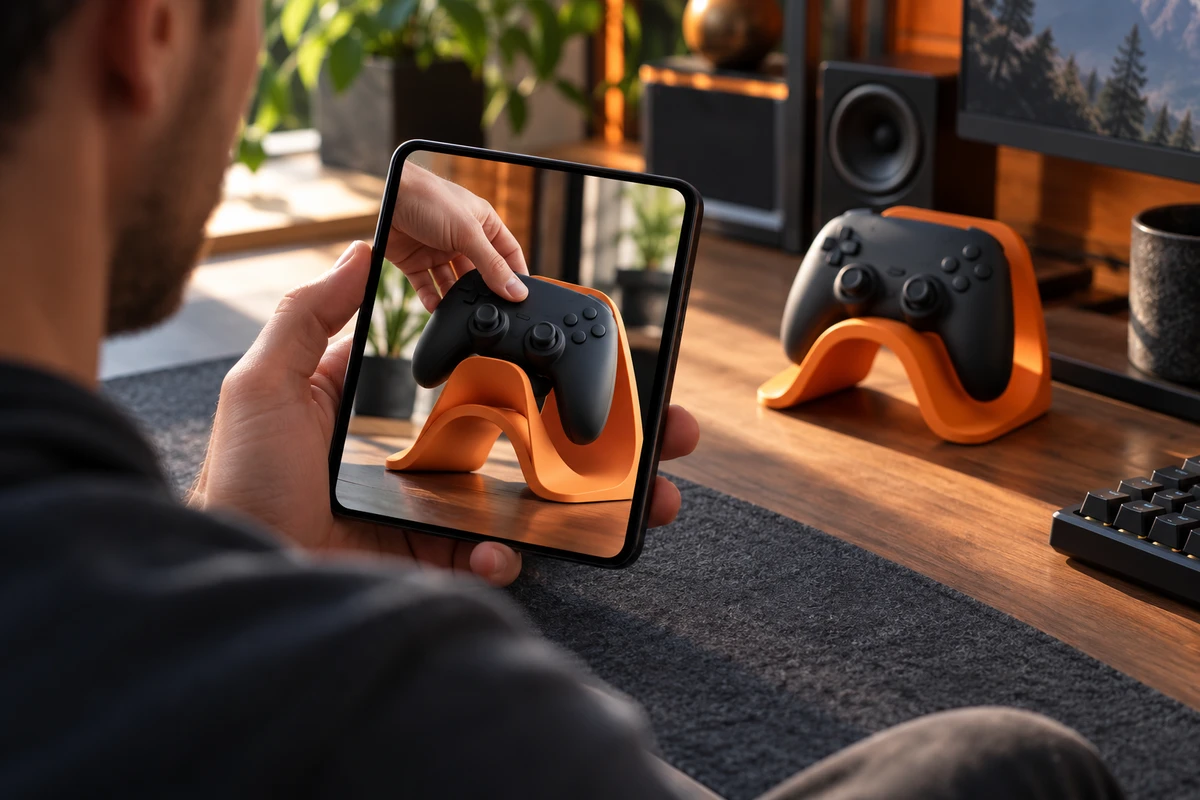
Consider a hypothetical controller-stand brand working with a Chinese supplier and production team, assuming campaign eligibility has been confirmed. Its existing lifestyle film may spend the opening on a room, a player and an evening mood, leaving the stand's function to the final reveal. Cropping that opening does not automatically create a product ad.
A purpose-built sequence could show a loose controller being placed on the stand, then hold long enough to establish the resulting storage arrangement and brand ownership. That demonstrates one use. It should not imply charging or universal compatibility unless those claims are independently substantiated.
The benefit of this approach is a clearer production task, not a promised conversion lift. A complete action may need fewer claims, a different camera position or a new opening shot—not faster playback.
Unity's Video ad best practices, checked October 19, 2026, recommends authentic app experience and clear, focused information for its own game-acquisition network. That is useful creative guidance, not independent evidence for hardware advertising or a specification for Discord. The transferable principle is clarity of action, not a borrowed duration rule.
Make further attention worth choosing
Where the format permits additional content, use it to answer a real next question: dimensions, supported use or a relevant limitation. Where a supported destination is available, make it match that question. A viewer should not need to mistake the brand's desired purchase for a requirement to claim a reward.
Keep reward messaging approved and accurate. Do not invent reward amounts, countdowns or additional purchase requirements. Nor should the creative assume that everyone who accepts a reward lacks genuine product interest. The two motivations can coexist; the ad does not tell you their proportions.
Review the sequence at the condition, then review the next step
At the agreed point, pause the edit and ask someone outside the editing process what the product did, whose product it was, and what further viewing or a visit would help them learn. Avoid explaining the intended answer first.
If the action is unclear, inspect its beginning and result before adding copy. If the function is understood but the brand is lost, improve ownership cues where the action occurs. A larger end card cannot repair information that was never made clear earlier.
This is a comprehension diagnostic. It does not reproduce a live rewarded environment, establish audience demand or measure sales causality. Campaign participation, observed understanding and voluntary subsequent behavior should remain separate observations. Where a measure is unavailable, label it unknown. ONCE's six conditions for short-form video marketing provides the wider distinction between receiving a viewing opportunity and processing a product message.
Write the production order around what is missing
For an overseas marketing team, the useful instruction to a supplier-side crew is not simply “deliver a shorter vertical version.” Specify the product action, the brand cue that must remain visible, the confirmed reward condition and the question the optional continuation answers.
Existing footage may support a re-edit if the complete action is present. A reshoot becomes a different scope when the decisive step is obscured, the result occurs too late, or reframing removes the subject. Quote asset reconstruction, missing demonstration shots, language and aspect-ratio adaptation, and reward-message coordination separately where they require different work. Keep media outcomes outside the production promise.
If an honest demonstration cannot fit, reduce the task or reconsider the creative and media combination. Do not hide essential steps or simulate product speed to satisfy the placement.
For a long-term content partner, the reusable knowledge is specific: which approved scene communicates which product action under which campaign conditions. A growing count of rewarded views is not a substitute for that knowledge. The next useful decision is whether the next format can reuse the demonstration—or needs a different one.
No campaign, customer result or cost benchmark is reported here. The controller-stand scenario is fictional; the method remains a proposal to be evaluated for the actual product and placement.