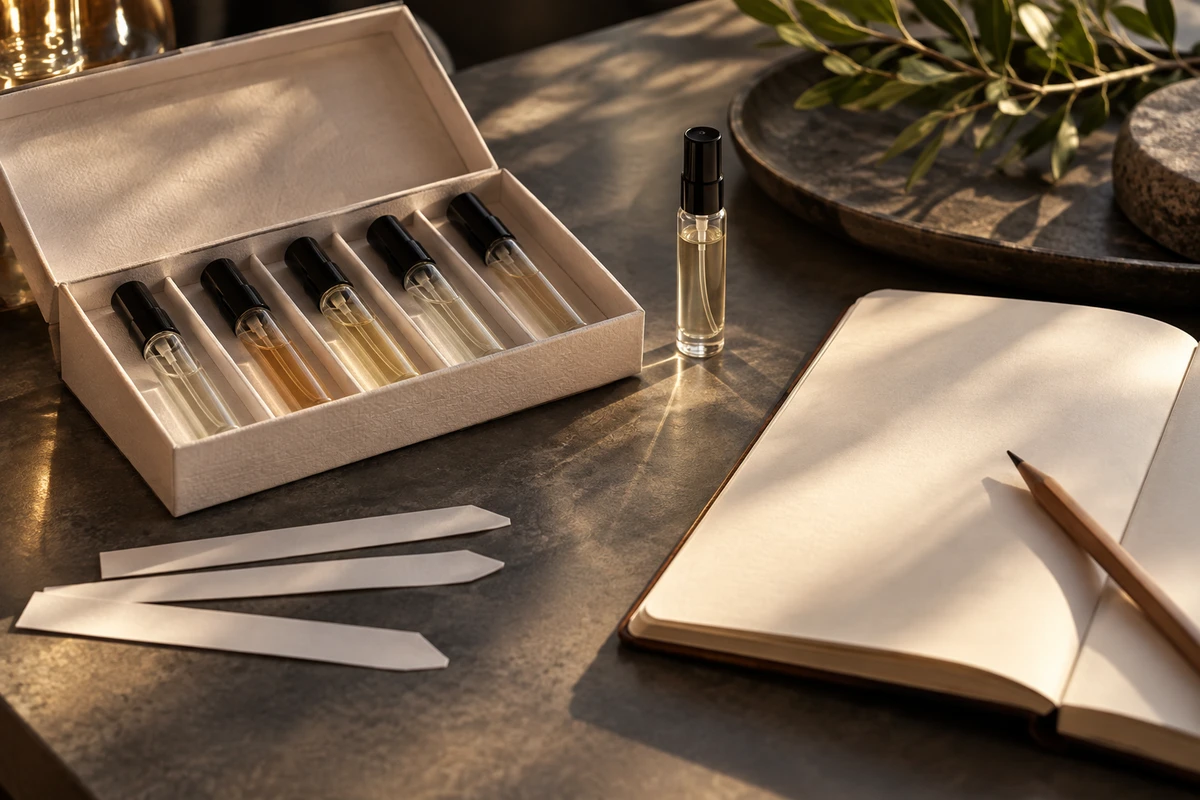
A discovery kit film can finish with an attractive arrangement of vials. Or it can finish by handing the decision back to the person holding the kit. For a fragrance brand working with China-based packaging or production partners, that difference changes the commission: are you selling the first trial, or helping someone make sense of it afterward?
ONCE recommends treating the acquisition ad and the post-delivery companion as different content tasks. You may not need two separate productions. You do need to decide which task the film must perform. A fast product montage does not become a useful companion simply because it appears on a card inside the box.
Start with what the public evidence actually shows
As checked on October 19, 2026, Le Labo's Classic Collection Discovery Set invites customers to take time exploring its fragrances. Jo Malone London's US discovery collection page also presents trial-size collections. These are examples of brands offering physical exploration as a product, not evidence that adding a companion video improves full-size sales.
This is an evergreen planning question grounded in current product pages, not a claim about a newly proven industry trend. Prices, offers, availability and use instructions should not be carried from those brands into another company's brief.
A cinematic campaign can create an imaginative world around fragrance. It cannot deliver the recipient's sensory experience through a screen. Once physical samples arrive, content can do a different job: help a customer retain a personal impression without supplying the verdict in advance.
Design the takeaway before the shots
ONCE's proposed “return-to-your-notes film” begins with three empty spaces. It is a script method, not a sensory testing standard or a validated conversion product. An ordinary private note is sufficient; an account or questionnaire is not a prerequisite.
| Space in the record | What content supplies | What stays with the customer |
|---|---|---|
| Expectation | Approved brand description, clearly presented as an introduction | Permission to disagree or use a different frame |
| Personal experience | Clear product identification, direction to the supplied product guidance, and a pause | Their own words rather than prefilled praise |
| Decision on return | A prompt to revisit the note, not a model answer | Keep exploring, rule out, remain undecided, or choose nothing |
For an overseas gift collection, a useful optional prompt might be, “When would I want to revisit this one?” It need not ask the recipient to identify specialist notes. Avoid merging the brand's description with the customer's response in one prewritten sentence.
Some recipients will not want to take notes. Let them mark a single fragrance to revisit, or browse without recording anything. A companion should not turn enjoyment into compulsory homework.
Give the experience time outside the film
Consider a fictional sequence: the demonstrator identifies a vial, introduces the approved description, and asks the viewer to pause and follow the product's own directions. The return section asks what the viewer recorded and whether they want to explore further. It does not announce what they must now be feeling. This is a proposed script, not an ONCE production case.
The pause is a deliberate part of the edit. Do not invent an application count or waiting period to make the running time tidy. Avoid countdowns or a mounting soundtrack that pressures viewers to work through every sample. Brand specialists must approve actual use instructions and restrictions; this article does not supply fragrance-use or safety guidance.
Make returning practical. Depending on the actual player, use clear chapters or separate short segments. Check the destination on the intended device: can someone identify the current item, find the pause, and resume the relevant section? A playable master file alone does not answer those questions.
An actor can demonstrate how to leave a note without portraying a genuine customer testimonial. If you use real participants, keep their actual, authorized words intact. Do not combine several people's comments into one person's invented experience or manufacture a unanimous preference for a particular fragrance.
Commission the missing help, not automatically another campaign
When the missing piece is a reason to try, commission the discovery-kit ad: explain the invitation, the actual contents, and the real offer. When recipients understand the offer but struggle to retain their impressions, consider a short companion. If the supplied printed guide already works, identify what motion or sound would add before approving a full tutorial.
Product identification and unboxing footage may serve both tasks. Their pacing need not match. The acquisition ad need not contain every instruction, and the companion need not repeat a sales prompt before every pause. Keep stable experience guidance separate from changing promotions so an offer update does not force a complete instructional remake.
A small usability walkthrough can reveal whether people find the pause, return successfully and leave a note in their own words. That is a content diagnostic, not proof of increased revenue. Record discovery orders, voluntary feedback and subsequent full-size purchases separately with their observation scope. No return purchase does not mean no trial occurred; a later purchase does not establish that the video caused it.
Feedback collection should be optional, with a clear purpose and appropriate data arrangements. Private paper notes can remain private. Do not require identifiable preference records merely to make the reporting more complete.
A better brief ends with an open choice
Bring the approved product descriptions, the actual in-box directions and a blank record example. Ask whether a recipient can finish with a personal “revisit,” “not for me,” or “undecided.” If the only intended outcome is that the film looks premium, the missing work is still the content task—not necessarily more elaborate photography.
For ONCE, a possible longer-term service is to connect acquisition creative, experience companions and genuine comprehension issues found in feedback. Approved demonstrations and chapter designs may be reusable. Improvements to repeat purchasing, support workload or service margins require evidence from real projects; none are claimed here.
Sources checked October 19, 2026. The two official pages are cited as accessed, without invented publication dates. We also reviewed Brenton Way's October 2026 fragrance creative report as a peer perspective, not campaign performance evidence. The script method, fictional sequence and commissioning advice are ONCE's original analysis.