A pile of leftover materials cuts to a beautiful finished object. The change is dramatic, but a story has not necessarily happened. Viewers know something has been reused. They may still wonder why it became this particular object rather than something else.
For a craft brand film about repurposing materials, that question can be more interesting than another close-up of a tool. A sequence of operations explains how something was made. An existing curve, dimension, pattern or missing edge may explain why the design emerged at all. If the camera pursues only flawless surfaces and complete forms, it can hide precisely what deserves to be told.
Starting with the material changes the story
The official Hermès Petit h page describes a workshop that begins not with a predetermined idea, but with materials other métiers cannot use. It lists saddle trees from the 1960s recreated as objects including chairs and guitars. This is an account of the official text, not a description of shots in a film. The page carries no publication date; it was consulted on October 17, 2026.
The Petit h section of Hermès Finance's Circular economy page likewise describes available material inspiring reverse creation. What is useful here is the creative starting point, not a whole brand model to borrow as your own story. Nor does showing a material being used again establish an uncalculated environmental benefit.
This suggests a specific task for brand filmmaking: show that the new object is not an arbitrary shape imposed on old material. Something that already existed helped determine what it became. That is this article's creative interpretation of the published descriptions; it does not imply that existing Petit h films use the approaches below.
Conventional product-film coverage might begin after every piece has been trimmed to a uniform shape, show orderly components and finish on a pristine object. The sequence could be clear while losing what made the starting material distinctive. A story of reinvention may need to preserve some irregularity: an edge that cannot extend as planned, or a curve finding a different role. The point is not to manufacture a distressed look. It is to keep the design's origin visible.
Recognize something old within the new use
The published example of saddle trees becoming other objects offers a useful starting question: if an existing curve contributes to a new form, where can the viewer recognize it? This is a discussion of possible coverage, not a claim about the construction or making of a particular Petit h piece.
A second of raw material followed by a finished object viewed from an entirely different angle may not connect the two. One option is to establish a contour clearly at the material stage, then find the same turn in the finished object. Camera positions need not match exactly. What matters is allowing the viewer to discover that it is still there.
That does not mean every trace must survive. Repeated close-ups of an old hole unrelated to the new use might suggest that it performs some important function. A defect removed during making need not acquire poetic significance. Choose a detail because it actually influenced the design, not because it looks like an evocative relic.
Busy hands do not necessarily show material influencing design
Cutting, sanding and stitching can make tactile images. Yet a succession of hand close-ups can reduce different crafts to the same rhythm: pick up a tool, work quickly, wipe a surface. Viewers see labor without understanding what this particular material brought to the process.
More purposeful coverage connects an action with the condition it responds to. Why turn the piece around? Why keep this part instead of squaring it off? Where the actual maker made such a choice, show the difference around the action and let them explain the reason in their own words. If the original decision was not recorded, a retrospective explanation is valid. There is no need to stage an apparently spontaneous moment of inspiration.
The maker then becomes more than a face representing craftsmanship. They can explain what they first intended and how the material led them elsewhere. Personality emerges through observation and response, rather than relying entirely on slow motion, close-ups of weathered faces and grand declarations about dedication.
Begin with the object or with its raw material?
Starting with the finished object makes its previous identity the discovery. Establish the new use, then reveal a recognizable earlier feature. The viewer gets a second understanding of the same thing. This works when the object is interesting in its own right and its origin genuinely connects with it. If only lengthy narration can join the two, the revelation may not be surprising.
Starting with the material instead invites viewers to wonder what it might become. You need not announce the answer immediately, but give them a specific condition to understand: an irregular shape, a limited usable area or a surviving fragment of a pattern. Subsequent images can show how the design develops in response. A generic pile of materials that could lead to any object gives that anticipation little direction.
Neither opening requires every operation. Repetitive work that viewers already understand can be omitted, leaving room for a joint or treatment that changes the use. Another possibility is to revisit the material once the finished object enters daily life. What does it now support, wrap or connect? Beauty on a display stand and usefulness in everyday life offer different kinds of interest.
A short version need not preserve three equally weighted blocks of material, process and product. Sometimes the contrast between one retained feature and one new use communicates the idea. Sometimes an unfamiliar original component needs more introduction. Let the difficulty of understanding determine the time, rather than giving every operation an equal share of footage.
Let the creative idea explain only what it can
Material reinvention can express how a brand regards things already in existence: whether it looks again, and whether it finds possibilities within constraints. Proving durability, structural reliability or environmental impact is a different task. A beautiful transformation or a light-touch demonstration does not automatically answer those questions.
Animation that unfolds or reassembles a material may help explain a concept, but should not be presented as a record of actual fabrication. Introduce a concept sample as a concept sample; do not edit a proposed use into an established production feature. When real making is less dramatic than imagined, form, sound and the maker's language can still provide interest. Invented failures, rescues and accidental discoveries are unnecessary.
The value of this kind of film is not making the old look worthless and the new look expensive. It is showing what changed when the same material found another use, and what someone took care to retain. Creativity becomes a particular way of seeing, rather than inspiration appearing from nowhere.
If your brand is developing a film about materials or craft, bring the actual materials, finished objects and the most revealing connection between them to ONCE's video production team to discuss where the story could begin.
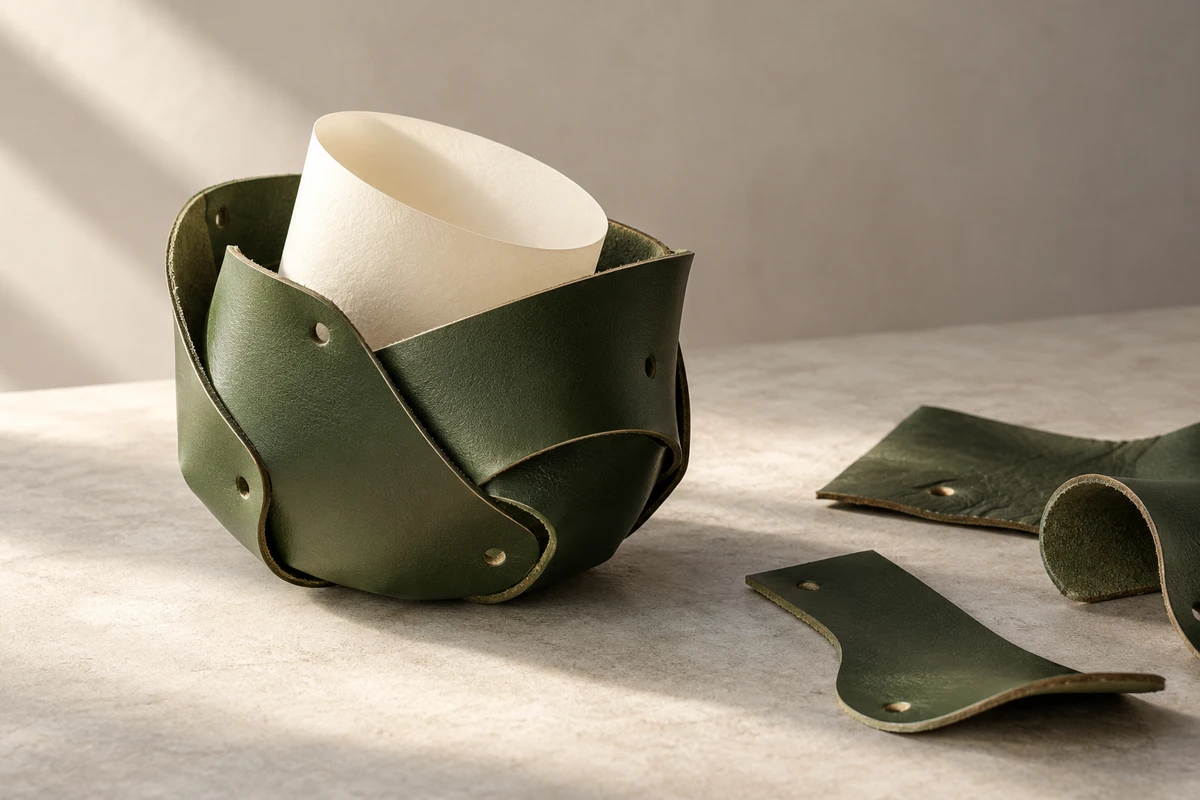
Source note: These filmmaking suggestions draw on the two official texts above, not a complete viewing or reconstruction of related brand films. No audience testing was conducted. The cover is an original AI-generated concept image, not a Hermès object, workshop or record of an actual transformation.