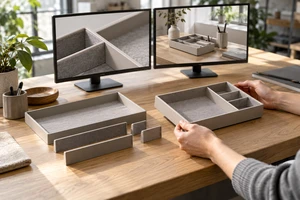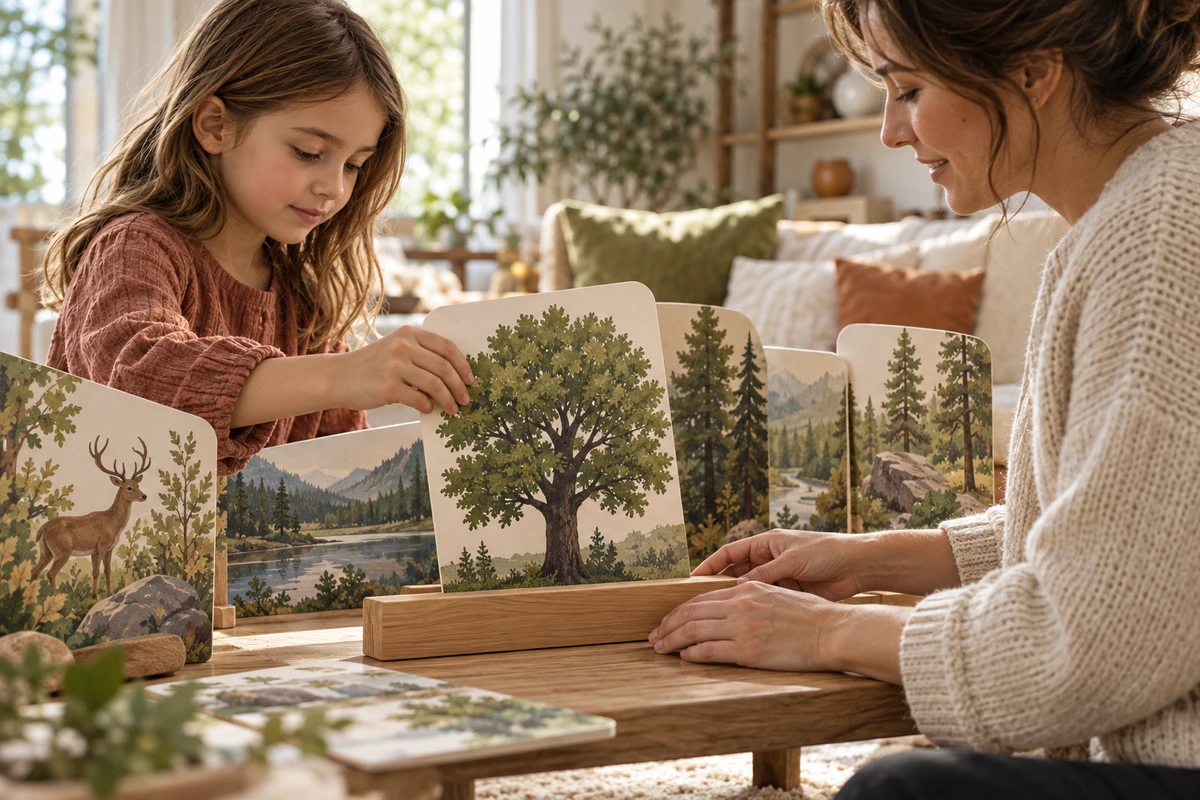
A child takes a storytelling kit from its box. Cut to a fully assembled miniature stage; the performance begins. It is a charming hypothetical commercial—and an incomplete account of the product if a grown-up actually needs to build that stage first.
For an overseas brand sourcing children’s products from China, the missing action can become a problem between the product specification and the final edit. The factory knows the preparation. The marketing team wants a moment of independence. The film must not quietly turn one into the other.
ONCE’s proposed Parent–Child Action Relay starts with that handover. It helps decide which adult preparation to acknowledge, which child action to demonstrate and whether a separate setup film is useful. It is a planning method, not a validated consumer or child-development study.
One control can involve two different jobs
Yoto’s September 10, 2026 hardware announcement describes the Green Button on its fourth-generation players as something grown-ups configure in the app, after which children can access the selected audio through a physical control. Playing audio with a Yoto Card remains an option. We checked the original announcement on October 17; its estimated dispatch dates are not evidence of completed delivery.
The brand’s How It Works page, checked the same day, addresses both children’s choices and adults’ peace of mind. That establishes how Yoto presents the experience. It is not independent proof of learning, sleep or developmental outcomes.
The useful creative principle is the division of work. A child’s everyday interaction can be simple while the preceding configuration belongs to an adult. Showing the former does not justify claiming there is no setup, no help or no need for supervision.
Nor must every commercial become a tutorial. A film may open after preparation is complete, provided its overall presentation does not misrepresent who did what.
Family interaction is already a production approach. Clearframe Studio describes capturing a parent-and-child play moment for a children’s toy rather than a conventional demonstration. We reviewed the page on October 17, not the underlying film or its results. ONCE’s additional question is whether the product action is assigned as carefully as the emotional relationship.
Map the relay before writing the shot list
Choose one family moment: starting a creative activity, selecting something to listen to, or preparing to leave home. Then connect the roles rather than simply requesting a parent, a child and a welcoming room.
| Relay point | What the team needs to establish |
|---|---|
| Adult preparation | Who assembles, configures, selects or checks, according to current product instructions? |
| Handover state | What is already complete when the child receives the product? |
| Child’s choice | What does the child actually choose or operate within the approved use conditions? |
| Product response | What visible or audible response can the real sample accurately demonstrate? |
| Continuing assistance | When does an adult still participate, rather than disappearing through an edit? |
These are planning questions, not five mandatory categories of footage. A short explanation may establish one prerequisite; another may need a visible handover. Detailed preparation may belong in separate content.
For a hypothetical China-made storytelling kit, suppose the approved instructions assign assembly of the base to a grown-up, while the child selects large story panels and places them in the prepared base. A coherent film can acknowledge that preparation, follow the child’s choice and then enter the imaginative story.
The adult need not dominate the frame. Their work should not be silently credited to the child. Equally, an adult making every choice while the child applauds is not a demonstration of the child choosing.
Send the current preparation instructions to the production partner with the approved product sample. A mood board cannot communicate a hidden assembly requirement. Resolve disagreements between the instructions, sample and script before filming a successful outcome.
Keep imagination separate from product evidence
A tabletop stage can become a forest in the child’s imagination. That can be a strong creative device, as long as the audience can distinguish the fantasy from what the product physically does.
A directed performance also remains a performance. It does not establish an unprompted first reaction, unaided usability or a lasting improvement in creativity or concentration. If a brand wants those claims, it needs appropriate support for those specific claims; the editor cannot supply it through a joyful reaction shot.
Choose the deliverables around the actual preparation
When preparation is straightforward and easy to acknowledge, one film may be enough. Retain the necessary adult action or accurate explanation, then give the narrative to the child. Two roles do not automatically require two purchased videos.
When setup is detailed or account-dependent, give the brand film and the adult-facing instructions different jobs. The first can explain the family moment and product value; the second can show preparation clearly. They should share approved facts, not necessarily the same pace, shot scale or structure.
When the product is intended for shared play, make the shared activity the idea. A cooperative game or craft need not be forced into an independence narrative. The exchange between adult and child may be the point of the experience.
When the permitted action is unresolved, pause that demonstration. Do not infer operation from a similar-looking sample or animate an unconfirmed response into existence.
Age suitability, permitted operation, supervision and production protections need project-specific review by the brand and appropriately capable personnel. This article provides no universal age threshold, safety assurance or filming-permission conclusion.
Deliver the role decisions as well as the edit
Scope the work with the actual tasks: adult preparation footage, child interaction, shared play, fantasy sequences and any separate instructions. Those choices affect casting, rehearsals, product preparation, scheduling and alternative coverage—not just the number of final exports.
A child’s emotional reaction should not be treated as a guaranteed production resource. If an action or reaction is unsuitable, adapt the creative plan. Keep staged performance, genuine experience and customer endorsement distinct rather than presenting one as another.
For an internal rough-cut review, ask someone outside the script discussion to describe the grown-up’s work first and the child’s action second. A mistaken answer identifies an expression problem to revisit. This proposed comprehension check is not child-usability research, an effectiveness study or evidence of market demand.
Retain the approved relay with the product version, preparation state, actions, permitted wording and triggers for review. If a later hardware revision changes the control or setup, the team has a concrete reference for deciding which footage needs attention.
For a production business, maintaining these scenario and role records is an option worth evaluating alongside future content updates. Recurring revenue or improved margins would still require actual demand, fees and workload evidence; they do not follow automatically from the method.
When briefing ONCE’s production team, bring a current product instruction, a representative approved sample and one family situation. Start with the handover: what the grown-up prepares, what the child chooses and what the product actually does. The emotional story can grow from there without changing the product’s truth.
Source scope: the Yoto announcement is dated September 10, 2026; the other cited pages have no publication date stated and were checked October 17, 2026. No child test, client deployment or campaign-performance verification was conducted. The storytelling kit is hypothetical.