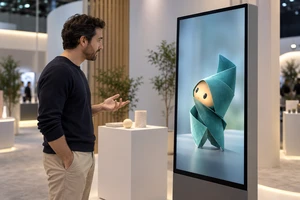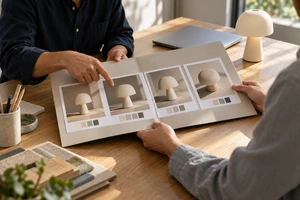
Four markets and four founders do not automatically make a series. Without a reason for the participants to meet, the films can become repeated introductions, business challenges and thank-you speeches, separated by different skyline shots.
For an overseas brand working with a Chinese manufacturing partner, the more useful first purchase may be research. What problem do the participants recognise in one another? What experience can each contribute? What could they actually observe together? Geographic coverage should follow that editorial decision, not substitute for it.
A current series built around an encounter
Lenovo’s October 14, 2026 announcement introduces a four-part Backing Every Business documentary around entrepreneurs visiting one another across markets. It schedules further episodes for October 19 and 21 and a complete version for October 29. Those future releases should not be described as already delivered. The announcement also cautions that potential outcomes discussed in the programme have not been independently validated by Lenovo.
We checked the source on October 16, 2026. We have not watched the films or evaluated their editing or campaign results.
A different production example, Casual’s NBA case study, describes a series rooted in local people and basketball culture rather than city scenery alone. Checked October 16, this is a production company’s project account, not independent evidence that one documentary format performs better than another.
The useful inference is about structure: a series can share a concern while allowing different people to interpret it differently. The brand might convene the encounter or contribute real resources. It does not need every episode to end with its product solving everything. Any claimed role should reflect what the brand actually did.
ONCE’s two-way problem card
This is a proposed commissioning tool, not a validated model or an ONCE client result. Interview potential participants separately, then prepare one card for a possible pairing:
- What is person A struggling with now? Ground it in a particular working experience, not simply a desire to grow.
- What has person B already done that might offer A a useful perspective?
- What does B still need to understand, and what can A contribute in return?
- What could they observe, discuss or try together—and what remains unknown?
The card should not manufacture compatibility. “Both are ambitious” is insufficient. So is an arrangement where one person only teaches and the other only receives advice. An interesting participant is not necessarily a useful counterpart.
Look for a visible difference in how people work
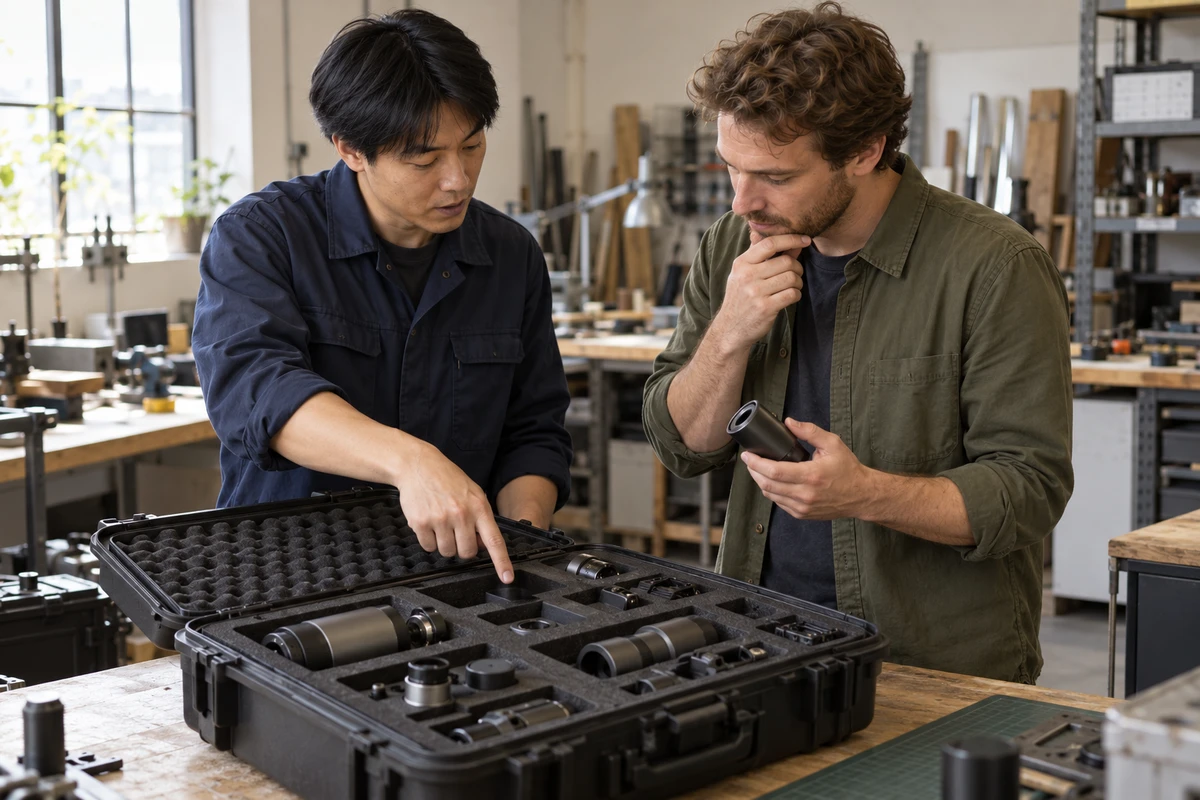
Imagine a consumer-equipment brand introducing a Chinese design engineer to an overseas event-production technician. This is a fictional planning example, not an ONCE project or a claim about any equipment.
The engineer thinks about component protection; the technician thinks about finding and accounting for parts during pack-down. A useful shared question might be: “How does one person know that the kit is complete when the job ends?”
They could compare existing packing routines, explain why each orders objects differently, and identify ideas requiring further checking. The documentary opportunity is the difference in their thinking—not a prewritten claim that a new design has improved productivity. Discussion is not testing, and filming must not prompt an unassessed equipment modification or hazardous demonstration.
If neither person has anything useful to exchange, change the pairing, narrow the question or stop the encounter format. Real people should not have to perform inspiration simply to preserve a multi-country concept.
Plan the access, not the happy ending
Confirm visits, topics, language support and feasible activities before filming. Do not require participants to promise a conversion, a recommendation or a moving realisation by the final scene. If a past event needs explaining, present it as a recollection rather than staging it as newly captured reality.
Keep three stages distinct in the edit: an idea was proposed; something was attempted; a change was subsequently established. A drawing demonstrates that someone made a drawing. Enthusiasm does not prove a lasting business outcome. If the story only reaches exploration, end honestly with what remains unresolved.
Make the sponsor’s contribution specific as well. Did it arrange the meeting, provide equipment or fund follow-up? Show those real actions without attributing the participants’ work and their peers’ contributions entirely to the brand. Agree participation, commercial relationships, public-use scope and sensitive information with the relevant people before the shoot.
Repeat the concern, not the answer
Another episode earns its place when the shared problem takes a meaningfully different form. A concern about keeping a kit complete may differ in a workshop, a touring environment or a home. Research must establish those differences; the production should not just replace names and locations in the same script.
Localisation is more than a subtitle swap. Preserve why a participant hesitates, how they interpret a question and which terms require explanation. Viewers in different languages should encounter the same exchange, not a rewritten endorsement. One person’s experience cannot establish what an entire market believes.
Commission the research before the travel plan
An initial scope can stop at candidate research, pre-interviews, the problem cards, access conditions and a feasibility recommendation. “Do not proceed with this pairing” should be an acceptable finding. Locking an entire season’s travel before establishing willingness and meaningful access places production commitments ahead of the story.
After that decision, specify the visit, local production, interpretation, activities, editing and language versions. Shared editorial principles do not imply identical shoot days or information density in every location. Obtain costs and schedules from the actual scope; a large brand’s announcement provides no reliable rate benchmark.
For ONCE, permitted research, evolving questions, encounter records and editorial decisions could help later work start with better understanding. That is a possible source of repeatable service value, not ownership of the participants’ lives or a promise of sales growth or asset valuation.
Before seeking bids, replace “we need films in four countries” with “these people face this problem and have a reason to respond to each other.” If that sentence is credible, use ONCE’s video production solutions to scope films and versions. If not, commission discovery before committing to a series.