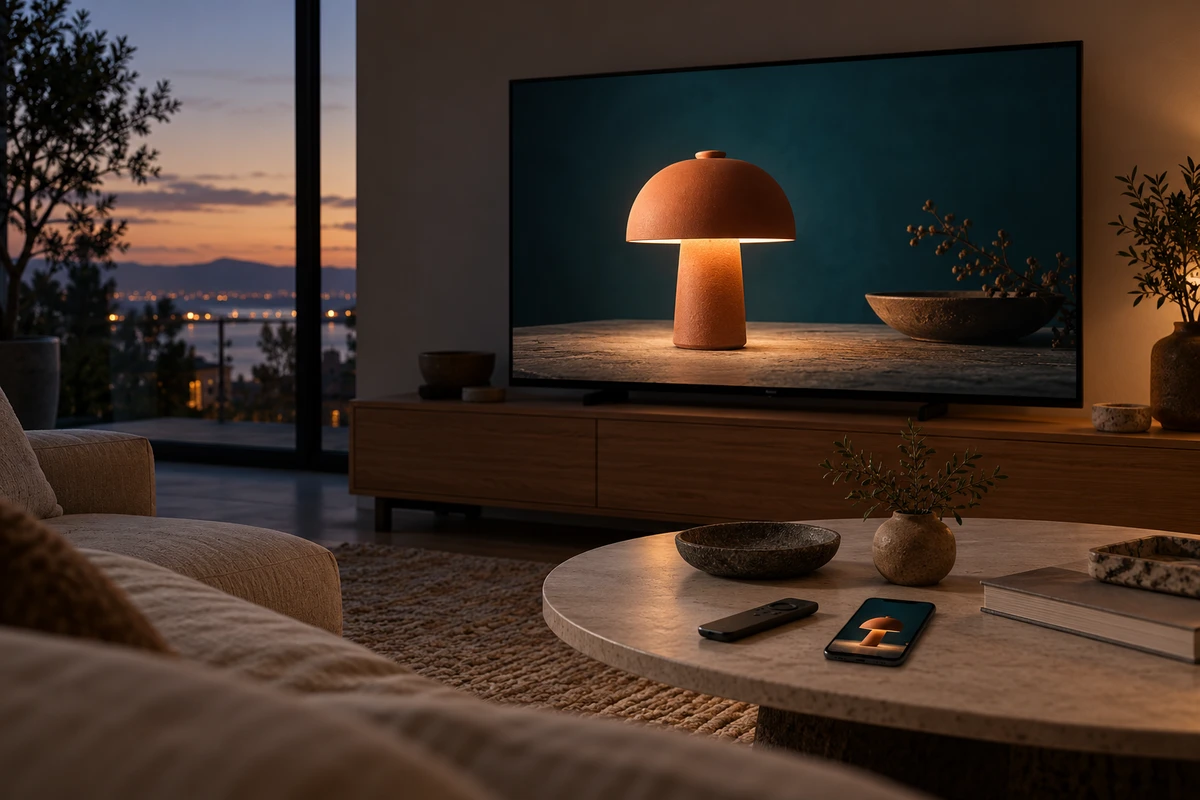
Your television creative may remain visible while a viewer answers a message or leaves the room. That does not give your brand a longer presentation slot. It gives you an uncertain opportunity to be understood when attention returns.
For an overseas marketing team commissioning product assets from a Chinese supplier, the useful question comes before the shoot: should this placement take someone to a specific item, or help them continue learning later? The answer changes the photograph, the product information and the destination you need to commission.
ONCE recommends treating the pause ad and its next step as one buying decision, with separate acceptance checks for each. A beautiful image attached to the wrong product is a failed handoff.
A current signal, with a limited claim
On October 9, 2026, The Trade Desk published Pause ads are here, signaling the next evolution of CTV. It argues for simple creative and a clear next action. That is a useful statement of a platform's direction, not proof that every paused-screen impression earns attention or produces sales.
The format itself is older. Amazon's September 30, 2025 announcement described remote-enabled shopping and information requests on Prime Video. Its launch eligibility should not be treated as a complete account-access guide today.
Google's current DV360 pause-ad guidance warns that publisher availability, scale and supported creative vary; reporting has limitations too. Confirm the actual placement before commissioning a universal asset pack. This article uses these sources to establish the opportunity and its constraints. The framework below is ONCE's analysis, not a platform standard or a validated performance model.
The ONCE Pause Handoff Sheet
A pause can contain several different moments. Someone may glance at the screen, look back later, then continue on a phone. Your concept should survive each transition without requiring a scene they missed.
| Moment | Creative job | Acceptance question |
|---|---|---|
| First glance | Establish brand, product category and one reason to care | Can someone identify what is offered without reading fine print? |
| Attention returns | Make the proposition self-contained | Does the image work without voiceover or preceding footage? |
| Action continues elsewhere | Preserve the item and the task | Does the next screen match the model, market and promise? |
This is a planning sheet, not an attention measurement instrument. It helps the media buyer, producer and ecommerce owner agree on the same task.
Choose a direct shopping route when the item is unambiguous, configuration is stable and little additional information is needed. An add-to-cart action can simplify an operation; it cannot make a size decision on the customer's behalf, and it is not a completed order.
Choose an information route when a buyer still needs to understand fit, installation, compatibility or dimensions. Where the placement supports it, a useful next step might be a sizing guide or an explanation page. An email option, QR route or editable button cannot be assumed to exist across every publisher.
If your destination is not ready, a clear awareness objective may be more honest. Adding a QR code that leads to an unrelated homepage does not turn exposure into a useful customer journey.
A supplier-side brief for a lamp campaign
Consider a hypothetical homeware brand sourcing a lamp in three sizes and two plug variants. This is an illustrative planning scenario, not an ONCE client result.
The best-looking frame in the brand film shows warm light beside a sofa. It creates atmosphere, but conceals the base and makes the model hard to identify. Connecting that frame directly to one retail item could imply that the buyer is getting a different size.
The remedy need not be another film. Commission a still that makes the intended model recognizable, plus a market-specific dimensions page. The photograph establishes the object; the next page answers whether it fits on the buyer's side table. Local product selection handles plug and delivery choices. If a supported information action can carry that task accurately, test it. If the placement imposes a fixed button, verify that the button and destination still make sense together.
A single fixed configuration, clearly depicted and available locally, may instead justify a direct-cart test. Neither route wins by default. Decide according to the information still missing from the customer's choice.
Approve the image and the route separately
Amazon's current Prime Video pause-ad specifications require a background of at least 1920×1080, PNG or JPG, at most 2MB. The pictured shoppable item must match the purchase; Amazon generates the interactive overlay. Its email flow goes to the primary account holder. These details apply to this product, not to CTV inventory generally.
For production, bring the actual publisher template into composition planning. Keep the product image, editable messaging and temporary offer information separate. Assess any proposed video frame for blur, obscured features and static legibility. Reuse an existing image if it works; add photography where it solves a concrete problem.
For operations, record the approved image, placement, market, destination SKU or URL, test device, outcome and owner. Use an actual preview or available publisher test environment to follow the action through. Opening a URL successfully is insufficient: it must reach the right item or explanation. Where email is involved, check the recipient assumption and the message itself. The person holding the remote need not be the account's inbox owner. Mark unavailable tests as unverified and assign responsibility for launch checks.
AI-assisted scene exploration can be useful, but a real product advertisement still requires verification of form, included accessories and the saleable variant. A generated control, attachment or lighting effect must not silently become a product promise. Label concept exploration and deployable advertising assets separately in the scope of work.
For teams arranging production in China, ONCE's video production solutions are a starting point for scoping those assets. Bring the actual retail configuration and destination requirements into the brief alongside the visual references.
Buy a bounded test, not a promise of prolonged attention
Separate the initial budget into creative production and adaptation, destination preparation and route checks, and media testing. This makes it easier to locate a failure: an unclear image needs a different remedy from a broken destination.
Keep reporting distinctions equally clear. Delivery metrics describe exposure. Recorded clicks, scans or email requests describe actions. Correct-item visits and subsequent shopping behavior describe what happened next, where that data is available. Do not substitute an entry-point click for a successful journey, or rank remote-cart and QR-scan rates as though their denominators and effort were identical.
A first creative comparison can keep the product, market, offer and placement type stable while varying the composition. Record other differences and avoid declaring a winner from an inadequate sample. This is a proposed test design, not an observed lift. Claims of incremental sales require an appropriate counterfactual beyond a creative dashboard.
The enduring production opportunity is the connection between accurate product imagery, placement adaptation and a usable next step. If pause inventory expands, that capability may become more valuable. For now, make one product in one market survive the handoff before scaling the asset count.
Dynamic specifications checked October 15, 2026. Reconfirm placement requirements before delivery. No client performance results or industry cost benchmarks are claimed.