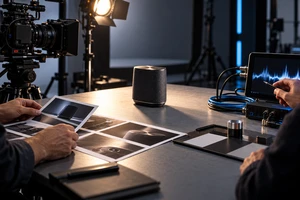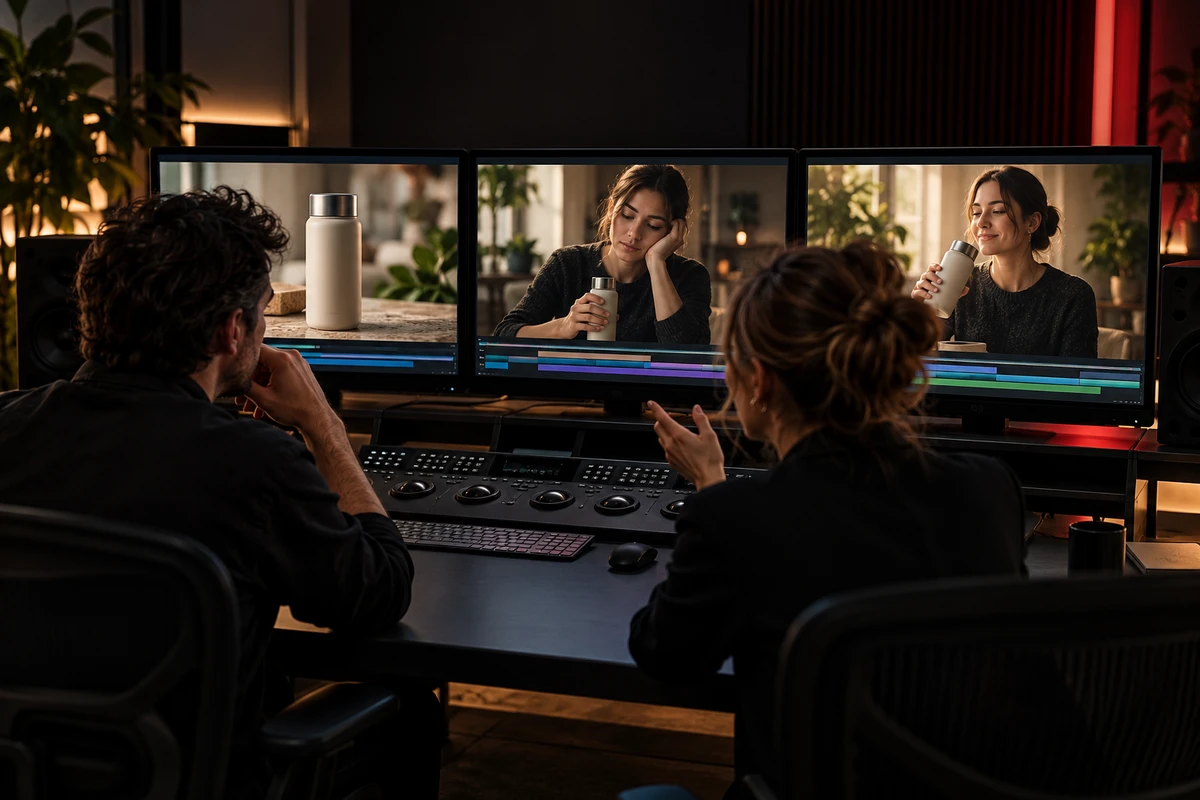
YouTube is moving A/B testing beyond titles and thumbnails and into the video edit itself. On 23 September 2026, the company said creators would soon be able to test as many as three cuts in Studio to see which hook holds audience attention best. For brands, the useful change is not “order two more videos.” It is to commission three cuts that answer one interpretable creative question.
If the variants change the opening, duration, music, voiceover and shot order at the same time, a winner still teaches the team very little. A stronger production package holds the program spine constant, changes one named creative variable and defines what the brand will do after the result.
Start with what YouTube actually announced
YouTube's creation tools announcement is specific but limited. The forthcoming video A/B feature will test up to three cuts to see which hook performs best. “Coming soon” does not mean that every channel, market and video type already has access. Nor does better attention automatically prove higher sales, leads or profit.
YouTube also reported that creators have run more than 40 million title and thumbnail experiments since that A/B feature officially launched in 2024. That is a platform-reported usage figure. It is not evidence that three video cuts always outperform one.
Brands can redesign production now without promising access that a channel does not yet have. Build testable variants first. Use native testing where available; otherwise preserve the same hypothesis structure for a controlled market, time or traffic split.
Three cuts should answer one question
An interpretable opening test might use:
- Cut A — problem first: show the user's friction before introducing the product.
- Cut B — mechanism first: show how the product works immediately.
- Cut C — outcome first: show the completed state, then reveal the process.
Keep the product promise, core proof, approximate total length, call-to-action and rights scope constant. The experiment can then inform a real choice—what kind of opening holds attention—rather than blending five unrelated changes into one result.
A different test could vary only the order of proof: process first, detail first or use case first. But each test family needs one primary variable. Audience, offer, aspect ratio and language are separate experiments, not extra ingredients to hide inside the same three cuts.
The ONCE CUT framework for a production brief
C — Context: lock the test environment
Record the channel, video type, audience, release window and whether the traffic is organic or paid. State whether the decision is about audience retention alone or will be reviewed alongside a business outcome. YouTube described a comparison of which cut holds attention best; that should not be presented as a conversion-lift study.
Keep the context consistent within the experiment. If Cut A reaches US English viewers and Cut B reaches German viewers in German, the result can reflect market and language differences rather than editing. Cross-border brands should validate the creative variable in one context before treating it as portable.
U — Unit of change: vary one named element
Break the timeline into controllable units: hook, problem, product proof, objection handling, brand reveal and action. Select one unit to change and lock the rest.
The purchase order should say more than “three versions.” It should identify the common spine, the single variable, the footage and audio that must remain identical, and the owner of version numbers and change logs. Otherwise, a production partner can deliver three polished films that cannot be compared.
T — Threshold: define the decision rule before launch
YouTube's two announcements do not publish the complete statistical methodology for video-cut testing, so a brand should not invent a universal percentage threshold. It can still set a decision rule: promote a winner only after the team's minimum sample requirement is met and the difference is stable; retain the control when results are close; rebuild the common spine when all three variants are weak rather than scaling the least-bad option.
Write the next action in advance. If A wins, use problem-first hooks in the next production batch. If B wins, move mechanism proof forward. If C wins, capture more outcome scenes. A test without a downstream decision is only extra file production.
Quote and deliver one experiment, not three unrelated films
A useful three-cut package should include:
- one common narrative spine and a written variable definition;
- three complete edits with unambiguous version IDs;
- a map of variable shots, locked shots, voiceover, music and captions;
- channel, date, market and version fields for publication;
- a one-page readout stating what happened, what the test cannot prove and what the next shoot should change.
Cost should follow the experiment design. The expensive work is rarely exporting two extra files. It is capturing viable footage for three hypotheses, controlling every other important difference, reviewing three publishable cuts and writing the learning back into the next production cycle. A quote that adds only “number of edit versions” is still buying files, not a learning system.
When three cuts are the wrong buy
Start with one strong cut when the channel is unlikely to gather enough observations within the decision window; the product facts or common script have not passed review; each variant requires a different territory, language or rights package; or the content serves a one-off event that will end before the test is useful.
A/B testing should not compensate for basic quality failures. Subtitle errors, mismatched product models, loudness differences or missing proof contaminate the result. Every variant needs to be publishable before it enters the test.
The CUT framework can be built into a brand campaign film and expandable content system: capture the actions, product details and outcome scenes needed for three openings during one shoot, then swap only the designated unit in post-production. Pace can be a valid variable, but “faster” is not a universal answer unless the context and unit are controlled.
YouTube's video A/B feature is still forthcoming, but the procurement logic can change now. When the next brief asks for three cuts, do not ask only whether the production team can make two more versions. Ask what stays controlled, what changes once and what the team will do if a variant wins. ONCE can help translate product claims into testable shot units before the shoot locks those choices in.