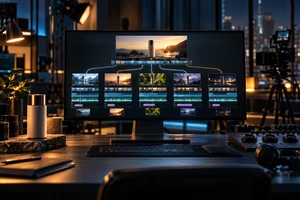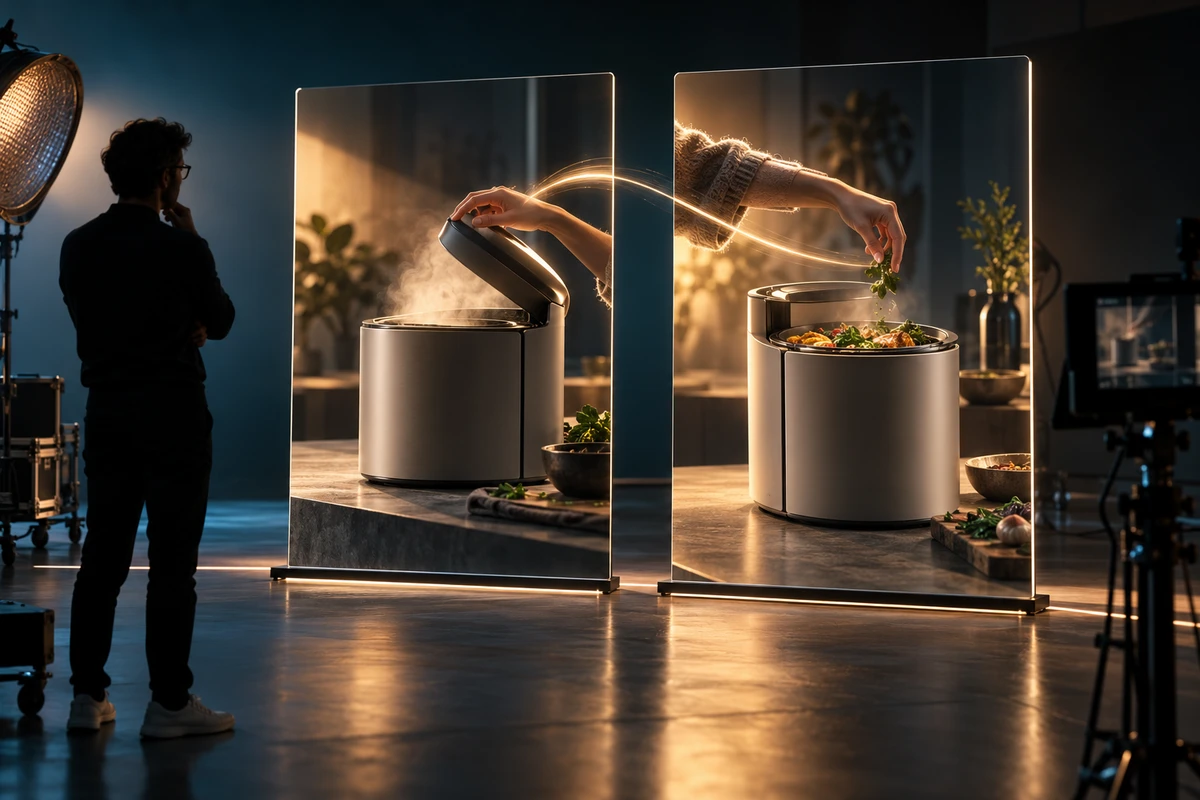
Cutting a 30-second brand film in half does not create a sequence. A useful second ad inherits one clear state from the first—product recognition, an unresolved question or an expectation—and moves it forward. If the second ad opens with the same introduction, two premium placements have purchased the same beginning twice.
That distinction matters for global brands commissioning video from China. The production brief should not simply request “two vertical edits.” It should request a verified creative pair: rewarding when watched in order, but still intelligible when a viewer encounters only one part.
What TikTok has actually announced
At TikTok World Canada on October 7, 2026, TikTok announced TopReach Creative Sequencing, which uses TopView and Top Feed to tell a continuous narrative as people open the app. TopView is the first content position on app open; Top Feed is the first ad position in the For You feed. TopReach packages the two high-visibility placements into one buy.
TikTok's TopReach specifications, last updated in August 2026, describe a one-day campaign, a frequency cap of one impression per person per placement, a reach objective and a recommendation of one or two creatives. Both Spark and non-Spark ads are supported, along with several calls to action and web or TikTok destinations. Add-ons must work in both placements rather than belonging to only one.
This does not mean every market or account automatically has access to Creative Sequencing. The October announcement is Canada-specific, and eligibility, reservation, order guarantees and creative requirements should be confirmed with the relevant TikTok account team. A platform announcement proves the format exists; it does not prove the format will improve every campaign.
TikTok has more than one sequencing model. In March 2026 it also introduced Prime Time, which can deliver up to three sequential ads from one advertiser to the same user within a designated 15-minute window. Different timing and placement rules are precisely why “sequence” should not become a fixed editing template.
Why a mechanical split usually fails
Part one carries the setup; part two carries all the value
If the first film only teases and the product benefit arrives in the second, anyone who misses the payoff receives an unfinished ad. If both films repeat the setup, brand and complete product claim, a sequential viewer learns nothing new the second time.
The files match, but the viewer state does not
Production teams often preserve the same cast, set and grade without defining what the first film leaves in the viewer's mind. Visual continuity is not narrative continuity. The object passed between films is a limited cognitive state, not a LUT.
The second film assumes too much memory
A social feed is not a theatre. Notifications, comments and other videos interrupt attention, and some viewers may only receive one placement. Part two should not depend on names, three product features and a complicated plot. A safe relay carries one assumption, such as “this is the cleaner that recognizes different floor surfaces.”
Correct delivery order does not guarantee a useful story order
The platform can control placement. It cannot decide which question the brand should create first or what proof should arrive next. Google Ads has long offered several video-sequence templates, including introduce-and-reinforce or attract-and-direct. Those templates show that order changes the job of each asset, but they do not replace the current TikTok specifications for a real buy.
We have previously argued that one product needs a different job on each short-video platform. Sequencing moves that principle inside a single platform: two exposures still need two different jobs.
Write a narrative handoff card before writing two scripts
Place the two films side by side and define six fields:
- Shared recognition anchor: the product, person, action, sound or visual motif that remains stable.
- State created by film one: the minimum thing the viewer should know or wonder after it ends.
- Assumption allowed in film two: only one; do not transfer the entire backstory.
- New proof in film two: the demonstration, comparison, result or action that advances the story.
- Compensation for a missed first film: the brief visual cue that lets part two stand alone.
- Next step by placement: recognition, differentiation, search, visit or purchase.
This card aligns the director, editor and media team around the same handoff. Without it, “make two versions” often collapses into swapping the hook, subtitles and end card.
The ONCE RELAY framework
R — Recognize the same world
Keep one stable anchor without making the films visually identical. It might be the product silhouette, a repeated action, a sonic cue or the same compositional relationship. The viewer should recognize within a second or two that this is the next movement of the same idea.
E — Establish one open question
Film one must deliver value while leaving a natural question for the next piece. It might show a product confronting a difficult use case and leave the mechanism to film two. Avoid unrelated cliffhangers that make the product feel like an afterthought.
L — Limit the handoff
Complete this sentence: “We only assume the viewer already knows ____.” If the blank needs a paragraph, the relay is overloaded. Product identity, character relationship and use context cannot all be treated as guaranteed memory.
A — Advance with new proof
Film two should reveal a result, explain a mechanism, introduce a comparison or give a clear next action. Play the films back to back. If removing part two loses no information, it is frequency—not progression.
Y — Yield a standalone entrance
Each asset needs minimum independence. A two-second product cue, a repeated gesture or a short context line can restore orientation without retelling everything. The relay rewards sequential viewing; the fallback protects the delivery gaps that exist in real campaigns.
What production should deliver beyond two timelines
Sequencing is cheapest when designed before the shoot. The missing bridge may be one extra product insert, reaction or action beat. Discovering that gap after both edits are locked often forces the team to patch narrative logic with text.
The delivery package should add four things: two independent timelines, a reusable recognition-anchor kit, previews of both viewing orders, and the narrative handoff card. Review three states—TopView followed by Top Feed, TopView alone and Top Feed alone. If the campaign may later use a format such as Prime Time, reassign the timing and job of a third asset rather than copying the two-part structure.
ONCE compares production options with this denominator:
Fully loaded cost per valid narrative handoff = (sequence strategy + base production + continuity assets + placement adaptations + three-state previews + version archive) ÷ handoffs that pass recognition, state-change, standalone and delivery-order checks.
Two exported files do not automatically create one valid handoff. The denominator increases only when film one establishes a state, film two adds information, both are recognizable, and neither becomes meaningless when delivered alone.
When a sequence is unnecessary
Do not force a two-part story when the media plan cannot guarantee or verify sequence eligibility, the product benefit fits clearly into one message, the budget supports only one meaningful exposure, or there is no second proof to reveal. One complete film with alternate hooks will often outperform a fake episode structure in clarity, even if no performance result should be assumed in advance.
Sequencing becomes useful when a launch genuinely benefits from “problem, then mechanism,” “recognition, then reason to buy,” or “tease, then product reveal.” A low-cost rehearsal can test this before a new shoot: write the handoff card, build two rough cuts from existing material and review all three viewing states. Only then decide which bridge shots deserve production budget.
When two premium placements become one narrative opportunity, the brand has not received permission to cut a film in half. It has received a chance to design a change in understanding. Film two must begin where film one leaves the viewer—or the sequence is only repetition with a more expensive media name.
Sources
- TikTok Newsroom, “TikTok World Canada 2026: Turning Discovery Into Business Growth with AI-Powered Innovations, Vertical Experiences and High Impact Brand Solutions,” October 7, 2026
- TikTok for Business Help, “TopReach ad specifications,” updated August 2026
- TikTok Newsroom, “NewFronts ’26: TikTok Unveils New High-Impact Ad Solutions,” March 24, 2026
- Google Ads Help, “About video ad sequencing,” accessed October 11, 2026