For years, a video-production order ended with a flattened master plus a few aspect-ratio and duration exports. That definition is becoming inadequate. Ad platforms can now generate video from existing assets and continue editing hooks, audio, clip length, overlays, captions and final scenes. The procurement question is no longer whether AI can create more versions. It is what a brand should permit the platform to change, what must remain locked, and how each change can produce interpretable learning.
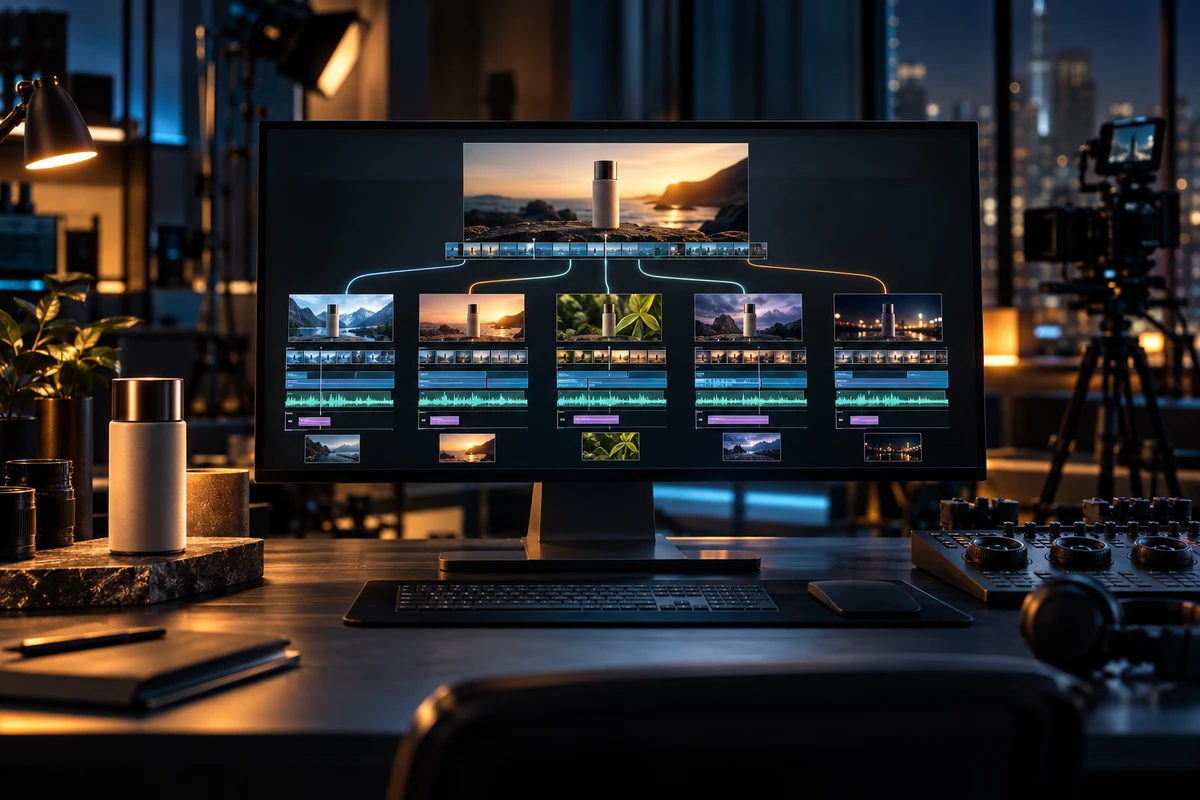
ONCE's view is that brands should buy neither a single flattened file nor an untraceable pile of variants. The more useful unit is an editable performance master: a controlled source asset that locks product truth and visual proof, exposes selected modules for testing, and records what changed in every branch.
Ad platforms are moving from distribution into the edit
On October 6, 2026, Meta said its Advantage+ image-to-video feature was broadly available. It also described Ads Creative Studio as a place to generate concepts and variations and edit hooks, audio, clip duration, overlays, captions and final scenes. Meta separately described catalog-image-to-product-video as a beta for eligible advertisers. Those rollout labels matter: an official product announcement shows what Meta offers, not that every advertiser or the entire industry has adopted the same workflow. See Meta's official update, “Advertising Week New York 2026: New AI Ad Tools to Help Businesses Grow.”
On October 1, 2026, Google outlined a YouTube workflow that can start from existing social assets, URLs and product photography. The strategic guidance around the feature is just as important: make changes gradually, prioritize quality over quantity, and allow sufficient time for measurement. See the Google Ads & Commerce Blog announcement.
Google's video experiment documentation and TikTok's Ad Testing Guide point toward a shared discipline: if a team wants to understand whether a creative change caused a different result, the control and treatment should be comparable and the test should isolate a variable. Platform capability makes that discipline more important, not less. If the hook, soundtrack, captions, shot order and ending all change at once, a better result does not tell the team what to keep next time.
More versions can create less learning
Fast generation does not solve four operating problems for a brand.
First, product truth can drift. A generated visual, revised ending or reformatted demonstration may quietly alter the product's appearance, mechanism, packaging, interface or claim.
Second, test variables can become confounded. A “new creative” with five simultaneous changes only proves that the whole package was different. It does not identify which decision should carry into the next brief.
Third, rights may not travel with the edit. Talent, music, fonts, third-party footage and generative-modification permissions may vary by platform, territory, term and method of reuse.
Fourth, variants may not receive enough delivery to support the intended decision. Without a predefined metric, observation window and an “inconclusive” outcome, teams can mistake media allocation for creative evidence.
Production therefore remains valuable, but the deliverable must evolve from a finished film into a controlled system for change.
The ONCE HANDLE specification
HANDLE is ONCE's acceptance framework for an editable performance master. It is not an industry standard. It is a practical way for brand, production and media teams to define the same deliverable before filming or generation begins.
H — Hypothesis
Each round should answer one question, such as: “Does opening on the outcome create stronger qualified viewing than opening on the problem?” Name the primary metric, observation window and conditions that result in “inconclusive” before making the branches.
A — Anchors
List the elements that cannot drift: product form, verified functions, approved demonstrations, required disclosures, brand identifiers and substantiated claims. A platform may optimize expression, but it should not invent facts.
N — Nodes
Treat the hook, problem, demonstration, proof, offer, call to action and end card as replaceable nodes rather than one inseparable timeline. Each node needs a name, clean in/out points and a replacement rule so one change does not damage the rest of the edit.
D — Duration
Plan clean handles, natural pauses, complete sentence endings and safe crop areas during production. A six-second branch should not be an emergency speed-up of a finished 15-second film.
L — Layers
Dialogue, voice-over, music, effects, captions, graphics, clean product plates and project files should be separated according to the agreed handoff. For multi-market work, keeping language layers separate from visual truth is what makes a localization-ready master reusable instead of disposable.
E — Entitlements
The rights sheet should cover source files, generative modification, talent likeness and voice, music, fonts, territories, term, platforms and permission to create further variants. Technical editability is not the same as legal or brand permission.
Three permission routes
Route 1: platform-direct editing
Use this for low-risk presentation changes within an approved range: reframing, caption styling, background pacing or a claim-free end card. The brand still defines editable fields, forbidden fields and who reviews the output.
Route 2: master-controlled platform branches
This is the practical default for many performance campaigns. The production team delivers an anchored master; the platform may replace only named nodes or layers; each experiment branch changes one declared variable. The platform supplies speed while the master protects product truth and brand continuity.
Route 3: locked master with human approval
Use this when the asset contains regulated claims, a precise product mechanism, readable interfaces or packaging, or restricted talent and music rights. Platform generation should be disabled or every output should pass review before publication.
Price the interpretable branch, not the export
A brand can compare suppliers and internal workflows with this model:
Fully loaded cost per interpretable branch = (modular pre-production + capture or generation + layer and source-file preparation + platform editing + factual and rights review + media test + analysis and archive) ÷ interpretable branches
A branch counts only when it changes one declared variable, preserves every anchor, and receives enough delivery to evaluate the chosen metric. This is not a market benchmark or a performance promise. It simply puts the hidden review, testing and archive work back into a procurement comparison instead of treating generated variants as free.
A pilot a brand can run in its next campaign
Start with one existing 15-second control and test only the hook. Build three opening branches while keeping the demonstration, proof, call to action, audio rules and ending unchanged. Define the primary metric, observation window and inconclusive threshold before launch. Let the platform deliver the test under comparable settings, then record winners, losses and unresolved results in the same version ledger.
Test the ending or audio in the next round, not at the same time. The result is more than a larger video library: it is a learning asset that connects the current media run to the next production brief.
The procurement decision
A locked film is still sensible for a one-time brand launch, especially when factual risk is high and ongoing media variation is unnecessary. If the asset must support continuous testing across platforms and markets, the contract should move from “number of finished videos” to HANDLE: anchors, nodes, duration logic, layers, entitlements and test records. Platforms can accelerate change. The brand still needs to own the definition of acceptable change.