For most of advertising history, a product video ended with two obvious viewer actions: click or move on.
A third action is entering the ad itself: ask a follow-up question.
The shopper may not care how beautifully the product was lit. They want to know whether the table fits their room, whether the shoe runs small, whether the charger supports their device, how many installation steps are involved, or which return policy applies. Once those answers appear beside the video, the ad is no longer only a linear message. It becomes a product conversation whose direction is chosen by the viewer.
That creates a new production problem. The video creates interest and the agent answers questions, but both must describe the same product reality.
What is live, and what is still a test
On September 16, 2026, Google invited U.S. retailers to join a Business Agent for YouTube Ads beta. Its September 24 Demand Gen update confirmed that viewers can engage with conversational AI alongside video ads with product feeds and get product or brand answers without leaving the viewing context.
The official beta interest form narrows the scope:
- an active Demand Gen campaign linked to a Merchant Center feed;
- a minimum daily budget of $10;
- U.S., English-language, mobile in-stream placements only;
- no Shorts for now;
- submission does not guarantee allowlisting.
This is not a global conversion of every YouTube ad into a chatbot. It is a bounded beta. The direction still matters. Google says advertisers do not need to write custom chat scripts or update their creatives; the assistant draws answers from the existing product catalog and website information.
The same pattern is appearing elsewhere. On September 29, Amazon Ads announced Branded Conversations, scheduled to launch in the U.S. in January 2027, so brands can add their expertise to sponsored Alexa for Shopping conversations. On September 16, OpenAI announced a U.S. test of Sponsored Agents that lets users choose a clearly labeled conversation with a business-sponsored agent after seeing an ad.
These announcements prove what those companies are testing or launching. They do not prove that the entire ad market has completed the transition. Together, however, they create a clear procurement signal:
Advertising assets will increasingly need to survive questions, not just views.
The largest risk is three versions of the same product
Imagine that a video shows a travel bag fitting under a seat. Merchant Center contains one set of exterior dimensions, the website FAQ still describes the previous model, and customer support is answering from another market’s policy.
The agent may accurately retrieve one source and still contradict the footage or the product in the box.
Conversational advertising pulls a familiar problem—conflicting product information—forward into the first seconds of the ad experience. Brands now need three layers to agree:
- Visual truth: Which SKU, dimensions, ports, parts, and use conditions does the footage actually show?
- Structured truth: Which specifications, variants, availability, and market fields exist in the product feed?
- Explanatory truth: What do the PDP, FAQ, setup guide, warranty, and support policy say?
When one changes, the other two need a path to update. Otherwise, production captures the right product while the catalog describes the wrong one, or the agent gives a technically correct answer for the wrong market or model.
The next product-video brief therefore needs more than mood, shots, and aspect ratios.
The ONCE Question-to-Proof Production System
ONCE recommends moving the starting point of the brief one step earlier—from “What do we want to say?” to “What will the buyer ask next?”
Each important question then travels through one chain:
Real question → approved fact → visible proof → agent boundary → next destination → outcome
The goal is not to stuff every answer into one cut. It is to turn production into a reusable evidence system organized around buyer questions.
Start with a question map, not a voiceover
Use support logs, product reviews, return reasons, sales conversations, and on-site search to identify the uncertainties that affect purchase decisions. Group them by category:
- size and fit;
- setup and learning effort;
- material, feel, and construction;
- ports, accessories, and compatibility;
- cleaning, maintenance, and durability conditions;
- shipping, warranty, and return limits.
An emotional ad can make a product memorable. A compatibility question still needs an answer that can be checked.
Give every question one approved source of truth
Map each question to a current specification, product-manager approval, manual, market policy, or compliance document. A model’s ability to produce a fluent sentence does not turn an unsupported claim into an approved answer.
Record SKU, market, currency, effective date, and owner. International brands often have plenty of documentation; the problem is that the factory, U.S. storefront, marketplace listing, and ad account each contain a slightly different version.
Translate questions into proof shots
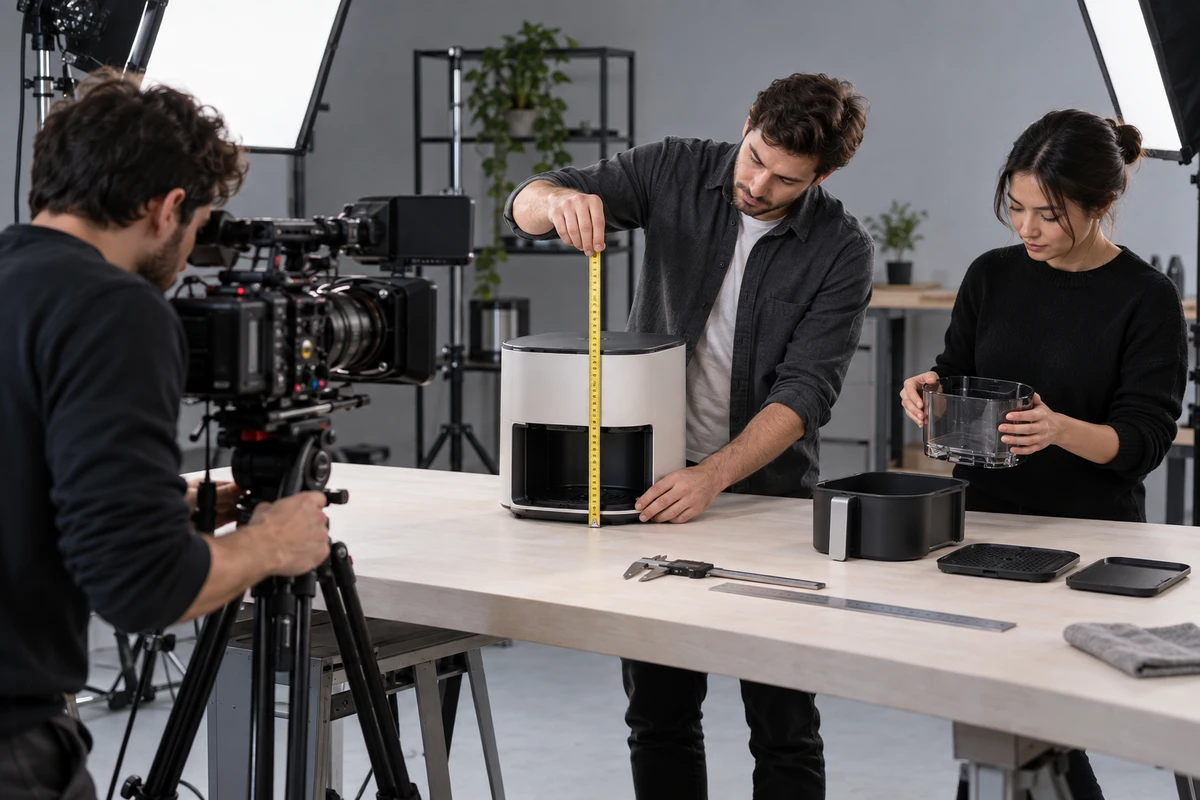
Not every fact belongs on camera. Shipping and warranty are usually better handled by current text sources. Opening mechanisms, scale, capacity, installation, and physical interfaces are strong candidates for independent proof footage.
For example:
- “What fits?” needs known objects and a continuous packing action.
- “Is setup difficult?” needs real steps, natural speed, and the required tools.
- “Where is the port?” needs a stable establishing view followed by a clear detail.
- “What does the material feel like?” can show texture, flex, and reflection, but footage should not be presented as laboratory evidence.
- “Is it compatible?” needs a named model or a visible connection state, not merely a beautiful working scene.
Keep a clean master, horizontal and vertical framing room, a shot ID, and the corresponding approved fact. The same proof shot can then support a brand film, PDP, support library, short-form edit, and future agent answer.
Define what the agent must not answer
Good product knowledge is not a table with every blank filled.
Questions involving unverified compatibility, personal health outcomes, regulation, live inventory, price, shipping, or market-specific policies may require a current page or human handoff. Define five states in advance:
- answer directly;
- answer with conditions;
- link to a specific destination;
- hand off to support;
- do not answer yet.
This is more important than making the agent sound endlessly confident.
Rehearse twenty questions before launch
Choose twenty frequent or high-risk questions and test them against the actual combination of ad, feed, and website data. Classify every response:
- correct and sourced;
- mostly correct but missing a condition;
- unsupported;
- in conflict with the footage, product, or policy.
Only the first class passes without changes. The second needs a condition or better fact source. The last two require a repair to data, footage, or the answer path.
This does not need to become a large AI transformation program. A brand can start with one priority SKU, one video, one feed, and one set of real questions.
The measurement unit also changes
When viewers can ask questions beside an ad, completion rate and click-through rate are not enough. Teams should also examine:
- which questions appear repeatedly;
- which answers have reliable support;
- which questions expose a footage or PDP gap;
- whether post-conversation visits show stronger buying intent;
- whether orders, returns, and support contacts reveal a problem worth investigating.
Google has not published independent performance results for the YouTube beta, and its form warns that Business Agent can make mistakes. Amazon and OpenAI are also describing limited launches or tests. The responsible decision is not to promise a conversion lift in advance. It is to run a controlled, inspectable pilot.
One useful readiness metric is:
Answerable proof rate = high-value questions with both an approved fact and suitable proof asset / high-value questions selected for coverage
This is not a conversion metric. It tells the brand whether the interest created by the video has enough content behind it.
If the project also needs to connect asset versions to commercial outcomes, ONCE’s creative-to-commerce decision trail covers that downstream layer. The question-to-proof system adds an earlier one: what the shopper asked and what the brand used to answer.
The practical opportunity for brands with Chinese supply chains
When prototypes, engineers, and factories are in China, many important answers are already close to the camera: actual dimensions, ports, package contents, setup actions, operating states, and differences between variants can be checked and captured before inventory ships.
That is a strategic advantage of producing with a Shenzhen-based cross-border ecommerce video team. The saving is not only shorter logistics. One production day can capture the emotional footage required by the campaign and the proof footage required by product pages, support teams, and shopping agents.
Product video may no longer end on its final frame. It will keep facing the shopper’s questions.
The valuable deliverable is not only a story that plays smoothly. It is a product reality that can answer back.