When a new SKU needs video, the easiest question to ask is: “What is the cheapest way to make one?”
The useful question is: what business problem must this asset solve for this SKU, and how much cash risk can that outcome reasonably justify?
There is no universal rule such as “spend X% of revenue on video.” A rational budget is capped by two things: the risk-adjusted incremental operating contribution the video can credibly create during its useful life, and the launch cash still available after R&D, first inventory, fulfilment, operations, and media testing. Use the lower number.
That is why large R&D or inventory spend is not a reason to buy a more expensive film. The more sunk cost a launch carries, the more carefully the brand should validate product readiness, stock, and traffic. Conversely, a very cheap video that omits product proof, placement fit, variants, and a test plan usually moves cost into reshoots, media waste, and operator time.
First, separate the assets people casually call “main-image video”
E-commerce teams often use one name for every product video. On Amazon, these assets do different jobs. A shoppable video is not a guaranteed hero placement: Amazon says it may appear in the main media block and other locations, with visibility still affected by image count and platform display logic.
| Asset | Job to be done | First metrics to inspect | What may not be a video problem |
|---|---|---|---|
| PDP shoppable video | Clarify size, use, setup, result, and limitations | PDP conversion, return reasons, ASIN sales | Price, ratings, delivery promise, or weak product value |
| Sponsored Products Video | Prove one feature at high-intent search | 5-second views, CTR, CVR, orders, ROAS / ACoS | Keyword choice, bids, targeting, or stock availability |
| Sponsored Brands / offsite short video | Drive discovery, context, and new-audience reach | Impressions, CTR, attribution path, new-to-brand metrics | Audience selection or a weak landing page |
| Post-purchase / expectation video | Set up, limits, and correct use | Returns, review themes, support tickets | Product defect or fulfilment failure |
Amazon’s current Sponsored Products Video guide supports one to five feature videos per product or ad group and recommends viewing CTR, CVR, ROAS, and video metrics together. That does not mean every SKU needs five films. It means the budget should buy a testable feature-asset system, rather than one immutable hero cut.
A sensible budget has two ceilings, not one percentage
The first ledger is the unit contribution ledger. Calculate what a retained order is actually worth:
Operating contribution per order = net realised revenue − landed product cost − marketplace / payment fees − fulfilment − expected returns and support − incremental media cost
Amazon’s profit-margin guide similarly separates gross margin from operating costs such as marketing, shipping, warehousing, software, and wages. Product gross margin or dashboard ROAS alone does not show that a content investment has paid back.
The second ledger is the launch-capital ledger: R&D, first inventory, inbound freight and duties, compliance, fixed operations, content, media testing, and working-capital reserve. It does not answer “is video valuable?” It answers “even if it may work, how much cash risk can this launch carry?”
Use this management rule:
Approved video-asset budget = min(risk-adjusted, verifiable incremental contribution − adaptation costs; launch cash still available after R&D, inventory, fulfilment, operations, and media testing)
The word “risk-adjusted” matters. Without a clean test, stable traffic, or a real cross-channel reuse plan, expected value needs a steep haircut. Product updates, packaging changes, rights expiry, platform rules, and creative fatigue shorten asset life. A file remaining on a drive does not mean it is still producing value.
Pass four gates before scaling production
| Budget gate | Question to answer first | Smaller move if the answer is no |
|---|---|---|
| Product | Is R&D frozen? Can the key function, size, limitation, or result really be demonstrated? | Make a proof sprint or sample test—not a lifestyle campaign |
| Operating base | Can stock, price, ratings, fulfilment, and return risk absorb more clicks? | Fix the operating foundation first; stock-outs make paid demand pointless |
| Traffic | Is there enough organic or paid traffic to learn? Is there a real test budget and window? | Approve a validation package whose deliverable is learning |
| Asset | Are format, sound-off readability, feature cuts, language / market versions, rights, and replacement needs defined? | Reduce scope, but do not remove the proof needed for the current decision |
Amazon’s inventory guidance frames the two-sided risk clearly: stock-outs lose sales, while overstock ties up cash. A launch-content budget therefore belongs on the same calendar as sellable inventory and the test window—not in a separate “creative complete” column.
Calculate a recovery threshold from incremental orders—not plays
Here is a math illustration only, not a price benchmark or performance promise.
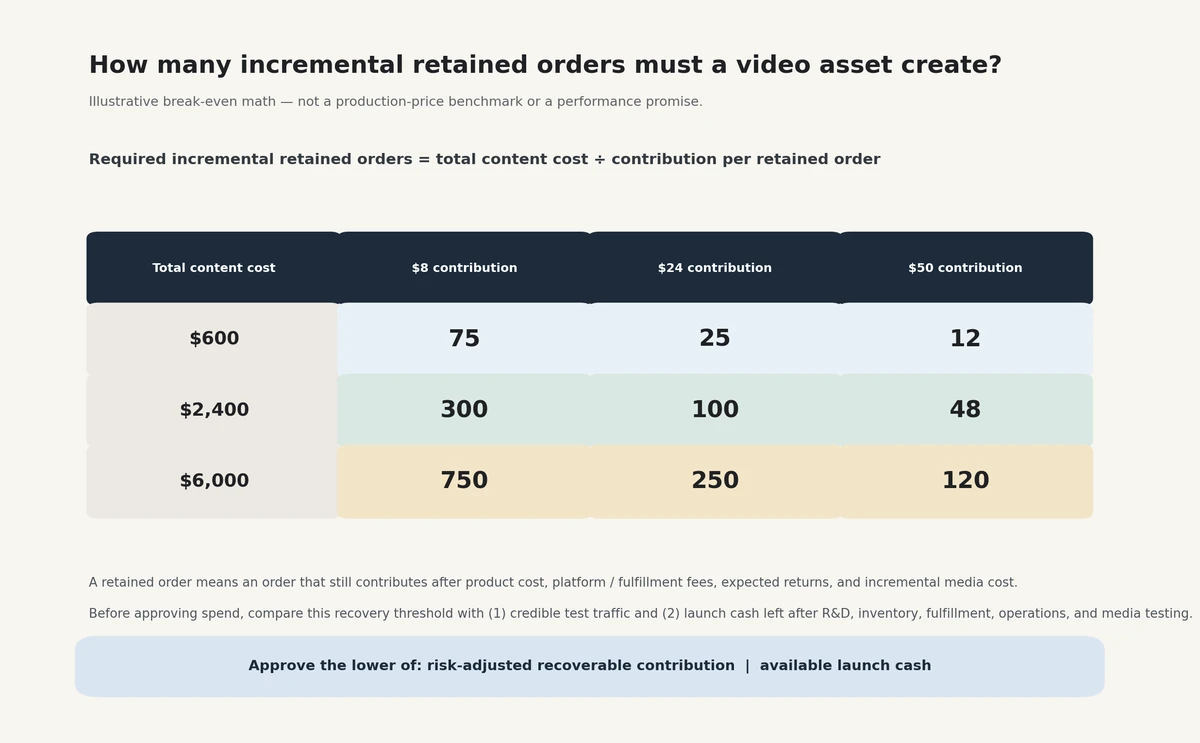
Suppose a SKU contributes $24 per retained order after product cost, marketplace charges, fulfilment, expected returns, and incremental media cost. A production, edit, adaptation, and necessary-version package costs $3,000.
$3,000 ÷ $24 = 125
The asset needs 125 additional retained orders just to break even. If the product gets 4,000 qualified PDP visits per month and video moves conversion from 8.0% to 8.5% for 12 months, un-discounted incremental contribution would be:
4,000 × 0.5% × 12 × $24 = $5,760
But that calculation assumes traffic, price, ratings, inventory, and media mechanics do not all change at the same time. If the brand only approves 50% of the inferred value as a safety-adjusted value, the ceiling is $2,880—not $5,760. The 50% is an illustration, not an industry norm; absent a clean comparison, it should be more conservative.
The recovery matrix below applies the same logic at different contribution levels. A lower quote does not automatically imply a lower threshold, and a higher contribution margin does not remove the need to validate demand.
Why “one cheapest video” often costs more later
Amazon’s own advice is appropriately modest: an authentic, clear product demonstration can matter more than polish. The point is not to pay for expensive-looking production. Pay for the following kinds of usability:
- Product proof: Show the product, action, scale, or outcome early. Explain setup, material limitations, and real use.
- Placement fit: Search video, PDP media, vertical short-form, and sound-off viewing do not always share the same best edit. Critical information cannot live only in audio or in an unusable crop.
- Feature variants: Search queries and audiences need different proof. Keep cuts that test a defined hypothesis rather than delivering only one brand-story asset.
- Versions and rights: Localised copy, captions, voice, talent / music usage, revision rounds, and source-footage rights decide whether the next cycle starts from zero.
- A learning mechanism: Every version should have a hypothesis, placement, metric, and observation window. Without test traffic, “reusable” has zero value in the budget model.
The cheapest option can be right for a low-margin, short-life product with simple proof needs, no stable traffic, or a test whose result will not change replenishment, pricing, positioning, or media decisions. In that situation, deliberately purchase a small, honest validation package.
It becomes false economy when a mechanism, size, installation, or result needs visual proof; when returns or poor reviews stem from wrong expectations; when media budget already exists and creative is the funnel constraint; or when master assets need to work across Amazon, a DTC site, paid social, and multiple markets. Save money by removing unnecessary scenes, talent, and complexity—not by removing the shots that make the product intelligible.
What platform data can—and cannot—tell you
Amazon says in its 2025 product-video article that product detail pages with shoppable videos had an average 23.8% sales increase relative to pages without them. Amazon Ads also reports that Sponsored Products campaigns with video had 67% higher CTR and 9% higher CVR than campaigns without video in its US internal data from June 2026, as stated in the current guide.
Those are useful signals to test video; they are not a promise that a production budget will repay itself. The published material does not provide a randomised result for every category, price point, review base, bid strategy, or inventory state. Campaigns with video may already differ in product quality, media strategy, and operating readiness.
The rigorous use is to test on your own ASINs while keeping keywords, bids, price, inventory, and other page variables as stable as possible, changing one creative variable at a time. Amazon’s Manage Your Experiments supports tests for eligible listing and A+ content; it should not be represented as pre-proving the causal return of any individual PDP video.
Configure scope by product stage, not a universal package
R&D not frozen or inventory constrained: Buy a proof sprint—one honest demonstration of the key action, size, and limitation, with a small set of replaceable hooks. The goal is to reduce misunderstanding and inform the next product or packaging decision.
New launch, little data: Buy a validation set—PDP explanation plus two or three short versions that test different feature hypotheses. Keep media budget separate and decide which question deserves scale.
Stable inventory, pricing, and conversion: Buy a performance-asset system—adapt the master into search-feature cuts, sound-off readable edits, vertical hooks, and A+ or DTC variants, while preserving rights and source assets for refreshes.
Proven winner expanding across markets: Only then should larger lifestyle, creator, localisation, or brand-story investment be considered. The comparison is no longer the price of a single film. It is the all-in cost per compliant, measurable, reusable asset.
One approval sheet for procurement, operations, and media
Before a production agreement is signed, use one shared sheet:
- Calculate net price, landed cost, fees, fulfilment, return allowance, and incremental media cost to get contribution per order.
- Record sellable first inventory, expected qualified visits, media-test budget, and an acceptable test window.
- For each video, state one shopper question, placement, success metric, and stop condition.
- Specify aspect ratios, feature cuts, captions / languages, usage rights, revision rounds, source footage, and reshoot responsibility.
- Back-solve the required incremental retained orders, compare it with remaining launch cash, and approve the lower number.
The most expensive cost is not necessarily a production quote. It is paid, high-intent traffic landing on a page that cannot prove why the product deserves to be bought—and a file that cannot be split, localised, tested, or used in the next cycle.
For adjacent planning guidance, explore ONCE’s Video Marketing insights. Calculate the budget ceiling first; then decide which shots and versions are worth producing.