An overseas marketing team receives an approved launch visual from its China-based production partner. The square version looks good. So does the wide banner. Then the local team supplies the final headline and a product qualifier, and the portrait version no longer works. Reducing everything makes the file fit, but leaves the product too small to explain.
The useful question is what failed: the relationships between elements, the capacity of this composition, or the source photography. Each calls for a different response. A resizing tool cannot make that commercial decision on the brand’s behalf.
A reusable design has relationships, not only an appearance
Adobe’s Create Style IDs, updated April 7, 2026, describes visual elements, layouts and spatial rules as separate parts of the Firefly Design Intelligence workflow. Components, arrangement and relationships are treated explicitly.
This is an Illustrator-based layout workflow. It is not interchangeable with training an image model on product photographs, nor does it establish that a complete video can be automatically re-edited. Our inference is narrower: brands commissioning repeatable campaign artwork should ask for the logic that lets a design change shape, not only the approved picture.
The English main-page Style ID best practices, updated April 8, recommends at least three artboards with varied aspect ratios, functional layer names and deliberate channel-to-layout mapping. Those are product-specific preparation recommendations, not a guarantee that three examples cover every campaign.
These documents were checked on October 18, 2026. This is an evergreen production analysis, not a claim of a new launch today. ONCE has not run a software benchmark for this article.
ONCE’s Three-Squeeze Layout Test
Before ordering a full export matrix, challenge one proposed design with the content most likely to expose its limits. This is our proposed planning method, not a reported client experiment. It applies to static ads, product cards and video end cards; movement and editing require their own review.
Keep the product, background, headline, action prompt and required explanatory copy separately editable. Then test three pressures.
Real copy at its most demanding
Use the approved market version that occupies the most space in the intended font. Do not rely on a neat English placeholder or assume one language is always longest. Check whether additional lines preserve the reading order and leave the product recognisable.
Agree an adjustment order: expand the text area, move decoration, then switch composition if necessary. Shrinking type indefinitely is not an acceptable default. A shorter copy alternative needs local approval of meaning and tone; a layout engine should not silently remove a qualification.
The product area that must survive
Mark what cannot be cropped and why. For a fictional countertop appliance, that might be the relationship between a lid, handle and opening. It need not be the entire product in every placement. The example is illustrative, not an ONCE project.
Run the narrowest and widest actual target formats. Can the background crop while the critical product area remains? Does containing the whole product make the demonstrated feature too small? Adobe’s Train Style IDs, updated April 6, distinguishes crop-producing Cover, aspect-preserving Contain and potentially distorting Stretch. A setting explains behaviour; it does not decide what the audience may lose.
A misplaced product may need a relationship fix. A product competing with an equally necessary headline may need a different composition. If the new composition still lacks an appropriate, sufficiently clear source view, assess an alternate approved asset or a reshoot. Generated extension should not invent missing product facts.
The copy people are tempted to remove
Restore the conditions, offer qualifiers or other explanations the responsible team has already required for this placement. This is a content-preservation check, not legal advice or a compliance certification.
If the full content cannot fit legibly, change the layout or obtain approval for a different message. Moving a qualifier into an unrelated file does not solve the design problem. The test set needs a content-heavy but valid version, not just the cleanest hero image.
Diagnose before commissioning more production
| Observed failure | First response | Escalation |
|---|---|---|
| Longer copy overlaps the product while usable space remains | Fix alignment, anchoring and text-growth direction | Change layout when that space is exhausted |
| Essential product area, headline and qualifier compete for the same space | Design a dedicated narrow or portrait composition | Reapprove the message if it still cannot fit |
| Composition works but the source view is cropped, unclear or inappropriate | Find an approved alternate asset | Commission a new view if the gap is real |
| A source-file object does not survive the tool workflow | Test a copy and compare manual treatment with restructuring | Preserve the original; do not damage the design to automate it |
The last distinction matters. Adobe’s supported-elements reference, updated April 6, lists text on a path, symbols and gradient meshes among unsupported elements, with caution around certain nested structures. Opening a file in Illustrator is not proof that every object is supported downstream.
Commission a system you can hand over
Retain approved editable elements, the content and formats each layout passed, and the reasons for switching to another layout or source image. An exception such as “portrait layout approved only with the short headline” is useful. A folder of unexplained final-final files is not.
For teams working across overseas marketing and Chinese production, this makes the next request easier to scope. Separate initial art direction, relationship setup, local-market review and exception handling. Use actual project records to judge whether maintenance earns its cost; no universal savings rate is established here.
Our view is that this transferable design logic can become a durable production asset. For a one-off campaign with few formats, careful manual layouts may still be the better purchase. For recurring releases across markets, start with the hardest real adaptation and document why it works before expanding the matrix.
Source-image suitability remains a separate issue from layout logic; our discussion of which footage is eligible for reuse explains that distinction at the library level. For a new brief, give ONCE the approved master, actual market copy, critical product area and required qualifiers. The first deliverable should be a reasoned choice between a rule adjustment, a new layout and new photography—not a promise to fit everything everywhere.
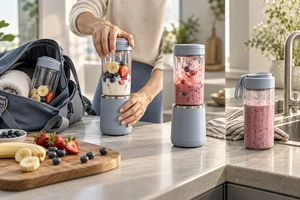
The cover is an original AI-generated concept still life, not client work or a software-output demonstration.