If a shopper asks an AI interface whether a product fits a specific use case, what should the brand supply: one polished hero image, or a small set of visuals that can actually support the answer? The more useful production brief starts with the question, not the aspect ratio.
On October 5, 2026, OpenAI announced a new visual ad format that it plans to test later in the month with an initial group of advertisers in the US. The test is described for image-generation moments on the Free and Go plans, with ads labeled and kept separate from the image a user is creating. On September 30, Amazon Ads described a rebuilt Responsive eCommerce Creative product that can assemble in-banner video, product carousels and conversational prompts from product-page, Brand Store and campaign signals. Its conversational prompts were listed as US-only at launch.
Those announcements do not establish an industry-wide conversion to conversational advertising. They do reveal a practical creative constraint: when the interface decides the placement and combination, the underlying visual still needs to make sense beside a buyer’s question without inventing a product fact.
The production unit is shifting from a finished ad to a usable answer
A conventional film can build a mood, reveal the product and deliver a claim in sequence. An AI-native placement may appear after intent is already explicit: the person is comparing options, imagining a use case or checking what happens next. A lifestyle image can be attractive and still fail to answer “How does this work?”, “What changes?” or “Under what conditions is that true?”
This is not the same as building a searchable footage library. Asset governance helps a team locate a shot and determine whether it may be used. Conversational creative adds another question: what can that shot responsibly answer? A file can be correctly tagged, fully licensed and still be semantically wrong for the moment in which a system selects it.
For teams that source samples and production in China, that distinction matters. More crops and exports will not repair a missing demonstration or an unsupported inference. Before commissioning variants, define the buyer questions that deserve a visual response.
The ONCE Decision-Scene Four-Shot
The Decision-Scene Four-Shot is an ONCE development method introduced in this article. It is not a platform specification, client case study or performance-tested formula. Each set addresses one buyer question through four production tasks.
1. Situation: show why the question exists
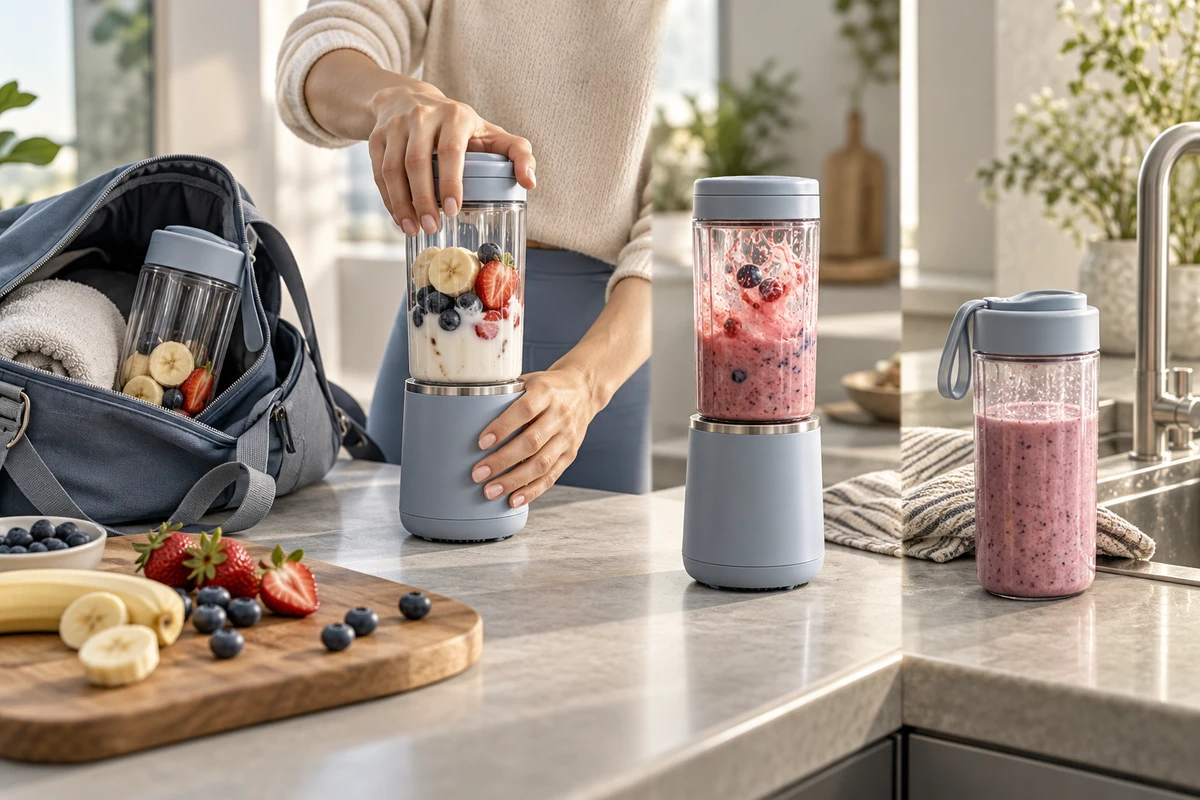
Establish the environment and friction before centering the product. In a fictional brief for a portable blender, a question about commuting might begin with the bag, desk, water source and the person’s movement between them. The example is hypothetical, not an ONCE client project.
2. Action: preserve the real operation
Film the essential handling in a complete, readable order. Keep visible any accessory, locked position, setup step or wait that the result depends on. Editing should clarify the operation, not erase its prerequisites.
3. Observable result: separate seeing from claiming
Capture only what a viewer can verify in the image: an assembled state, an interface response, a changed position or a cleaning step. Claims about speed, runtime, load, health or safety still require an approved source and the right market context. A beautiful shot is not substantiation.
4. Condition: define where the answer stops
Put visible conditions in frame when possible. Record the rest on a compact answer card: buyer question, SKU and market, what each visual can establish, the product-fact source, permitted landing page and latest review date.
The four tasks do not require four stills. A set can combine a still, a short clip and a product image. The requirement is semantic: together they form one answer, and removing a frame should not leave the viewer to supply an unproven conclusion.
Use a question-swap assembly before scaling production
Start with one stable SKU and three questions taken from search, support or sales conversations. Produce one four-shot set for each question. Then run two assemblies.
First, place each set beside its intended question and check whether the situation, action, result and condition remain coherent. Second, deliberately move the set to a neighboring question. Put “easy to carry” visuals beside “easy to clean,” for example.
If the second assembly looks fluent but does not support the new question, the answer card needs a narrow usage rule. If it becomes incomprehensible, the shots may depend too heavily on surrounding copy. If one image appears to answer every question, it is probably generic atmosphere rather than decision material.
This exercise checks meaning, not media performance. It does not forecast clicks, conversion or platform delivery, and it cannot turn a scripted scene into a customer testimonial. Once a set passes the meaning check, the team can adapt it for languages, crops and placements with far less ambiguity.
Split responsibilities where the facts are closest
When samples and suppliers are in Shenzhen or elsewhere in China, the production team is best placed to verify the physical product state, operation, accessories and pickup needs. The overseas marketing team is closer to local buyer questions, approved claims, product pages and market-specific destinations.
Both teams should work from the same answer card before the shoot. Production owns the physical continuity of the four visuals and delivers clean clips, stills and alternate framings. The brand owns the SKU, claims, locale, destination and review date. AI can propose layouts or combinations; it should not silently decide whether a product statement is accurate or current.
Who should test now—and who should wait
A small pilot makes sense for a brand with a stable SKU, repeat e-commerce activity across markets, real buyer questions and approved product information. The four-shot sets can be captured alongside a normal product shoot, keeping the experiment bounded.
Wait if the product is still changing, the landing-page claims are unsettled, the sample cannot demonstrate the operation reliably, or the team has no access to real buyer questions. Producing a large “AI ad asset pack” under those conditions only multiplies ambiguity.
For the next brief, add one page: three buyer questions, with a situation, action, observable result, condition, fact source and destination for each. Whether conversational ads scale quickly is still uncertain. Visuals that answer a real question accurately can still earn their keep on product pages, sales demos and short-form video. For production planning connected to China-based samples and suppliers, start with ONCE and bring the questions before the shot list.