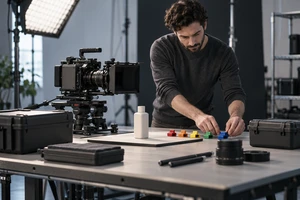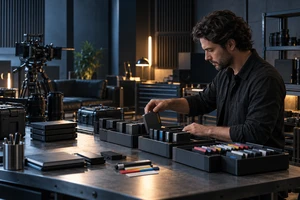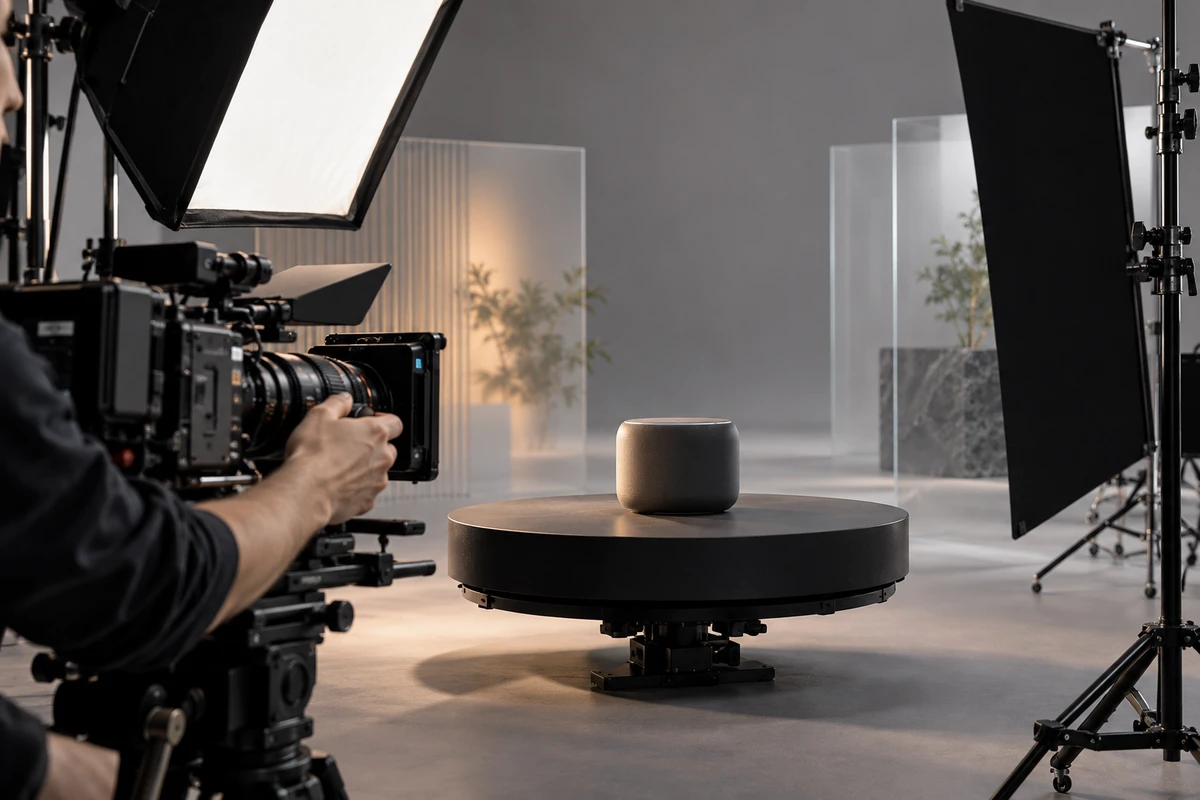
Yes, brands still need a real shoot. The useful question is not whether AI can animate a packshot. It is which seconds of the ad the model must never be allowed to guess.
Image-to-video tools can now create new backgrounds, moods, aspect ratios and story variations from a small set of assets. That removes part of the scene-production cost. It does not remove the cost of establishing product truth: exact geometry, material response, labels, ports, scale, hand interaction, operating sequence and visible proof of a claim.
The best hybrid workflow separates those two jobs before production begins.
“Start with one image” is now a platform workflow
In September 2026, Google described Gemini Omni in Asset Studio as a workflow that can turn an image into a full video ad for multiple placements, with scene-by-scene storyboard refinement. Google also recommends supplying four or five real product views from different angles. Amazon’s Creative Studio likewise offers video ads generated from static product images for sellers.
That is a meaningful production shift, but it is not a transfer of accountability. Google Ads’ own guidance says generative AI may produce inaccurate content and tells advertisers to review generated assets for accuracy, misleading representations, policy compliance and applicable law before publishing.
Platforms are making variations cheaper. The advertiser still owns what the product appears to be and what the ad implies it can do.
Every shot contains two different assets
A five-second product shot often combines two layers that should be commissioned differently:
- The product-truth layer: silhouette, dimensions, color, reflections, ports, accessories, readable marks, use sequence, contact mechanics and performance evidence.
- The variable-scene layer: background, mood lighting, abstract particles, non-functional props, transitions, pacing, crop and a lifestyle environment that makes no factual claim.
AI is strongest as an expansion engine for the second layer. Live action is most valuable as an evidence system for the first. If both layers are handed to the model as one prompt, every new output also creates a new product-QA task.
The ONCE Product Truth × Scene Cost Matrix
Before writing the shot list, score each shot on two dimensions: the risk of getting a product fact wrong and the cost of building the scene for real.
| Shot condition | Recommended route | Typical use |
|---|---|---|
| High truth risk, low scene cost | Shoot live | Ports, materials, hand operation, box contents, assembly and connection steps |
| High truth risk, high scene cost | Hybrid production | Capture the real product and action, then composite them into an AI environment |
| Low truth risk, high scene cost | Generate first | Surreal worlds, seasonal settings, abstract energy and impractical locations |
| Low truth risk, low scene cost | Use the fastest compliant route | Simple color moods, atmospheric inserts, aspect ratios and opening rhythms |
“Truth risk” is not a realism score. It asks whether an error would change a buyer’s understanding of the item. An imperfect fantasy background is usually a creative issue. An extra port, a distorted scale or an exaggerated waterproof demonstration is a product and compliance issue.
Photorealistic is not the same as evidential
A March 2026 AAAI paper, RefAdGen: High-Fidelity Advertising Image Generation, notes that existing approaches either require extensive fine-tuning for a reference image or struggle to preserve fidelity across diverse products. The paper proposes a new high-fidelity method, but its premise matters for marketers: product consistency is a distinct technical problem, not an automatic by-product of attractive generation.
Video adds physics. The August 2026 MotionPhys study found that generated clips can look plausible across short frame sequences while failing to preserve physical consistency through a complete action. That distinction matters when a shot includes pouring, pressing a pump, fabric under tension, assembly, lids, hinges or a hand making contact with the product.
Any shot that carries the burden of proof should therefore use the real product, or at minimum a real product layer inside a controlled composite. As we argued in our guide to turning buyer questions into product evidence, the camera should answer the objection that would otherwise block a purchase.
Build a Product Truth Kit before scaling variants
Traditional production often buys assets one finished film at a time. A hybrid system works better when it first creates a reusable Product Truth Kit. ONCE recommends seven components:
- Approved multi-angle masters: front, side, back, top and the key three-quarter views needed to verify geometry.
- Color and material references: accurate color, gloss, reflection, transparency, texture and finish under neutral light.
- Scale and human-context references: holding, wearing or placing the item beside a known object.
- Real operations and state changes: press, pull, rotate, connect, pour, open, activate and before-and-after states.
- Macro proof footage: ports, mechanisms, labels, seams, outlets and other details a model is likely to alter.
- A claim-to-evidence map: what each claim may show, what it must not imply and which real shot supports it.
- Clean compositing assets and a version ledger: isolated plates, shadow and reflection references, plus the correct SKU, packaging and rights status.
This kit can support new aspect ratios, languages, seasons, platforms and campaign ideas without asking the model to rediscover the product each time. Manage it alongside a provenance and rights record. When the SKU changes, replace the changed truth layer instead of rebuilding every scene.
Run a four-shot pilot before setting the annual budget
Do not begin with a philosophical debate about “AI versus live action.” Test one real product master, two AI environment variants and one real functional demonstration. Review every frame for nine items: silhouette, color, label, interfaces, accessories, scale, material, motion and implied claims.
Then measure four outcomes:
- Cost per approved usable variant: production and review cost divided by the assets that are actually cleared to run;
- Verified product-fact coverage: how many critical facts are shown clearly and accurately;
- Correction cycles: how many product fixes are required before approval;
- Time to live: elapsed time from product approval to the first compliant assets in market.
If AI environments pass after one review while product actions require repeated correction, the next budget decision is straightforward: scale scene generation and keep demonstrations live. If a SKU is visually simple, contains no small text and makes no performance claim, it can move further toward generation.
Shoot what the model must not invent
The opportunity in AI product video ads is not to eliminate the studio. It is to turn the studio from a place that remakes every ad into infrastructure that continuously captures reliable product masters.
Once the product truth is locked, worlds, moods, pacing, languages and placements can multiply quickly. Without that truth layer, faster generation simply scales unverified guesses. On the next brief, do not ask whether the whole film can be AI-generated. Ask of every shot: Is this second proving the product, or packaging the scene?
Shoot the first. Generate the second. Combine them into a system that is both faster and safer.