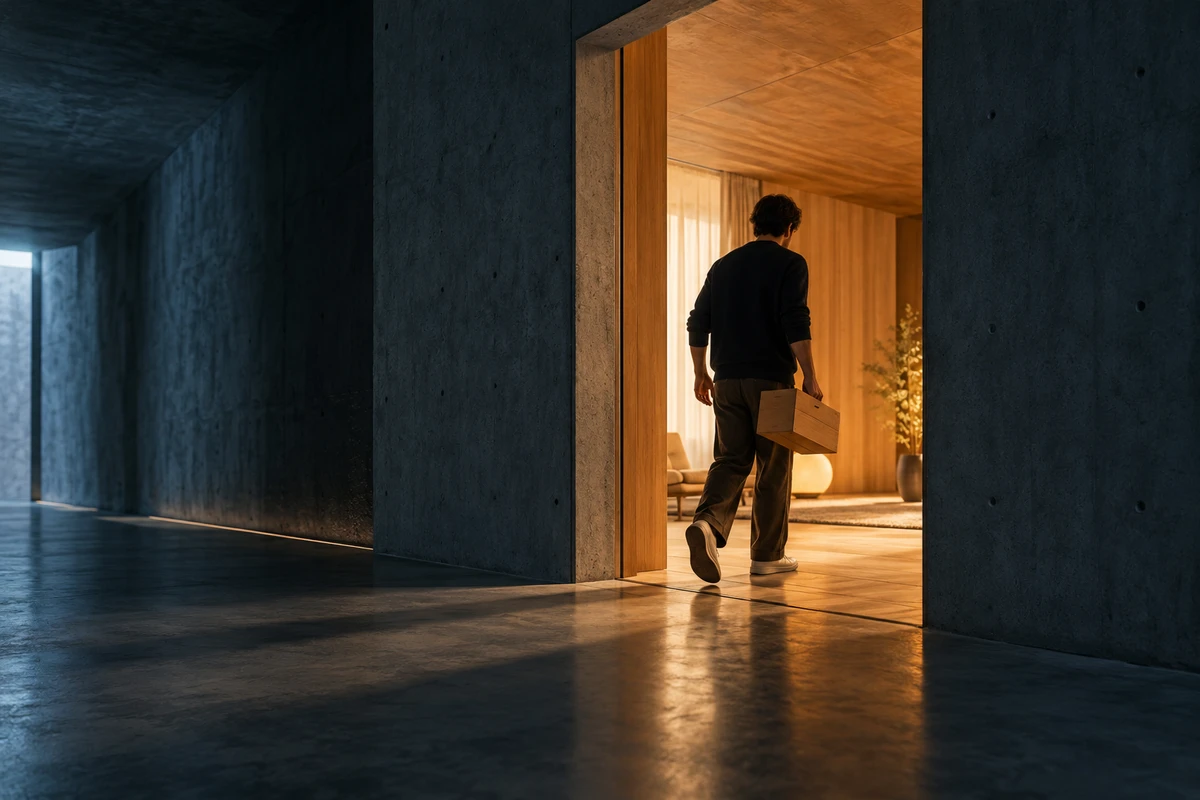
Why can the same person crossing the same doorway three times feel like three different chapters? The first passage might mark a move into a new home. The second might reveal the chaos of a leak. The third might bring the character back with a changed relationship. The door has not changed, but the story uses it to change time, identity, and emotional state.
That is the real value of a spatial transition. It is not a stylish route from one attractive set to another. It lets a character cross a boundary and emerge with a different goal, relationship, or use for the product. Doorframes, corridors, car doors, elevator thresholds, and even a line of light dividing inside from outside can all perform this job.
A doorway is an event boundary, not just a prop
Cognitive research offers a careful explanation for this intuition. A 2026 study in Memory & Cognition asked 90 participants to move through a five-room virtual environment. The findings showed that spatial boundaries affected memory for the temporal order and contextual location of objects. The researchers describe a doorway as a possible signal that one event is ending and another is beginning.
This does not mean that adding a door to an advertisement will automatically make it memorable. A 2021 study in BMC Psychology did not consistently reproduce the classic doorway effect and questioned how robustly it generalizes across tasks and environments. The useful creative conclusion is narrower: a spatial boundary can help viewers understand change, but only when there are genuinely different events on either side. If the character has the same goal, relationship, and action before and after the crossing, the door remains scenery.
Before asking how to shoot the doorway, write down what exists on each side. What does the character not know before entering, and what do they know after leaving? Who stands beside them before the crossing, and who is absent afterward? Is the product merely being carried at first, then becoming a condition for action? If these questions have no answer, even a seamless transition is only a technical demonstration.
Three ways through a threshold tell three different stories
Spatial transitions are often grouped together as “going through a door,” but they operate through three different narrative grammars.
Continuous crossing: the change belongs to the character
The camera follows a character from one space into another without concealing elapsed time. Viewers assume that the same person has carried their body, object, and intention into a new situation. This approach suits decisions, commitments, and discoveries because the character performs the change.
Continuous crossing becomes weaker when the camera takes over the scene. If the lens rushes into the new space before the character acts, viewers may notice an impressive move without understanding who made a choice. A clearer version usually lets the action begin first, then has the camera respond. A hand on the handle, a footfall, or a product passing through the frame becomes the action anchor connecting both sides.
Occlusion cut: time is allowed to compress
When a door, wall, shoulder, or area of darkness fully covers the frame, the edit can move to another time or place at the point of maximum occlusion. This is useful when the preparation is less important than the changed state that follows.
Occlusion cannot explain everything on its own. At least one cue should continue across the cut: the direction of movement, the product being carried, the center of the composition, or a sound that bridges both spaces. If movement direction, lighting, framing, and object position all change at once, viewers must rebuild the geography before they can understand the meaning.
Matched repetition: before and after become comparable
The camera does not need to pass through the doorway. A character can appear repeatedly in the same framed position while season, wardrobe, companion, carried object, or pace changes. The repeated composition becomes a measuring device, making difference visible.
On September 17, 2026, Amica released a campaign in which Drake Maye and Ann Michael Maye repeatedly pass through the same front door. Moving in, minor household disasters, seasonal shifts, and lighter relationship moments all share one spatial reference. The device works because the same doorway absorbs the passage of life. The insurance promise of preparedness and support does not need to be re-explained in every scene.
Change one core relationship across the doorway
The doorframe is not the main design problem. The relationship on either side is.
The change may be between a character and a goal: hesitation before the crossing, action afterward. It may be between people: two enter together, but only one leaves; or one enters alone and returns with a companion. It may be between a character and a product: the product begins as an object being carried, then becomes the tool that opens a space, removes friction, or connects people. It may also be between viewers and information: the new room reveals a cause or consequence they could not previously see.
Filmmaster's published case for Enel's Doors uses colorful doors as literal entries into new uses for energy. Characters cross into worlds of renewed infrastructure, faster connections, smart homes, and electric mobility. The grammar is one of rupture and possibility. It contrasts with Amica's repeated doorway: one device accumulates time in the same place, while the other expands the world through spatial transformation. The right choice depends on whether the brand is expressing continuing support or entry into new possibilities.
With several characters, the threshold must also serve their relationship. Who crosses first, who pauses, and who holds the door all redistribute agency. ONCE's article on supporting characters in brand films explores how secondary figures change a protagonist's choices. A spatial transition compresses that relational change into a visible boundary.
Sound and light should prepare the crossing
A convincing spatial change often begins before the character reaches the threshold.
Sound can announce the next space early. Machinery, rain, or distant conversation may enter before the door opens. The opposite approach lets the previous room continue audibly after the picture changes, then allows the new environment to absorb it. The first method creates attraction; the second preserves emotion. If picture, ambience, music, and dialogue all change on the same frame, the transition can feel like channel switching.
Light provides direction and state. Brightness through a gap can tell the character where to move. A shift in color temperature can mark an environmental change. Backlight can briefly withhold expression until the crossing is complete. Yet the new room cannot become a blank glow. Product shape, eye line, and landing point still need to remain legible.
A 2026 study in the Journal of the Academy of Marketing Science combined scene-cut analysis, visual-complexity measures, and eye tracking in video advertising. It found that cuts reorganize attention and that short, simple scenes can be effective at guiding viewers toward important elements. Applied to a doorway transition, the first beat after a cut should not introduce a new character, caption, product, and large camera move simultaneously. Let viewers read one meaningful change before the world continues to unfold.
AIGC can generate a door without remembering the room
Doorways appear ideal for generated transitions. They provide heavy occlusion, rapid change, and a plausible route between radically different scenes. The difficulty is concentrated at the crossing. The system must preserve the geometry of the door, character identity, carried object, direction of motion, light source, and scale of the new room at the same time. Drift in any one of these can turn a crossing into an unmotivated transformation.
Recent primary research shows why this remains a production issue. UniScene-MoTion at AAAI 2026 explicitly adds depth-aware 3D reasoning to video-transition generation. VideoGPA at ICML 2026 targets geometric consistency and spatial drift. 3D Scene Prompting at ICLR 2026 maintains a memory of static scene geometry for controllable camera motion. These studies show rapid progress, but they also confirm that coherent space is a dedicated technical problem, not something guaranteed by a prompt such as “move through a door into another world.”
The task can be divided. If the doorway is part of the product, architecture, or brand identity, establish its geometry with live action, CG, or locked visual references. Generated imagery can extend the world beyond it, change atmosphere, or build environments that do not carry product claims. When a continuous take drifts, split the sequence into three beats: approach the threshold, enter brief occlusion, and arrive in the new space. Use the concealed beat for controlled compositing instead of asking a model to sustain a complex long take.
This is not a timid use of technology. The purpose of the transition is not to prove how many seconds a system can generate. It is to make viewers understand who crossed, what they carried, and why they returned changed.
Rehearse with one real doorway
Before building a set or generating a world, use an ordinary doorway and a phone to shoot three versions: a continuous follow, an occlusion cut, and a matched fixed-frame repetition. Keep the performer, action, and object constant. Compare what each grammar emphasizes.
Then watch the sequence once without sound, and listen once without the picture. If the before-and-after states collapse when music is removed, or if the audio alone provides no sense of spatial change, the transition has not yet become a complete audiovisual relationship.
Return to the opening question. Why can one person pass through the same door three times and appear to cross three chapters of life? Not because the door has magical power, but because each crossing carries away an old state and leaves a new state that can be compared with it.
If you are planning a brand film that moves a character across locations, time, or relationships, ONCE can help shape the spatial path, blocking, live-action and AIGC roles, and transition structure for both the master film and short versions. Explore our brand video and content production solutions and bring an existing script, location photographs, or storyboard to begin the conversation.