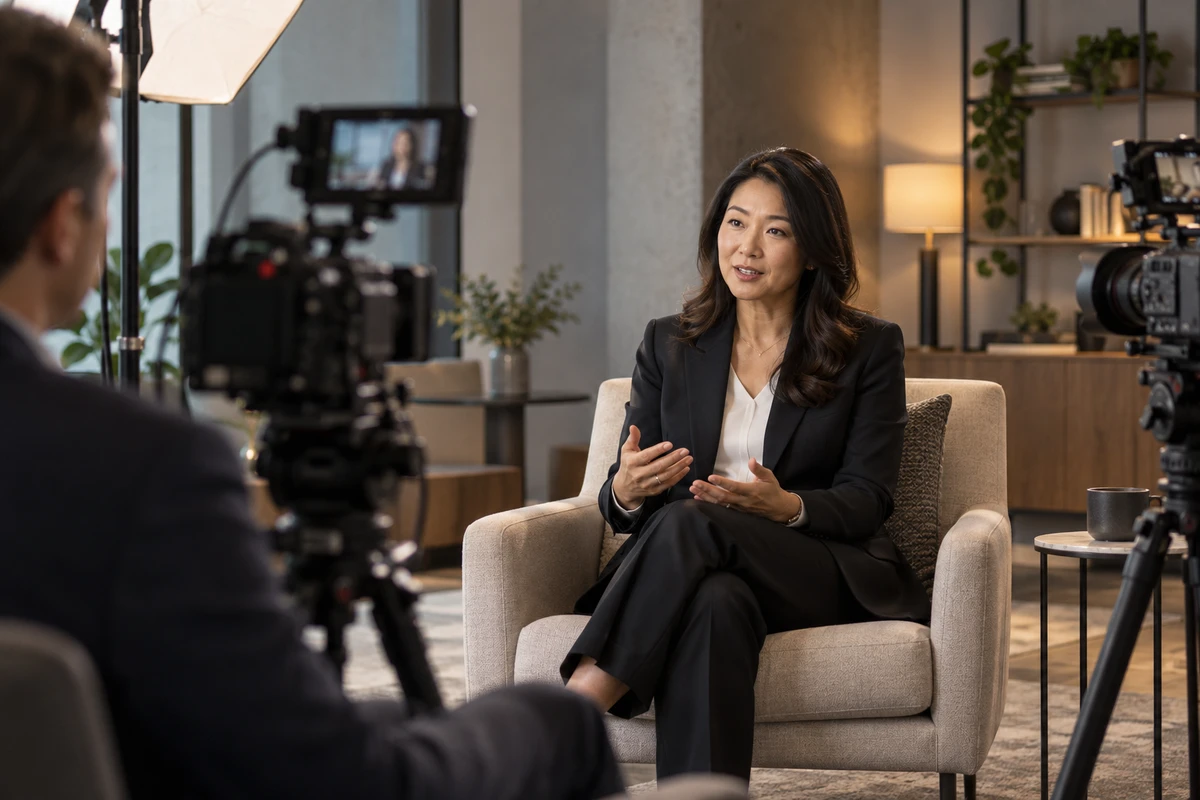
Soon after a corporate interview begins, someone usually says, “Look here.” Yet “here” is not merely a convenient point for framing. When a subject looks into the lens, the viewer becomes the person being addressed. When the subject looks at an interviewer beside the camera, the viewer becomes an observer, close enough to hear a conversation unfold. Both eyelines can work, but they create different relationships.
That decision should not be improvised after the subject sits down. First decide whether the line is a public explanation, a promise to customers, or a memory being uncovered. Then place the interviewer, the main camera, and the second camera around that purpose. An eyeline is not posture management. It is the address on the message.
Decide whether the viewer is addressed or allowed to observe
Looking into the lens places the viewer directly in front of the speaker. It suits moments of responsibility, explanation, or invitation: an executive stating a position, an engineer explaining a safety procedure, or a presenter introducing a product function. The camera behaves like a specific person, so sentences usually work best when they are complete, concise, and consciously delivered.
Looking at an interviewer preserves the sense that a question is being answered. A founder recalling a turning point, an employee describing a difficult moment, or a customer explaining a change often benefits from follow-up questions, pauses, and the rhythm of remembering. The viewer is not being addressed head-on; the viewer is watching someone form an answer. That slight off-axis gaze leaves room for hesitation, a smile, or the search for the right word.
This is not a simple rule that direct gaze always creates trust. A series of advertising studies published in the Journal of Consumer Research found that direct gaze could support spokesperson credibility in informational appeals, while averted gaze could improve narrative transportation in emotional appeals. The research does not prescribe a universal interview setup, but it reinforces a useful distinction: eyeline should follow the communication task. A promise needs to reach the viewer; a story may need the viewer to come closer without interrupting it.
Place the interviewer close enough to be clear, far enough to feel natural
For an off-camera interview, “somewhere beside the camera” is not precise enough. The BBC Academy framing guide notes that moving the interviewer to the other side of the camera changes the direction of the subject's eyeline. It also warns that an angle that is too wide can feel remote, while an angle that is too narrow creates ambiguity about whether the subject is looking at the interviewer or the lens.
A practical setup puts the interviewer immediately beside the main camera's matte box or lens and at roughly the subject's eye level. The face remains open rather than turning into profile, but the gaze still has a readable destination. If the interviewer stands, wanders, or repeatedly leans around a monitor, the subject's eyes will chase the movement. Those small shifts become visible jumps in attention when answers are edited together.
The background participates in the eyeline. If the subject looks toward frame left, leave a measured amount of conversational space on that side. Keep bright objects, open doors, and moving staff from competing with the interviewer. The gaze is meant to lead the audience toward an unseen conversational partner; a busy background can break that line.
A second camera should protect the same conversation
The easiest way to make one interview feel like two unrelated conversations is to place the second camera across the interaction axis. If the main angle shows the subject looking slightly out of frame, a cut to the opposite side can suddenly reverse the subject's screen direction. Adobe's guides to the 180-degree rule and eyeline matching explain the underlying goal: preserve a spatial relationship that the audience can continue to read across a cut.
Draw an imaginary line between subject and interviewer, then keep both cameras on the same side. Let the main camera carry a stable medium close-up. The second camera can move tighter or farther to the side for hands, pauses, and changes in expression; it does not need to cross the line simply to look different. If crossing is essential, a frontal shot, a wider view, or a visible camera move can re-establish direction before the edit changes sides.
Both cameras must also agree about who receives the answer. If the main setup asks the subject to look at the interviewer while the second camera keeps tempting the subject toward the lens, two technically sharp angles will still be difficult to cut into one psychological space.
A teleprompter can protect wording but cannot replace an answer
Prompters are valuable when legal language, product specifications, investor information, or a multilingual welcome must be exact. Turning an entire conversational interview into a verbatim script, however, often makes the subject chase words. The eyes scan, pauses stop reflecting thought, and emphasis lands in the wrong place.
A more resilient design gives the prompter the wording-sensitive opening, required numbers, and call to action, while leaving experiences, judgments, and examples to a real conversation. A confidence monitor can show short phrases or factual anchors; the interviewer stays near the lens, listens, and follows up. The company retains control of compliance and message boundaries without reducing the person to a delivery device.
Direct-to-camera speech does not automatically require a prompter. Some speakers can talk naturally from three or four points and glance at a card between takes. Conversely, an off-camera answer may still need a prompt positioned near the interviewer when every word must be exact. The tool should serve the speaking mode rather than choose it.
AI eye correction can repair drift, not redesign the relationship
AI eye-contact correction is useful for small departures: a subject briefly checks a monitor, reads near the edge of a prompter, or records remotely with the webcam above the screen. VEED's help documentation, updated in August 2026, says its correction works best on clear, well-lit talking heads and may stop correcting when the subject is too far away, the image is low resolution, or the gaze is too far off. That safeguard matters because forcing the eyes while the head stays elsewhere can look unnatural.
The technique is much less convincing when it turns an entire interviewer-led answer into direct address. That changes the intended recipient without changing the head angle, expression, or rhythm of speech. A 2024 study of perceived eye contact on a two-dimensional display also found that the gaze judged most direct did not necessarily align perfectly with the geometric camera center in its experimental setup. The exact result should not be generalized to every production, but it demonstrates that perceived contact is more complex than moving pupils to the middle.
The safer principle is simple: use AI to correct a small error; use production to choose the relationship. Review blinks, eyelids, pupil edges, and head turns at normal playback speed. If correction creates an unbroken stare, a natural degree of drift is usually the better performance.
Let one interview contain more than one viewing relationship
A corporate profile does not need one eyeline from beginning to end. It can open off-camera as the subject recalls a specific event, move to the lens when a central commitment needs to land, and return to a quieter side-angle moment at the end. Each change needs a clear narrative hinge. Randomly alternating eyelines between adjacent sentences simply fractures attention.
Instead of labeling a shot list only “interview medium” and “interview close-up,” label the recipient of each passage: a public explanation, an invitation to customers, a memory of the past, or thanks to colleagues. Once the recipient is explicit, the eyeline, camera positions, prompting method, and edit axis start making the same decision.
A strong corporate interview does not force the subject to stare at one point. It ensures the viewer always understands who is being addressed. If your brand film needs interviews, observed action, and key messages to share one coherent viewing relationship, explore ONCE's brand video production approach and begin with interview structure and camera tests rather than repairing the gaze in post.