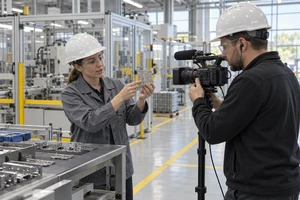
The person stops, but the camera keeps moving. Is that a mistake, or an unspoken nudge to hurry up? In a long take ad, meaning can reside in a small difference in timing. The camera may follow, arrive early, wait or hesitate. What matters is whether viewers can understand its relationship with the person on screen.
Keeping an action within a continuous passage does not require camera and performer to move at the same speed throughout. Immediately matching every turn and smoothing away every pause may produce a fluent image while removing the observer's attitude. The creative question is why the camera initially keeps its distance, then becomes willing to move closer.
Sony Cine's May 19, 2026 article, Cinematographer Joe Bressler Makes the BURANO Dance with NYC Ballet, describes the promotional film for Continuum. Bressler explains that the camera begins as a curious observer, not fully synchronised with the dancers, before rotating with them and entering their rhythm. The article describes the film as a single take. This is the creator's written account, not a claim that we have analysed the film shot by shot or tested its equipment.
For brand films, the useful possibility is that the camera's relationship with a performer can develop. It starts by watching, then participates; it seems eager to go elsewhere, then becomes willing to stay. This offers a creative thread beyond simply moving from a wide shot to a close-up: distance and timing can change the meaning together.
The same performance can be led or waited for
Imagine an original, explicitly fictional canvas-tote ad. An adult places a closed notebook into a bag on a table, pauses to think, picks up the bag and walks toward a doorway. This is not an ONCE client project and has not been filmed or tested with audiences. Keep those actions fixed, then change when the camera leaves the table.
If it begins drifting toward the doorway as soon as the notebook goes in, while the person is still pausing, the newly empty space may suggest impatience. The next thing has already begun, but this person is not ready. That might suit an idea about busyness or hesitation. For a brand seeking an unhurried departure, it could work against the intended message.
Alternatively, the person stops and the camera stays at the table. Both the bag and the person remain visible; viewers are not immediately led toward the next action. Only when the person lifts the bag does the camera move with them. The pause can then belong to the person, rather than appearing as empty time the production needs to eliminate.
A third possibility lets the camera move ahead initially, then slow near the doorway, wait for the person to approach and leave alongside them. The change occurs between the two: a camera that seemed to be rushing adjusts its rhythm. It need not add a line about slowing life down, although the intended shift must still be judged through the actual image and performance. A written treatment cannot guarantee the reading.
These are alternatives for discussing an idea, not three mandatory deliverables. The same performance can acquire a different attitude depending on when its observer moves or waits. Judging only the smoothness of the camera move can miss that distinction.
A difference in timing needs a readable reason
Deliberately separating camera and performer does not justify losing essential content. In the fictional sequence, putting the notebook into the bag still needs to be clear. If an early move obscures that action, viewers may simply think the camera failed to keep up.
Consider both tasks within the passage: make the necessary action legible, then allow room for what follows it. What the product is and what the person does with it are basic information. Whether the camera stays with the person for a moment is an expressive choice. The two can support each other or compete for time.
In a rehearsal, let the person complete the action at a natural pace while the camera initially maintains a clear view. Try moving early on another pass, then staying behind on another. Compare more than the attractiveness of the results. At what moment does a version begin to feel impatient, patient or companionable? This is a proposed creative exercise, not an experiment we have carried out.
The performer also needs to understand the camera's intention. If they assume it must follow them while the camera is waiting for them to catch up, both may compensate until the planned distance disappears. A director can describe the relationship concretely: “You have not decided to leave yet, but the camera has already gone.” Then judge together whether the interval earns its place.
This does not require deliberately slow acting or constant camera movement. A fixed frame can retain a person's belongings after they leave. A short lateral move can change our distance from them. Location, equipment, blocking and the actual product need to be considered together; a motion-control example does not establish a route every setup can reproduce.
End when the relationship has changed
A long take need not conclude at a spectacular camera position. In the fictional tote concept, person and camera finally leaving the table at a similar pace may complete the idea. Another room or a larger orbit may add movement without adding meaning.
Conversely, if the passage must explain the bag's interior, or an important expression remains obscured, a cut deserves consideration. A clearer viewpoint may communicate what matters at that moment. Continuity is an expressive condition to choose, not a decision-maker for every idea.
Continuous appearance also needs to be distinguished from one uninterrupted recording. Honda's May 12, 2020 retrospective, Cog: The Most Influential Advert Ever?, states that the finished Cog film combined two takes. We use only that production detail, not its budget, revenue or viewing claims. A passage can feel continuous while containing a join; its viewing relationship and its recording method need separate explanations.
Where footage is offered as evidence of elapsed time or a complete operation, the actual recording and post-production methods deserve particular clarity. A conventional brand narrative can choose a single take, a joined sequence or visible cuts according to its purpose. Production difficulty itself need not become a product benefit.
Alongside a proposed camera route, write a short relationship description: how does the camera initially regard this person, and which action changes its attitude? Bring the actual product and that idea to ONCE's brand and commercial video planning. By the end, does the camera understand the person better, or has it only travelled further?
Sources were checked again on October 18, 2026. This is original creative analysis; the packing scene and AI concept cover are fictional. We have not performed a shot-by-shot viewing of the referenced films, camera tests, product tests or advertising-effectiveness tests. The Chinese edition retains accurate overseas source names, titles and dates without links whose mainland China accessibility has not been independently tested.