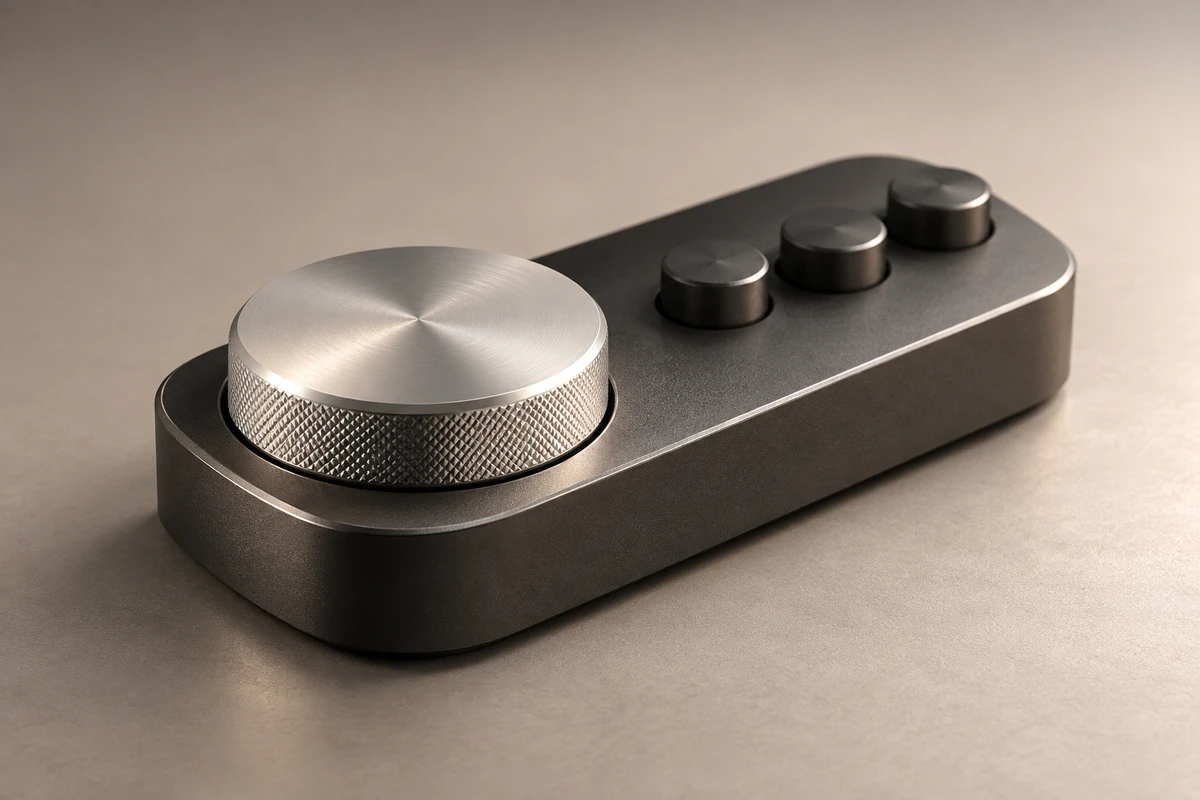
An advertising hero image may let a product's distant buttons fall softly out of focus. A layout image on its product page may need those buttons to be readable alongside the dial in front. Neither picture is inherently wrong: they ask the viewer to do different things. Focus stacking addresses the second need—making necessary details at different distances readable together in one still image—not a requirement to eliminate every blur.
What must one picture explain at once?
Imagine a fictional desktop controller with a knurled dial at the front and a group of buttons behind it. This is neither an ONCE client project nor a shooting test. If the picture explains the control layout, viewers need to understand where the dial and buttons sit in relation to each other. A beautiful dial alone does not finish that job. If the picture instead emphasizes tactile appeal, making the dial the sole visual focus while letting the distant buttons soften may be appropriate.
That distinction shapes composition before capture. Making two product features readable does not mean making the tabletop grain, props and background equally sharp. Mark the features that matter on a sketch, then ask whether they really belong in the same picture. If viewers need the surface detail of a button, a separate close-up may explain it more directly than packing everything into an angled overview.
Before choosing a stack, compare three compositions: keep the angle and extend the sharp region; change the angle to show the relevant features more directly; or retain a selective-focus overview and add a detail image. There is no automatic winner. The deciding factor is the picture's explanatory job, not the complexity of the technique.
Capturing a focus sequence is not the finished stack
Nikon's explanation of focus shift and stacking separates capture from compositing: take pictures at progressively different focus settings, then combine their sharp regions to extend depth of field. A camera's focus-shift capture function therefore does not necessarily deliver the final composite.
Stopping down further is not a cost-free alternative. Nikon also notes the definition trade-off from diffraction at very small apertures. Settings depend on the lens, conditions and requirements; aperture, step and frame-count examples for one camera are not a universal product-photography recipe.
For the imagined controller, the capture could cover the necessary range from dial to buttons rather than include the background merely to accumulate frames. Know where the sequence needs to end, and inspect whether any required region remains unrecorded in sharp focus. Post-production can select sharp material that exists; it cannot treat missing real detail as something already captured.
Lighting consistency matters too. Nikon notes that changes in light during a sequence can make images unsuitable for stacking. Planning a still-life sequence therefore means more than pressing the shutter repeatedly: consider continuity of both the product's state and its illumination. There is no universal step size or minimum frame count here; judge coverage from the actual captures.
More sharp detail can still have a clear hierarchy
Depth of field and visual emphasis are separate design decisions. A sharp dial and sharp buttons do not have to be equally bright, equally large or equally central. The dial can attract the first glance while the rear buttons remain available for closer inspection. Negative space can separate the whole product from its setting. These are composition and art-direction choices, not automatic benefits of a software command.
Conversely, if the composite becomes a field of equally insistent textures, the problem is not necessarily that stacking looks inherently unnatural. Props previously subdued by blur may now compete with the product. Revisit the set and lighting instead of endlessly blurring the background in retouching. The extent of sharpness should support a reading order, not demand equal attention everywhere.
After the merge, return to the source pictures
Adobe's extended-depth-of-field instructions, updated February 23, 2026, describe loading photographs as layers, running Auto-Align Layers, then Auto-Blend Layers with Stack Images selected. This identifies the tool path; it does not replace reviewing the result.
In our hypothetical controller image, inspect the route from the dial's edge across the housing to the rear buttons—the features that were meant to be readable together. If a contour looks interrupted or a texture suddenly softens, compare the relevant source frames and layer masks. Was a sharp region actually recorded? Did the composite select the appropriate material? Do not invent structural details merely to make the finished picture appear complete.
Review it at the intended display size as well. Surface texture worth preserving in a large image may not remain important when reduced, while the control layout still needs to read. Magnified inspection addresses local continuity; viewing at delivery size tests whether the picture serves its purpose. Neither replaces the other.
A sharp still is not a promise about a moving shot
Focus stacking organizes multiple photographs into one still. A focus pull in video instead changes the viewer's point of attention over time. A photograph with near and far features in focus is not a reason to assume that the same composition and appearance will automatically work in a moving shot. When a project includes both photography and video, discuss what each medium needs to explain and how it should do so.
Return to the fictional controller: a layout image may need the dial and buttons readable together; a tactile hero image may retain selective focus. Stacking does not decide which aesthetic is superior. It is one way to help the former picture do its job.
If you are planning product content, bring product images, the intended placement and the relationship you most want viewers to understand to a commercial-image discussion with ONCE. Decide together what belongs in one composition and what deserves a separate view.
This article draws on the official Nikon and Adobe documentation above, consulted October 18, 2026. The controller is hypothetical and the cover is an AI concept image, not evidence of a real shoot, optical test or stacking result.