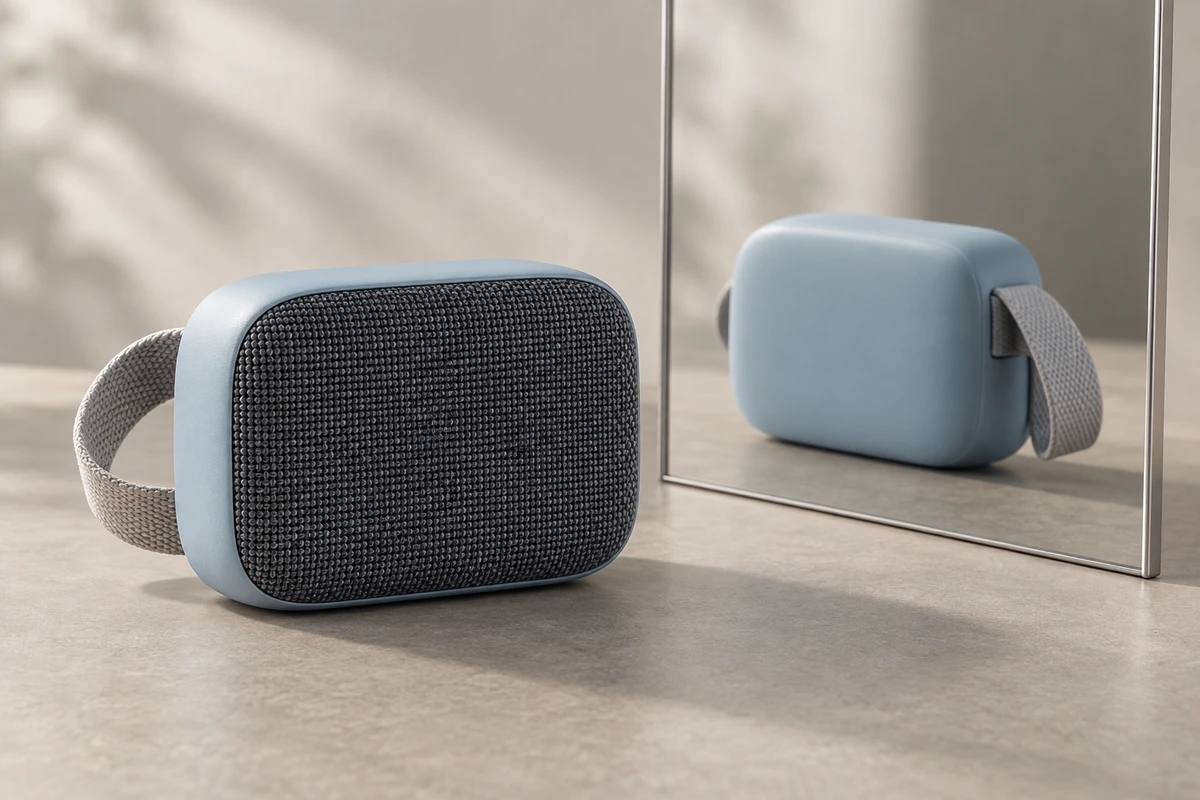
Only one product stands in front of the camera, yet two views can appear in the frame. That is the appeal of mirror composition in product advertising—and an opportunity easily wasted. If the direct view already shows the front clearly and the reflection repeats that same front, the image gains complexity without necessarily adding information.
A reflection can, of course, be about atmosphere alone. Symmetry, continuing blocks of color and the distance between an object and its image can establish a visual character. But when a mirror is meant to help introduce the product, another question matters: what does the second view help someone understand?
Give the two views different information
In broncolor’s public production account, How to shoot with reflection elements, Urs Recher describes using a mirror and glass to bring different views of gin bottles into one picture. He notes that this complicated the lighting and discloses mirroring one label in postproduction. The page has no confirmed publication date. It was checked on October 17, 2026; this analysis uses the written account, not an on-set recreation or a complete film viewing.
The useful idea is not that every product belongs on a mirror. It is that another view can perform a different viewing task. The account also reminds us that an apparently natural mirrored composition may involve deliberate postproduction choices. The finished picture alone cannot establish that everything appeared that way in camera.
Consider a fictional portable-speaker advertisement. The direct view introduces its woven front and overall proportions. An angled mirror behind it is positioned to reveal where a carrying strap joins the rear housing. One view establishes appearance; the other adds a carrying relationship. This is a concept, not a statement about a particular model, a performance promise or an ONCE client project.
The two pieces of information need not be equally large or bright. If the front is the priority, keep it complete and clear; the reflection need only explain the strap’s connection to the back. Conversely, a film about the rear design could let the direct view recede. Hierarchy comes from the shot’s purpose, not a rule that the physical object must always dominate its reflection.
Repetition can look good—know its purpose
A reflection that extends a contour or creates symmetry has a graphic role. It need not be described as an explanation of structure. This can be a valid way to establish a style or introduce a product.
The difficulty is adding repetition while asking it to explain more. If the strap remains hidden in darkness, another attractive grille cannot substitute for it. Temporarily mask the mirror and consider what disappears: a rhythm, or important information? Either answer can justify the shot, but lighting, action and editing should follow the appropriate purpose.
A reflection is not a second product to place anywhere
OpenStax’s Physics, section 16.1 Reflection explains that the angle of incidence equals the angle of reflection, measured relative to the surface normal. For a plane mirror, the virtual image is as far behind the mirror as the object is in front. These fundamentals, checked October 17, 2026, explain why an image cannot simply be moved to a more attractive position while remaining a natural reflection of the same scene.
For the fictional speaker, revealing the rear strap requires considering product orientation, mirror orientation and camera position together. Turning the mirror also changes the environment it brings into view. Moving the product changes the relationship between object and image. Composition means finding two workable viewing paths, not dragging a duplicate layer into empty space.
Do not twist the product until neither view is intelligible simply to obtain both. If the reflected back is a narrow fragment that needs an explanation before anyone recognizes the strap, a separate direct rear shot may be clearer. A mirror provides an expressive opportunity, not a guarantee that every presentation task can be solved at once.
Light the front, then examine what the mirror reveals
Once the direct view works, examine the reflected product and environment. A bright area that leaves the front grille unobscured may fall directly across the reflection. An object hidden beside the camera may become visible along another path. Decide where reflection adds information and where it conceals information, rather than trying to remove every bright reflection indiscriminately.
First make both views readable, then consider whether they share the intended atmosphere. A gentle front view beside a suddenly dominant reflected highlight may not provide the contrast the shot needs. If improving the reflection continually compromises the front, reconsider mirror placement—or separate the views into different shots. More lights do not automatically make a more complete solution.
Text needs similar consideration. Markings in a real reflection may not be suitable for direct reading. If a label is adjusted in postproduction for legibility, treat that as an explicit graphic choice, not permission to alter the positions of real components. Art direction can depart from natural reflection without turning a structural introduction into a different product.
When the picture moves, decide what changes
A successful still composition does not make every movement successful. For the fictional speaker, three different actions could be explored. They tell different stories.
First, lock the camera and mirror while a hand enters to lift the product. The reflection changes with the action; the carrying relationship is the point. Examine more than the attractive resting frame. Does the hand obscure the detail being introduced, and do both views remain intelligible during the lift?
Second, keep product and mirror stationary while moving the camera. The viewing path changes, along with what is visible in the mirror. This can develop a gradual discovery of another surface, but both beginning and end should contain something definite—not merely make everything in the reflection slide.
Third, move the mirror itself. It can reveal a previously concealed detail and make the image feel more deliberately presented. That is not inferior to a naturalistic scene; it is a different style. The mirror is performing, while the product is not necessarily being used. Script and sound can acknowledge the staged quality instead of dressing it as a chance event with everyday ambience.
There is no need to use all three. Choose the most worthwhile change and organize its beginning and end. If natural reflection becomes a designed composite graphic during the shot, give that transition an expressive reason. Viewers need not know every production step, but product identity and the relationship between actions should not change unnoticed.
Nor must the two-view shot be the longest in the edit. It might offer a brief discovery: recognize the object, notice the rear relationship in its reflection, then move into an ordinary carrying action. If another shot explains that relationship more clearly, the mirror shot can retain only its distinctive graphic rhythm. Beauty is not the sole reason to keep it, but it need not be disguised as an unproven sales result either.
ONCE’s public work and content explore different visual relationships for products. If you are developing a product advertisement, bring the actual sample, the additional surface you want to show and your references to a conversation with ONCE through our commercial and product video production solutions. Is the mirror repeating an attractive shape, or helping someone understand a little more about the product?
This is original creative analysis, not a practical shoot, audience study or advertising-performance test. The speaker scenario and original generated cover are concept illustrations, not broncolor case imagery or actual project records. Overseas sources were not tested on a mainland China network; the Chinese version therefore identifies them accurately without adding unverified overseas links.