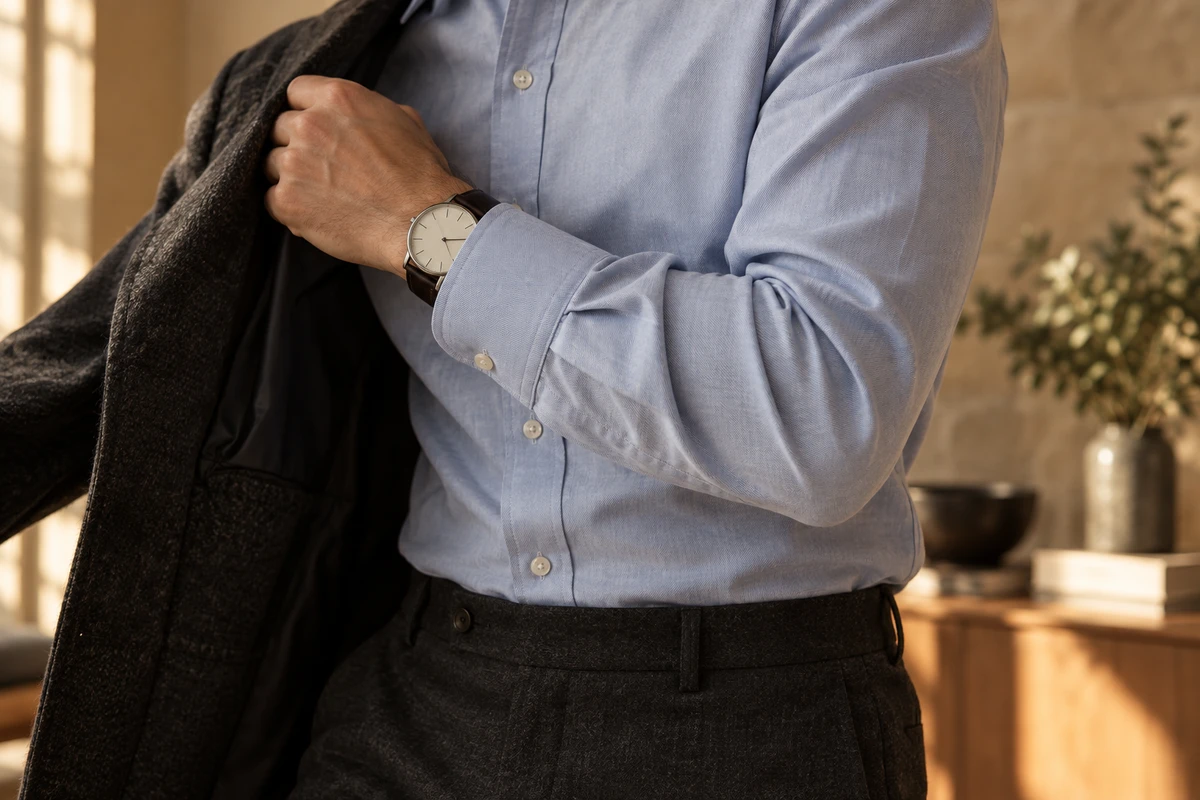
Imagine a fictional watch commercial. Someone shuts a laptop, puts on a jacket and heads out to dinner. In the styling photograph, a loose shirt looks good with the watch. Once the actions run together, however, the cuff covers the dial. Someone suggests keeping both sleeves rolled up to the forearms.
The watch is visible now. Why the character is dressed that way becomes harder to explain. Rolled sleeves are not inherently wrong; the commercial is simply pursuing two goals that do not always align: making this person’s destination believable and showing the product clearly.
Everyday clothes are part of the character
In How To Create a Great Costume Design, published on February 25, 2015, the Academy of Motion Picture Arts and Sciences distinguishes costume design from fashion or personal style alone. Clothes help make a character’s identity believable. This is filmmaking material, not research establishing that a particular outfit improves advertising conversion. Its useful question for an ad is whether the clothes describe the same person as the script.
Labels such as urban professional, relaxed or youthful can start a conversation, but they cannot choose the shirt. Has this person just finished work, or changed clothes before returning to the laptop? Is the jacket an everyday item left over a chair, or something taken out especially for tonight? The reason for wearing the same garment can change the character’s situation.
Clothes should not substitute for characterization through stereotypes. A suit does not automatically mean success; casual clothes do not mean a life without pressure. A more useful direction is specific to the moment: this person wants to look a little more considered tonight than during the day, without seeming to have tried too hard. That gives the team something to work with when choosing fit, combinations and dressing actions.
If the script’s difficulty is dialogue that sounds like a list of selling points, our discussion of actor performance in advertising addresses that question. Wardrobe works on another layer: what the image tells us before anyone speaks.
A covered dial is not necessarily a failed shot
In this fictional commercial, a watch that belongs naturally in everyday dress may sometimes disappear under a sleeve. But if the entire film never shows it clearly, viewers cannot understand what is being advertised.
Different shots can do different jobs. A medium shot preserves the complete action of putting on the jacket, without making the person stop and pose for the product. When the hand reaches for a door handle, the cuff moves and briefly reveals the watch. A clear close-up can then show the dial and strap. That close-up should still connect with the surrounding wardrobe and watch position, rather than suddenly introducing a different way of wearing it for a prettier image.
The question is not how many seconds the watch remains exposed. It is whether its appearance helps us understand both the person and the object. A fleeting glimpse cannot explain a specific operation if that is the shot’s purpose. Equally, an emotional departure scene need not turn every gesture into a feature demonstration.
Clothing also makes physical contact with the product. A cuff might press against the crown, catch on a strap or make the actor keep adjusting their wrist. These are possibilities to consider in this imagined shoot, not allegations about a particular watch. Choose clothes with the actual filming sample on the actor, rather than inferring compatibility from a styling board.
Watch a complete dressing action, not just a styling photo
BAFTA’s Talking about costume design: BAFTA sessions 2019, published on February 26, 2019, records designers discussing everyday clothes, repeated fittings and actor feedback. Apparently simple jeans and T-shirts can be difficult to get right; fittings involve adjustments and attention to the wearer’s comfort. The transferable idea is a working method, not a claim about advertising effectiveness.
For the watch film, a fitting could follow one sequence: close the laptop, stand up, put on the jacket, take the keys and leave. First consider whether the person can complete it comfortably, then notice when the watch appears. A sleeve length that looks right in a still photograph can behave differently when the arm reaches forward. Clothes that look good standing may fold and cover things differently when seated.
When a conflict appears, the outfit need not immediately become a product display stand. Is the cuff too tight, or is the shot carrying too many responsibilities? Another shirt that still suits the character, a different camera position or a motivated close-up may work better than asking the actor to keep a hand raised. The choice depends on what this part of the story cannot afford to lose.
A good outfit needs another judgment through the camera
Color is not an isolated styling decision either. Imagine the same pale watch dial next to a bright white cuff and a dark gray one. Either could work, but each separates the watch from the clothing differently. A reference image alone cannot establish which will be clearer. Look at the actual watch, fabric, skin tone and setting under the intended lighting and framing.
Shot size changes the trade-off. In a close-up, the cuff edge and strap position matter. In a wider frame, the overall silhouette and action may be read first. Arranging the sleeves too neatly to expose the watch in every wide shot could weaken the sense of someone just finishing work. Treating everyday realism as permission for arbitrary wrinkles and obstruction could sacrifice necessary product clarity.
There is no universal percentage for either loss. Decide whether this shot introduces the product’s appearance or establishes the life it belongs in. Both matter; they need not always happen in the same image.
Make clothing part of a person’s choice
The fictional commercial could include a small change: before leaving, the person decides the jacket feels too formal and returns it to the chair. Clothing becomes a choice, not just a background. Whether that gives the watch a different meaning depends on how clearly the film has established the person’s feelings about dinner. Changing an outfit cannot create that meaning on its own.
Not every product film needs such a scene. A clean demonstration may be more direct when the purpose is to explain dimensions, construction or appearance. Wardrobe becomes a narrative opportunity when people, relationships and situations matter. Good styling gives someone a reason to wear the clothes, lets them move naturally and makes the product clear when it needs to be understood.
For a product commercial with people on screen, bring the product sample, the character’s situation and a key action to ONCE VISUAL to discuss how wardrobe and camera work can support each other.