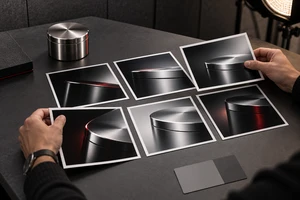
Sound memory is not a dramatic hit added when the logo appears, nor is it simply a catchy music track. It behaves more like a thread hidden inside the story. The first time viewers hear it, it belongs to an action. The second time, it starts shaping the rhythm. When it returns at the end, the image no longer needs to explain that the same idea has come back.
The thread can be extremely short: the onset of a button press, the movement of a rail and a fading resonance. What matters is not how loud it is, but whether each appearance stays connected to the same product quality or emotional meaning.
Memory begins with a return, not a first appearance at the end
When a sound appears only with the closing logo, it can punctuate the film but has little opportunity to build memory across the story. A more organic approach is to introduce it first as a sound that genuinely belongs in the scene.
Imagine a film about a speaker with a mechanical dial. At first, the audience hears the small resistance of the dial as it turns; the sound simply makes the action believable. Later, the editor places that short attack inside the musical rhythm. At the brand reveal, its attack and pitch contour return in a cleaner, compressed signature.
This is not a formula for every brand. Food, fragrance and service brands may not offer an obvious mechanical action, but a sound seed can still come from the central experience: air released by opening a package, glass meeting a tabletop, fabric moving, or the pause before a person breathes in. The useful test is whether the sound has a genuine relationship with the product or story—not whether it resembles a conventional advertisement.
Keep an identity while allowing variation
Repeating the same recording three times can make it feel like a notification. Changing it too much removes its identity. Start by holding two or three recognizable properties constant while allowing the others to move.
Those properties might be the attack, rhythmic spacing, pitch contour or dominant timbre. A short-pause-long rhythm and an upward pitch ending could remain stable while the first appearance uses real metal, the second sits inside percussion, and the third becomes a softer synthetic tone. Viewers may not be able to describe the rule, but the three sounds can still belong to one family.
The peer-reviewed study The Recall and Recognition of Sonic Logos, available through the University of Cambridge repository, tested 90 commercial sonic logos with 1,860 participants. Within that sample, melodic complexity affected recognition and sung recall in different directions: more structural complexity could support recognition while making a logo harder to sing back accurately. The finding suggests at least two meanings of “memorable”: knowing whose sound it is when it returns, and reproducing it after the film ends. A brand film should decide which matters more.
Timbre is already speaking for the brand
A sound motif is more than a sequence of pitches. A wooden impact, metal collision, breathy voice and granular synthesizer can imply different personalities even when they perform the same notes.
The Journal of Marketing Research article The Sound of Music reports ten studies on timbre in audio logos. It found that rougher or smoother timbral qualities informed judgments such as ruggedness or sophistication, and that changing instrumentation could alter perceptions of established brands. The research concerns audio logos rather than every kind of brand film, but it helps explain why changing an instrument is more than a cosmetic choice.
Sound selection can therefore return to the product itself. A film about precision may lose definition if every sound has a soft onset and diffuse body. A brand seeking warmth and tactility may feel colder when dominated by sharp digital high frequencies. There is no universal “premium” timbre; the question is whether sonic material and visual material describe the same character.
Let music, action and the brand signature borrow from one another
Many films treat music, sound effects and the final signature as three separate tasks, then stack them in the mix. The result can be polished without feeling like one sonic world.
A more coherent approach lets the three share material. Action can supply rhythm. Music can introduce the interval that will later appear in the signature. The tail of an environmental sound can become a transition. The brand sound then grows from the film instead of arriving as a badge attached at the end.
During editing, remove the full music track and listen to dialogue, action and space. Does the story still have movement? Add music without filling every opening. When the brand sound arrives, ask whether it resolves a relationship that has already been established or suddenly introduces a different language. In the latter case, the problem may be conceptual rather than a matter of mixing.
Space changes what the ear notices
Effective quiet in advertising rarely means muting every track. It often means withdrawing the most continuous layer so that breath, cloth, machinery or room decay moves into attention.
G. Douglas Olsen's experimental work on auditory contrast in advertising found that short contrast intervals could improve recall of highlighted information under the conditions tested, with silence outperforming music as the highlighting device. The study does not mean that three seconds of silence automatically improves an advertisement. The safer creative inference is that memory needs contrast. When volume, density and emotional intensity remain constant throughout a film, even beautiful sound becomes background.
In a September 2026 Little Black Book interview, BUCK creative director Alex Moulton similarly described quiet as space in a mix rather than absolute silence: when music recedes, ambience and decays can remain. This practitioner view is not the same kind of evidence as a controlled experiment, but it suggests a concrete mixing question: not only where should the film go silent, but where should it lose one layer?
Generative audio can expand options, not define identity
Generative audio can help explore material quickly. The same rhythm can be tried with multiple timbres; the same action can receive realistic, heightened or abstract treatments; early drafts can give directors and sound designers something audible to discuss. But a brand sound must remain related across shots. A collection of individually attractive results is not yet an identity.
One practical division of labor is to let generation produce variation while people protect continuity. Define the rhythm, pitch direction, attack and narrative meaning that must remain stable, then generate candidates. Review them in the complete film: do they compete with speech, follow the action, and remain part of the same family? For audio intended for repeated brand use, licensing, provenance records and channel scope still need separate confirmation.
Test the sound line without the picture
When the sound concept is ready, turn off the picture and listen to three moments: the first point at which the product enters attention, the moment when action or emotion changes, and the final brand appearance. If the moments are unrelated, the audience has little basis for connection. If they are identical, the film has no development.
The goal is not to make viewers immediately notice the sound design. It is to create a slight familiarity at the final return: this sound has been here from the beginning.
Explore more creative and production thinking in ONCE's video production journal. If you are developing a brand film that needs both a visual and sonic identity, bring the product, references and intended emotion to ONCE for a creative conversation.
Sources checked on October 13, 2026. The “three appearances” method is an editorial recommendation, not an industry standard or a completed client case. The cited research examines sonic logos, timbre and auditory contrast in advertising; each film still requires testing with its actual material.