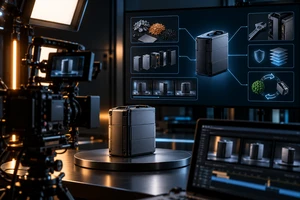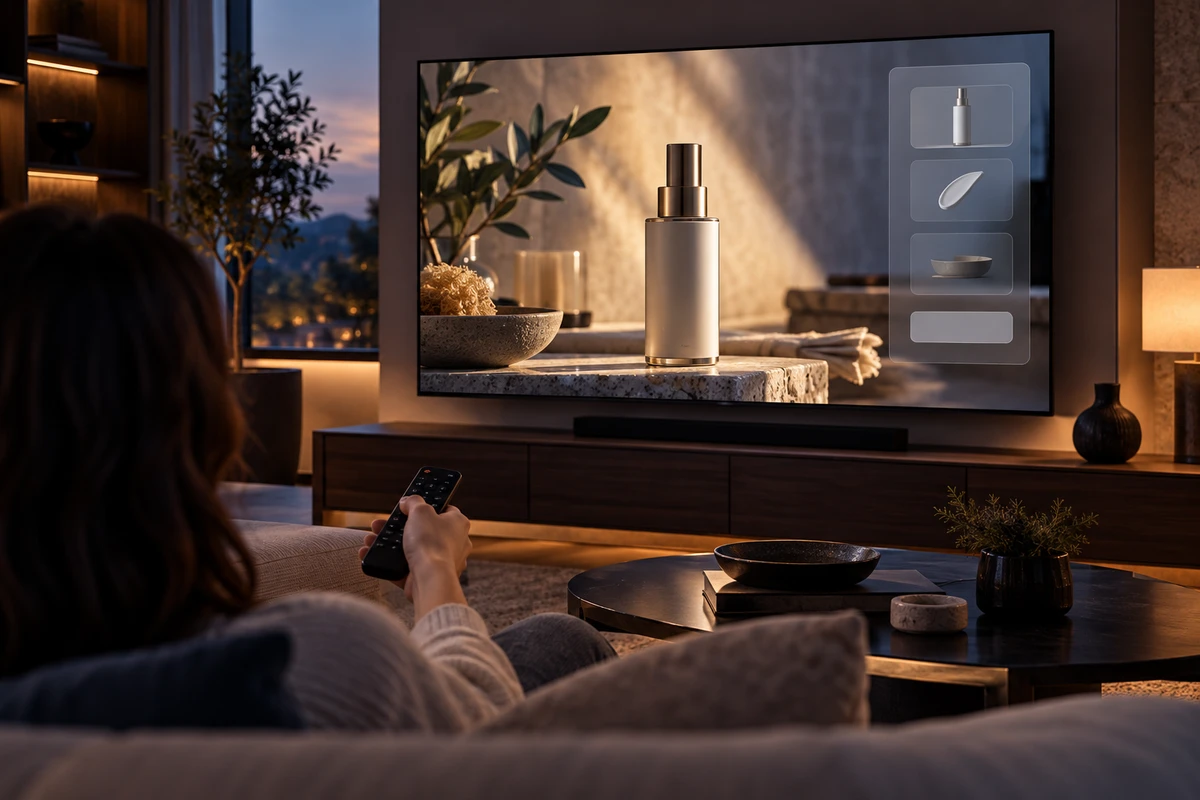
A television spot used to end with a memory cue: remember the brand, search later, or visit a store. On some connected-TV inventory, the remote can now add a product to a cart, send details to a phone, or start a sign-up flow. That turns a production question into an operating question: should the action live inside the video, or should the media platform supply it?
For global brands sourcing products or production from China, the safer answer is to keep the base film complete but interaction-ready. Commission one narrative that works without a click, compose it so an overlay cannot hide the product or required claims, and deliver a product-action map that tells the media team which item, market and destination belong together. A flattened TVC with a burned-in “Shop now” button is usually the least flexible master.
What has changed—and where the boundary still sits
Amazon Ads introduced Dynamic TV Creative on May 11, 2026. For eligible Prime Video campaigns, a single base creative can be combined with different interaction formats, calls to action, headlines, product imagery and details such as price or ratings. At announcement, access was limited to select U.S. advertisers that sell on Amazon, with category and inventory restrictions.
Amazon had also announced remote-enabled interactive formats for Samsung TV Plus, including Add to Cart for Amazon sellers and Send to Phone or Sign Up Today for advertisers that do not sell on Amazon. Samsung named its first participating brands on June 22, 2026.
These are verified platform capabilities, not evidence that every CTV market or account has become shoppable. Locale, inventory, account eligibility, serving method and supported action still need to be checked before production starts. The durable implication is narrower: a video master should no longer assume that its CTA, product information and final destination will always be fixed inside the pixels.
The failure mode is not “bad TV design”
A burned-in button competes with the real action
Amazon's current Streaming TV and Prime Video specifications say non-interactive ads should not show button-like prompts to click, while interactive ads use an overlay controlled by remote or mobile. If the film already contains “Buy now,” and the platform adds “Send to Phone,” viewers receive two instructions and the media team loses the ability to change the action by audience or account type.
A broadcast-safe frame can still be interaction-unsafe
The same specifications require overlays not to obscure copy, primary content, disclaimers, claims, product or rating information, or the full primary product and logo. A composition that pushes the hero product to one edge and legal copy to the other may pass a normal 16:9 review but leave nowhere for an interactive layer.
Product drift creates a commercial mismatch
Dynamic product information reduces the need to render every variation into the base film. It also creates a new failure: the black appliance demonstrated in the video can lead to a white model; a bundle can lead to a single-item page; or a market-specific claim can land on a different offer. The production handoff therefore needs SKU or ASIN, destination and market ownership—not just a clean ProRes file.
The story still has to survive without the overlay
Interactive availability varies by locale and supply. Amazon also notes that a creative may remain eligible to run without interactivity if it meets general streaming-TV policy. If the product promise only becomes clear when an overlay appears, the same asset turns into an incomplete ad elsewhere.
This extends the same principle behind giving one product a different job on each short-video platform: a shared master can carry the product truth, but each environment needs its own action logic.
Reverse the brief from three deliverables
1. The standalone narrative master
Turn every interactive layer off. The viewer should still understand the product, the use case and the reason to care. Demonstration, brand memory and required claims belong in the film; the overlay should shorten the next step, not repair missing storytelling.
2. The interaction-safe composition
Mark potential overlay areas before storyboards are approved. Separate the product silhouette, subtitles, legal copy and essential hand actions from those zones. This is not a blanket instruction to shrink everything into the middle. Each shot should define what may be covered and what must remain continuously visible.
3. The product-action map
For every intended interactive state, record the SKU or ASIN, market, action, headline, product-data source, destination, availability owner, expiry date and update trigger. It gives media teams a reliable answer to a basic question: which product shown in this moment sends which viewer to which next step?
The ONCE REMOTE framework
R — Reserve interaction space
Use the platform's official template when one is supplied. Keep the hero product, subtitles, disclosures and crucial motion outside the candidate overlay area. For a cross-platform master, work from the strictest verified safe zone and create platform adaptations rather than pretending one crop fits every environment.
E — Establish the product-action match
Choose the product first, then the permitted action. A seller account may support Add to Cart; another advertiser may only be eligible for Send to Phone or a sign-up destination. The action has to follow account, market and product conditions—not a line invented in the script before eligibility is known.
M — Make the film complete without a click
Review a clean version with every interactive element disabled. If the brand, product use or core benefit disappears, the narrative is unfinished. Interaction should reduce friction after interest, not manufacture the interest itself.
O — One action at one moment
Ten-foot viewing makes competing instructions expensive. Do not ask a viewer to scan a code, press the remote, remember a URL and save an offer in the same beat. Give each interactive state one primary action and one primary destination.
T — Test from the sofa
Check type, product recognition, overlay obstruction and remote cues on a real television at a realistic distance. Then follow the destination and confirm that the product, color, bundle and market offer match the film. A desktop review does not reproduce the viewing or purchase context.
E — Export the master with its action map
The final package should contain the base film, safe-zone reference, clean preview, interactive-state previews, product-action map, version ID and update owner. That preserves production intent when a media team changes a CTA, destination or product detail later.
Buy the route before buying the number of versions
A campaign limited to non-interactive inventory needs a strong standalone TV master without a fake click prompt. An eligible Prime Video or Samsung TV Plus test adds interaction-safe design, product mapping and device QA. A program spanning markets and platforms needs a maintained system of deployable states, not a quote based only on the number of exported files.
ONCE uses this denominator to expose the difference:
Fully loaded cost per deployable interactive state = (strategy + base master + overlay-safe finishing + product/action mapping + device and market QA + version archive) ÷ states that pass product-match, obstruction and destination checks.
An exported file is not automatically a deployable state. It only counts when a specified product, market, action and destination have passed the checks. This prevents a large version count from disguising a small usable inventory.
A small pilot with a useful answer
Choose one product with a stable SKU, reliable availability and a benefit that is easy to demonstrate. Rework one existing 15- or 30-second asset into a pilot:
- Cut a story that remains complete with interaction disabled.
- Reserve one explicit overlay area.
- Preview two eligible action states only if the account actually supports them; otherwise test one real state rather than two fictional ones.
- Review at ten-foot distance, then verify the product-action-destination match.
The pilot should not promise a performance lift. Its job is to reveal whether the existing production system can create valid interactive inventory. If the master needs a structural re-edit to make room for the overlay, or nobody owns the product mapping, that is a production finding worth resolving before media scale.
The remote can become a commerce input, but it does not automatically make an ordinary product film shoppable. The valuable asset is a production system that tells a complete story when no action appears, protects the product and claims when an overlay does appear, and keeps every product connected to the correct next step.
Sources
- Amazon Ads, “Amazon Ads introduces Dynamic TV Creative for Prime Video,” May 11, 2026
- Amazon Ads, “The biggest moments from NewFronts 2026 show the future of streaming TV advertising,” March 27, 2026
- Amazon Ads, “Streaming TV & Prime Video ad specs,” accessed October 11, 2026
- Samsung Newsroom US, “Samsung Ads Announces Shoppable CTV Experience with Flagship Brand Partners,” June 22, 2026