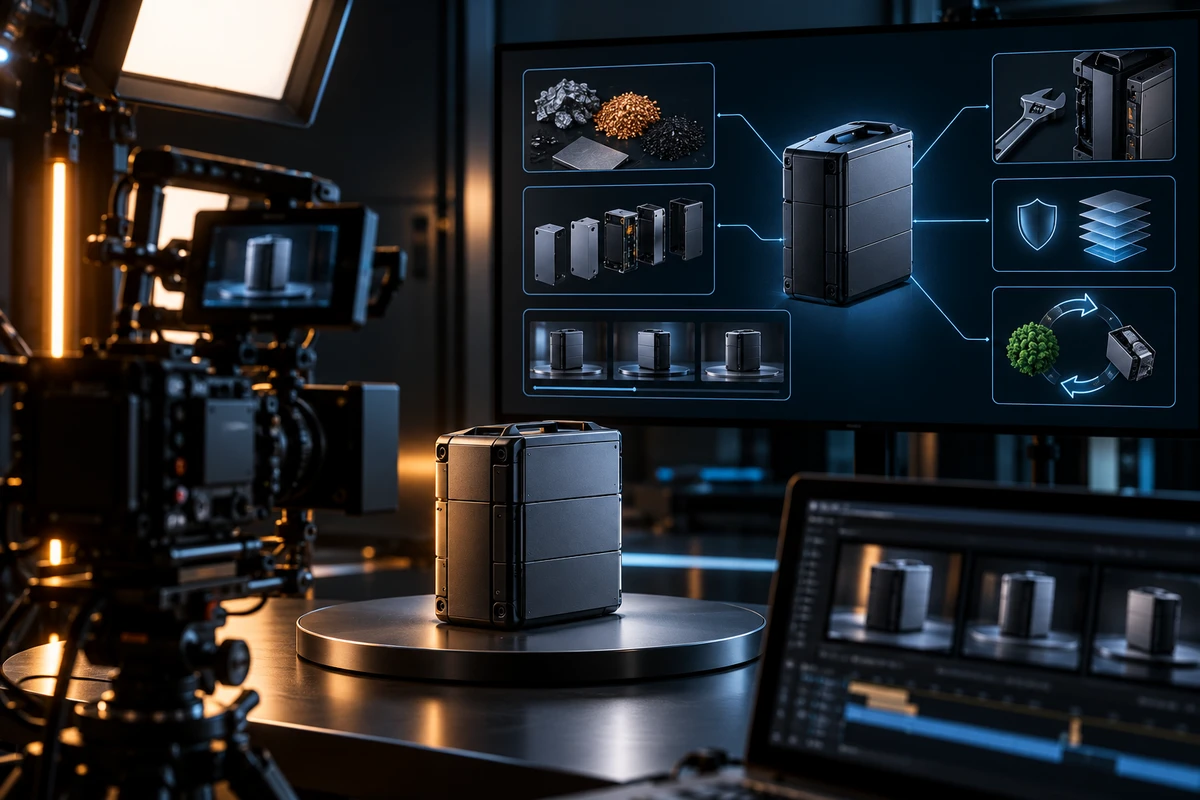
Imagine a finished video for an energy-storage product. It says the cells last longer, the enclosure contains recycled material, the unit is easier to repair, and a QR code appears in the final frame. Six months later, the production batch uses a different material supplier, the repair documentation changes, and the EU model is no longer identical to the version shown on screen. The video still looks correct. Its claims may no longer describe the same product record.
That is the content-production problem hidden inside the EU Digital Product Passport (DPP). A DPP does not turn every commercial into a compliance film, and it does not mean every product already needs a passport. The deeper change is that product information is moving from scattered copy, manuals and sales claims into data that can be checked and updated against a product identity. Every important video claim will increasingly need an answer to four questions: which product version, which source, which owner and which update trigger?
The infrastructure is live; obligations arrive product by product
The European Commission announced on July 20, 2026 that the DPP Registry and its testing environment were operational. The Registry stores unique identifiers and required registration metadata, while full product information remains decentralised with the economic operator or a service provider. Registration can be handled through a user interface or an API. The related standards cover identifiers, data carriers, APIs, exchange protocols, storage and interoperability.
Operational infrastructure does not make every product mandatory on the same date. The Commission's current DPP timeline identifies February 18, 2027 as the first clear mandatory date for certain large batteries. Textiles, aluminium, tyres, furniture, ICT products, energy-related products and other groups will follow through product-specific delegated acts or separate EU legislation. Exact data fields, granularity and dates depend on the rules applicable to each product.
For a manufacturer outside the EU, the first action is not to add a passport-shaped QR code to an ad. It is to confirm whether the product is in scope, which economic operator is responsible and when product identity and data need to connect. The Commission's guidance for economic operators says obligations apply to covered products placed on the EU market whether manufactured domestically or imported, and that DPPs must be accessible for distance selling where the applicable rules require them.
Why this becomes a production issue
A DPP may include composition, environmental impact, durability, repairability, safety, use, maintenance and end-of-life information. Those are also the subjects most likely to appear in product films—and most likely to drift as a product changes.
When a production brief says only “make it feel sustainable, durable and repairable,” a creative team can turn those words into attractive scenes without knowing the SKU, batch, test method or market variant behind them. Legal may remove a line during final review, but no one can reliably identify the old exports that need attention when the underlying product record changes later.
A DPP-aware video therefore does not need to show the passport interface. It needs a traceable relationship between creative claims and product data. That relationship reduces three common forms of waste: repeated script changes because no one knows what can be said; re-exports because changing numbers were burned into the picture; and old ads that remain live because the affected assets cannot be found.
ONCE LINK: give each claim a route back to the product
LINK is ONCE's four-column acceptance method for product-video briefs. It is not an EU standard and it is not legal advice. Its purpose is to let product, compliance, marketing and production teams work from the same factual base.
L — Link the product identity
Record the model, SKU, market, version and applicable batch. Also state whether the filmed unit is an appearance prototype, functional prototype or final production sample. If the final unit is not ready, use a sample-state production plan to separate safe appearance shots from functional claims that must wait for a production unit.
I — Index each claim
Assign an ID to every material claim in the script, captions, packaging close-ups, voice-over and visual implication. “Recycled material,” “replaceable components” and “longer life” are not one green theme. They are separate claims with separate conditions. A teardown, comparison or use scenario can imply a claim even when no words appear on screen.
N — Name the evidence owner
Connect every claim to a product-data field or evidence file and name the person or function that owns it. Supply chain may own composition data; engineering or quality may own performance testing; service may own repair information; compliance may approve environmental language. A production partner translates approved evidence into images. It should not invent the evidence.
K — Keep versions in sync
Define the events that trigger review: a material or supplier change, firmware and feature updates, certification expiry, a new market, a revised DPP field, or a packaging and data-carrier change. The ledger should work in reverse, showing every video, cutdown, subtitle and market export affected by the change.
Build the video in three layers
Durable evidence
Accurate product form, physical structure, approved use actions and stable visual proof can sit in the long-lived master. Capture clean product plates and versions without burned-in text so the evidence can be reused.
Updateable information
Model names, figures, material percentages, repair periods, certification status, QR codes, disclosures and language subtitles should remain separable where practical. This is not a promise that post-production can fix everything. It means a data change can replace only the affected element. A data carrier should enter the final delivery only when its destination, version and validity are known; pre-production uses a clearly marked placeholder.
Market expression
Hooks, settings, talent, music and pacing can change by market as long as they do not outrun the evidence layer. Creative work can make “repair information is available” understandable and memorable. It should not silently turn that fact into “this product will never become obsolete.”
Apply the same rule to AI-generated scenes. Generative tools can extend environments, rhythm or explanatory animation. If they alter product construction, materials, included accessories or use, the scene returns to the LINK sheet for review. Photorealism is not product evidence.
Add these deliverables to procurement
A DPP-ready video project does not need an enterprise data platform on day one. It should, however, deliver:
- a product identity and filmed-sample-state record;
- a claim-to-field-to-evidence-to-owner map;
- an indexed script and approval log;
- separable figures, subtitles, disclosures and data-carrier layers;
- model, market, language and approval date for every export;
- review triggers and an archive location for affected versions.
Compare workflows with a maintenance-aware cost model:
Fully loaded cost per maintainable claim module = (claim mapping + capture or generation + layered post-production + product and compliance review + language versions + update archive) ÷ claim modules that remain identifiable and independently updateable
This is not an industry benchmark and it does not predict legal implementation cost. It simply brings work that was previously hidden in revisions, re-exports and obsolete-asset cleanup back into the procurement decision.
A pilot that does not depend on final sector rules
Choose one EU-bound SKU with relatively mature product data and one active 15- to 30-second product video. Index every explicit and implied claim. Locate current evidence and an owner for each claim. Then separate the numbers, captions and data carrier from the picture master wherever practical.
Simulate one change: a material supplier, repair document or target market. The team should be able to answer within an hour which claims are affected, which versions should pause, which need only a layer replacement and which require a reshoot. If it cannot, the first gap is not missing DPP software. It is missing product identity and version relationships inside the content library.
The decision for brands
If a product is not near a relevant DPP milestone and the film is a one-time piece of brand expression, a complex data workflow may be unnecessary. If the product is approaching a defined requirement, spans many SKUs and markets, or changes frequently, claim mapping and version maintenance belong in the video brief now.
The long-term significance of the DPP is not another QR code in the end frame. It is a route from product storytelling back to product truth. The images can remain imaginative. Every claim about materials, performance, repair and environmental impact should still know which product it belongs to.
The European Commission's consumer guidance explains the types of information people may access through a passport. Product scope and exact obligations should always be checked against the latest sector-specific legislation and professional legal advice.