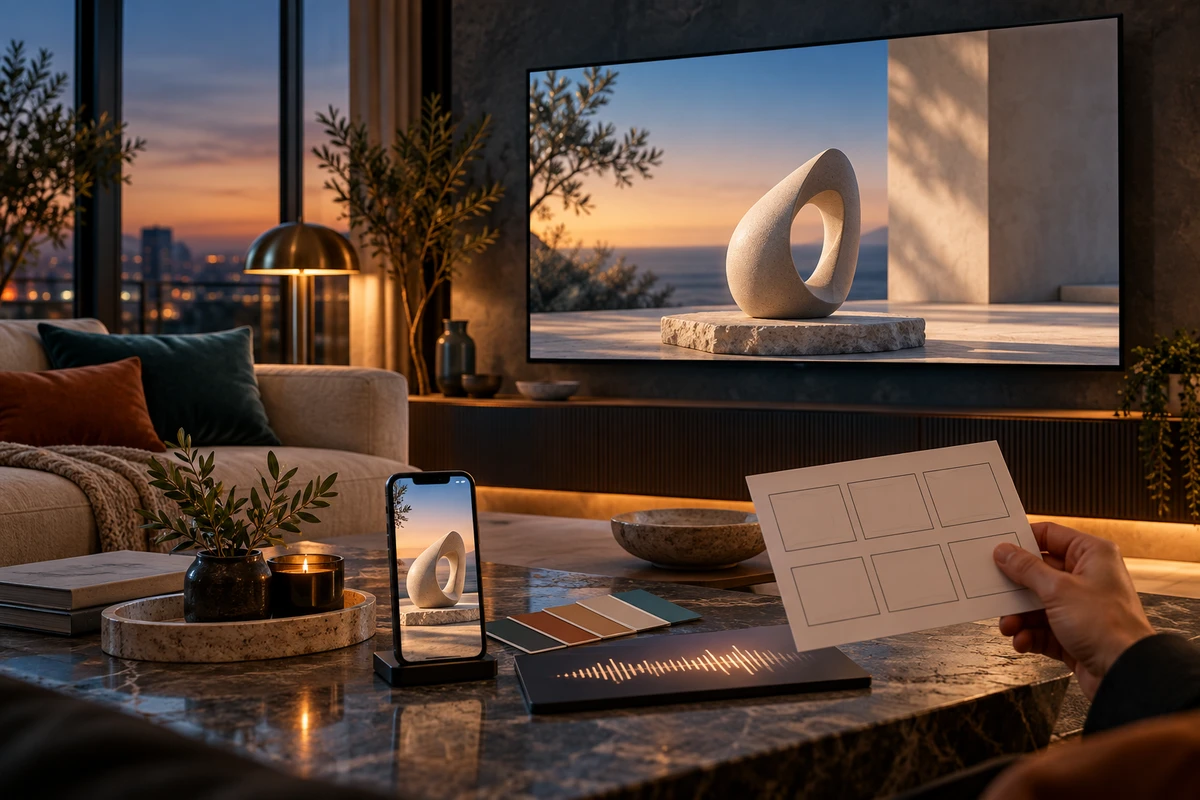
A product clip can look crisp on a phone and strangely weak on a television. The pack shot shrinks into a corner. The captions become unreadable from the sofa. The final two seconds ask viewers to tap a button that does not exist in a lean-back viewing experience.
That is not an aspect-ratio problem. It is a procurement problem. Social assets can be raw material for connected TV, but they are not automatically a television commercial.
Disney made that distinction newly important on July 23, 2026, when it announced a closed beta of Disney Ad Creative Studio for a select group of advertisers. The tool sits inside Disney Campaign Manager and uses existing logos, product imagery, brand guidelines and prior creative assets to produce CTV video. Advertisers can create variations, manage approvals and prepare campaigns for activation in one workflow. Disney's own quick-start guide narrows the current creative task further: it guides users toward a finished 15-second ad.
The strategic change is not that AI can make another kind of video. It is that the production entry point for streaming television is moving closer to the media-buying interface. A smaller advertiser that lacks a television spot may be able to start with the assets it already owns instead of commissioning a complete production before it can even test the channel.
But Disney is explicit that this is a closed beta, not a generally proven industry workflow. Its July announcement also says human creativity, strategy and oversight remain essential. The announcement establishes what Disney is testing. It does not establish that every brand library is ready for television or that generative CTV production has become standard practice across the market.
The platform can complete a scene. It cannot decide whether the product reads from the sofa.
Disney tells advertisers to inspect the storyboard before generation: Does each scene do the right narrative job? Do the people, places and products look accurate? Does the pacing feel right for the brand? Is there visual clutter that should be removed? Those questions expose the part of production that cannot be delegated to a model or a media platform.
Many teams connected to Chinese manufacturing and ecommerce have abundant product-page photography, factory clips, vertical UGC and marketplace videos. Those assets were built for close-range viewing, swipes, comments and clicks. CTV is a different room. The audience may be several metres from the screen, watching with other people, and unlikely to interrupt the programme to interact immediately. A product story has to survive distance, divided attention and a much larger canvas.
The technical handoff is different too. Disney's March 2026 short-form video specifications prefer 1920×1080 at 16:9, accept fixed durations including 15 and 30 seconds, and say skippable video is not accepted. The same document notes that most video commercials are not directly clickable, so button-like calls to action such as “Learn More” or “Buy Now” are not allowed, and Disney retains final approval of creative. Google’s current CTV creative guidance separately notes publisher-specific checks and prior approval for Disney+ inventory in its exchange workflow.
“Generated” is therefore a production status. It is not a clearance status, a rights status or a creative-quality judgment.
Build a Living-Room Entry Kit before choosing the tool
A brand does not need to select an AI vendor first. It needs an asset package that can pass five tests.
1. A product image that remains legible at distance
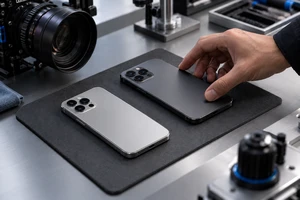
Provide at least one clean widescreen product hero shot or high-resolution product image in which the silhouette, important features and use action remain obvious from across a room. Fine-print PDP callouts and tightly cropped interface screens should not carry the central claim.
2. One story line that fits fifteen seconds
Reduce the brief to one audience, one friction, one proof and one memory cue. If the spot must explain five benefits, three personas and two offers, additional generated scenes will usually fragment the message rather than solve it. A complex product can choose one use case for television and leave deeper comparison to search, retail pages or follow-up content.
3. An ending that does not depend on a click
The audience should be able to remember the brand, the product category and the next action. URLs, QR codes and interactive elements must be assessed against the specific publisher format instead of copied from a social template. CTV can support interactive formats, but interactivity is not universal; the IAB Tech Lab's current CTV portfolio work exists precisely because connected-TV formats and signaling require standardisation.
4. Rights and claims that can withstand amplification
Likeness, voice, music, fonts, packaging, product claims and regional usage rights must cover the target market and media use. Large screens magnify visual errors; paid distribution magnifies unverified claims. Any generated person, scene or voice needs a documented source, permitted use and human review.
5. A launch package, not one MP4
Handoff should include the mezzanine master, required transcodes, captions and audio files, a rights manifest, the approved script and claim version, named approvers and a change log. If a publisher rejects a spot, the team can then isolate whether the cause is technical, creative, legal or factual instead of rebuilding the entire ad.
Three production routes belong in the brief
| Route | Use it when | What to buy | Do not use it when |
|---|---|---|---|
| In-platform generation | The proposition is simple; product assets are clean; a generated setting does not carry the proof | 15-second story design, structured brand inputs, generation, human review and publisher-ready delivery | Product geometry, regulated claims or performance need exact visual control |
| Hybrid pickup shoot | Existing social assets are useful, but the library lacks widescreen proof, clean product action or a strong end frame | A focused shoot for irreplaceable evidence, then platform or post-production versioning | The positioning is unresolved; additional footage cannot repair a confused proposition |
| Original brand film | The campaign must create a new brand memory, direct performance, stage a complex demonstration or build a long-lived hero asset | Strategy, script, casting, production design, live action, sound and cross-channel masters | The immediate goal is only to test one simple message with an adequate asset library |
The hybrid route is particularly valuable for overseas brands that rely on Chinese supply chains. The factory and commerce teams may already have hundreds of pack shots, unboxings and vertical creator clips, yet still lack three shots television needs: a clean widescreen hero, a truthful use action and an end frame with enough safe space for brand memory. Capturing those elements once can be more controllable than repeatedly prompting around missing evidence.
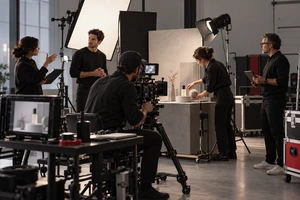
This also changes the production partner’s role. The valuable service is not simply exporting an accepted file. It is auditing the library, identifying the shots that cannot safely be synthesized, directing a compact pickup, building a rights-aware assembly and preparing the approval package. That is a different scope from either a full commercial shoot or a low-cost resize job.
Use approved spots—not generations—as the cost denominator
Generation makes attempts cheaper. It does not make every attempt usable. A practical cost model is:
Cost per qualified CTV spot = (asset preparation and pickups + 15-second story design + generation or post-production + rights and publisher review + exception fixes) ÷ spots approved by both brand and publisher
Track two supporting rates. First-pass approval is the share of versions that avoid structural rework after the first submission. Exception rate is the share that requires human correction because of product distortion, unreadable information, unclear rights, claim risk or publisher requirements. There is no honest universal benchmark for these rates; their value is in comparing one brand’s own batches and locating recurring failure.
If ten versions are generated and one is cleared, the denominator is one. If a focused product shoot supplies reusable proof for three markets, its value should not be charged only to the first export.
The useful first purchase is a living-room test
Disney Ad Creative Studio matters because it may let some advertisers test whether a product story works in a 15-second living-room environment before funding a full hero film. That is a meaningful procurement option, not a verdict that original production is obsolete.
Use in-platform generation when the proposition and assets are already television-ready. Choose a hybrid pickup when authentic proof exists but the library was framed for ecommerce and social. Commission original production when the brand needs new meaning, controlled performance or complex demonstration.
The entry barrier is falling. The quality of the decision should not fall with it. Getting a file into a CTV platform is not the same as getting a product story into the living room.
Scope note: This analysis draws on Disney's July 23, 2026 closed-beta announcement and quick-start guide, Disney Advertising's short-form video specifications updated March 5, 2026, Google Display & Video 360 guidance, and IAB Tech Lab's CTV portfolio materials updated July 22, 2026. The production routes, Living-Room Entry Kit and cost model are ONCE analysis, not performance claims by those organisations. For a related production decision across display, video and audio, see ONCE's multi-format product-film framework.