When a brand first discusses combining virtual environments with live-action production, the conversation often starts with the background: How tall should the plants be? How far should the city extend? What color should the sky become? Yet the part that makes the image believable is usually much closer—the small area beneath the performer, around the hands, and beside the product.
This article makes one direct recommendation: build a “minimum practical island” before deciding how the world will extend. The minimum practical island is the foreground that must physically carry, touch, occlude, shadow, illuminate, or reflect the performer and product at close range. It may be no more than a platform, a tabletop, several foreground props, and controlled practical light. But it carries most of the visual evidence that tells the viewer these elements occupy the same world.
This method does not mean every project needs an LED volume, nor that generative imagery belongs only in the background. It addresses an earlier decision: which relationships become unconvincing when simulated poorly, no matter how beautiful the final environment looks?
Viewers believe the contact before they believe the world
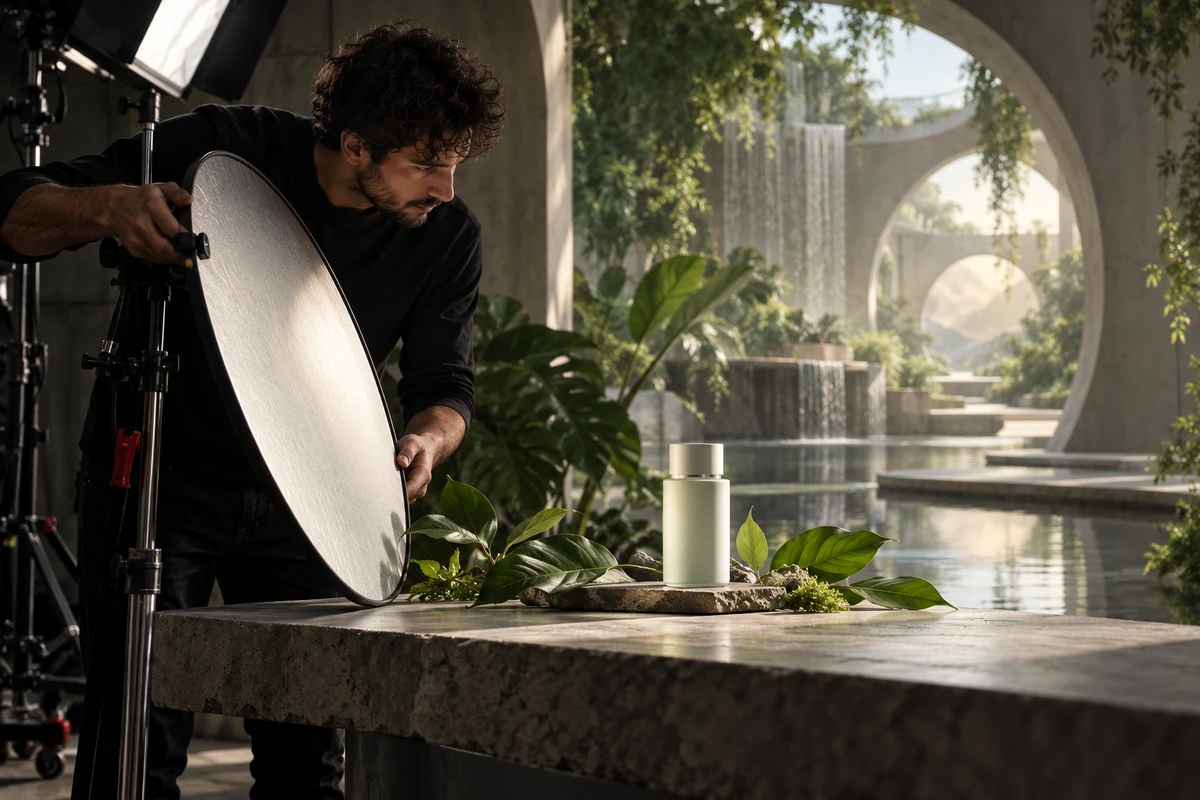
Imagine a haircare commercial. A performer lifts a bottle inside a vast botanical atrium, an arm passes through foreground leaves, and a moving green highlight travels across the package. The distant architecture might come from a real-time engine, offline CGI, or generative extension. But the pressure of the fingers on the bottle, the moment its base leaves the surface, the leaf that crosses the wrist, and the scene reflected in the package are all close-range physical relationships.
When those relationships fail, the problem does not always look like an obvious visual-effects error. The product may simply feel weightless, material-free, or disconnected, and the performance may feel directed at empty space. A viewer may not identify the cause, but the image loses credibility.
Instead of dividing a shot only into foreground and background—or live action and AI—begin with four relationship checks:
- Load and contact: Where do the feet land? What does the hand grip? Which surface supports the product? Should soft materials compress?
- Occlusion and interpenetration: How do hair, clothing, transparent materials, leaves, and props cross one another? Do their edges change naturally through the action?
- Reflection and transmission: What should appear in metal, glass, glossy packaging, and screens? Does environmental light actually affect the product and skin?
- Parallax and camera movement: During a truck, push-in, or orbit, do the near, middle, and far layers move consistently with the lens and camera position?
If a shot activates two or three of these relationships, it is not merely a “background replacement.” Production needs to decide which physical evidence should remain practical and which space may be extended.
The practical island is derived from the shot
The same creative idea can require a different practical boundary in every shot.
A locked medium or close shot
If a performer demonstrates a product at a table and the camera remains mostly fixed, the minimum practical island may include only the tabletop, chair, performer, product, contact props, and nearby light sources. The distant space can be produced through green-screen compositing, a pre-rendered plate, or generative extension. The goal is not to fill the studio. It is to keep the hand, product, surface, and shadow inside one physical system.
A visible lateral move or orbit
Once the camera moves, a flat background can reveal itself quickly. A real-time scene paired with camera tracking can update perspective from the camera position. An LED workflow can present the camera with an inner-frustum image rendered for that view. Epic Games describes in-camera VFX in Unreal Engine 5.8 as a combination of LED lighting, live camera tracking, real-time rendering, and off-axis projection. Its ICVFX overview explains how the inner frustum tracks with the physical camera to create parallax, while the outer frustum can act as a dynamic light and reflection source.
That is one production route, not a rule that every moving shot needs an LED wall. If the move is small, depth of field is shallow, and the background has few geometric cues, a pre-rendered plate may be sufficient. If the camera orbits a reflective product, tracking, lens calibration, and environmental reflections become much more important. The relationships in the shot should select the technology—not the other way around.
Reflective, transparent, or screen-based products
These products carry the surrounding space into the bottle, metal frame, glass, or display. Expanding the practical island is often more controllable than repairing the image frame by frame. The production can retain a real surface, reflection cards, nearby props, and controlled light, or use the LED outer frustum to introduce environmental color and moving reflections consistent with the virtual world.
LED stages still impose conditions: moiré, color shifts, screen angle, shooting distance, synchronization, and real-time performance. Epic’s ICVFX best-practices guide explicitly notes that content that performs acceptably on an artist workstation may not remain stable in an nDisplay stage configuration. Target-hardware and on-stage tests are still required. Equipment does not replace previs.
Make a relationship map before choosing LED, green screen, CGI, or AIGC
Rather than writing only “live action plus AI” beside a storyboard frame, add a relationship map. Each shot should mark at least five items:
| Relationship | Question | Typical treatment |
|---|---|---|
| Contact | What touches what, and where is the load? | Practical subject and support surface |
| Occlusion | Which edges cross frequently? | Practical foreground, controlled occluder, or detailed matte |
| Reflection | What nearby space appears in the product? | Practical reflectors, LED environment, or tracked reflection plan |
| Movement | How do camera, lens, and depth change? | Tracked real-time scene, plate, or offline composite |
| Versioning | What will a vertical crop expose? | Larger safe area or a dedicated composition |
The map does not lock the team into one technique. It lets directing, cinematography, art, virtual production, and post see the same risk. “The performer parts a leaf” sounds like a simple action note. On the map, it activates contact, occlusion, shadow, and perhaps reflection. If the leaf exists only in a generated layer, post must rebuild finger pressure, leaf rebound, and changing edge intersections. Keeping a few foreground leaves inside the practical island may be simpler.
Product facts and asset provenance still require their own review. ONCE’s guide to defining live-action and AIGC boundaries in storyboards addresses production-layer assignment; this article narrows the decision further to the physical relationships inside an individual shot.
A hypothetical haircare scene
The following is a method demonstration, not an ONCE client project, and it contains no performance result.
Suppose a brand wants a haircare commercial in which a performer stands inside an oversized botanical atrium, lifts a bottle from a shallow water surface, and reveals distant architecture through mist. Starting with the “large background” might lead the team to generate the entire atrium first and then insert the performer and product. Starting with the minimum practical island produces a different division:
- Practical island: performer, product, forearm contact area, shallow-water surface, several leaves crossing the lens, reflection cards near the product, and key and fill light.
- Virtual extension: distant architecture, oversized plants, sky, mist, and impossible spatial depth.
- Boundaries to previs: whether the water continues into the virtual space; whether leaves cross between practical and generated layers; whether architectural parallax matches during the push-in; and whether the bottle reflects unintended studio equipment.
- Fallback: if a liquid macro and package highlights remain unstable in LED or compositing tests, capture the product macro as a separate practical shot and connect it through editing and sound instead of forcing a single continuous take.
This division does not automatically reduce cost. It can add early testing. Its value is making uncertainty visible before the set build and principal photography, so the brand can decide which relationships deserve physical fidelity and which spaces can be virtual.
ONCE’s public AIGC video portfolio shows how concept environments can establish scale and narrative action. Those pages are useful for observing visual organization, but they do not disclose hybrid-production parameters and should not be treated as evidence that this method produced a specific result.
Light and color are part of the boundary
A virtual background and a live subject often separate first in the product highlights and skin tones. The set must answer three questions. Does the key-light direction in the virtual world actually reach the performer and product? Does a glossy surface reflect the intended environment or stray studio objects? Are live action, real-time rendering, compositing, and grading operating inside a documented color pipeline?
The value of the LED outer frustum is that it can bring part of the virtual environment’s light and reflection onto the live subject. Even with LED, the final image should be judged through the production camera, and the panels should be tested as a light source against skin and product materials. A non-LED route should still record lens, camera position, light position, exposure, color temperature, and reference images so post has a stable comparison.
ACES or OpenColorIO cannot repair poor lighting design. Color management can, however, reduce ambiguity when the same image moves among capture, rendering, compositing, displays, and delivery. Its role is to make the pipeline interpretable, not to make every source match automatically.
Review relationships in motion, not just beautiful stills
Hybrid shots often pass a single-frame review. A still can conceal changing contact, tracking drift, and delayed reflections. Boundary failures tend to appear before, during, and after the action.
A useful review includes:
- pause where a hand reaches the product, a foot lands, or a foreground object crosses the performer, and inspect contact points and occlusion edges;
- watch at normal speed and half speed to compare shadow, reflection, and motion blur timing;
- for a moving camera, inspect parallax at the beginning, middle, and end—not only the hero frame;
- watch once without sound so music cannot mask an implausible action;
- review horizontal, vertical, and crop variants to ensure the new frame does not expose the virtual boundary; and
- retain clean plates, mattes, tracking data, light references, and approved virtual-scene versions so a failed treatment can be rolled back.
The acceptance question is not simply, “Can we tell that AI was used?” It is, “Which physical relationships does the viewer use to understand the product and action, and are those relationships continuous, accurate, and reviewable?”
When a virtual environment is the wrong choice
If the image derives its value from a real location, a real process, a regulated functional demonstration, or complex unpredictable liquid, transparency, and crowd interaction, fully practical production, traditional CGI, or a more conservative hybrid may be more reliable. If the schedule does not permit asset tests, lens calibration, stage previs, and a composite proof, virtual production is not necessarily the faster route.
Similarly, a generative environment may be appropriate for expanding a concept without being appropriate for product dimensions, materials, structure, or functional evidence. The world can be imaginative; product facts must remain verifiable.
Conclusion: spend on what the viewer must believe
The first drawing for a live-action and virtual-environment project should not be a vast background concept. It should be a close-range relationship map: where the feet land, what the hand touches, what the product reflects, which object crosses another, and how the camera moves.
Build a minimum practical island around those relationships, then select LED, green screen, real-time rendering, offline CGI, or AIGC. The technology can then serve the shot instead of forcing the shot to repair the technology. The island may be small, but it must carry the evidence of reality.
If you are evaluating a hybrid commercial, start with ONCE’s AIGC commercial and live-action hybrid production service. Bring the storyboard, product facts, planned camera moves, and delivery versions; the first useful decision is which contact relationships deserve to remain physically real.