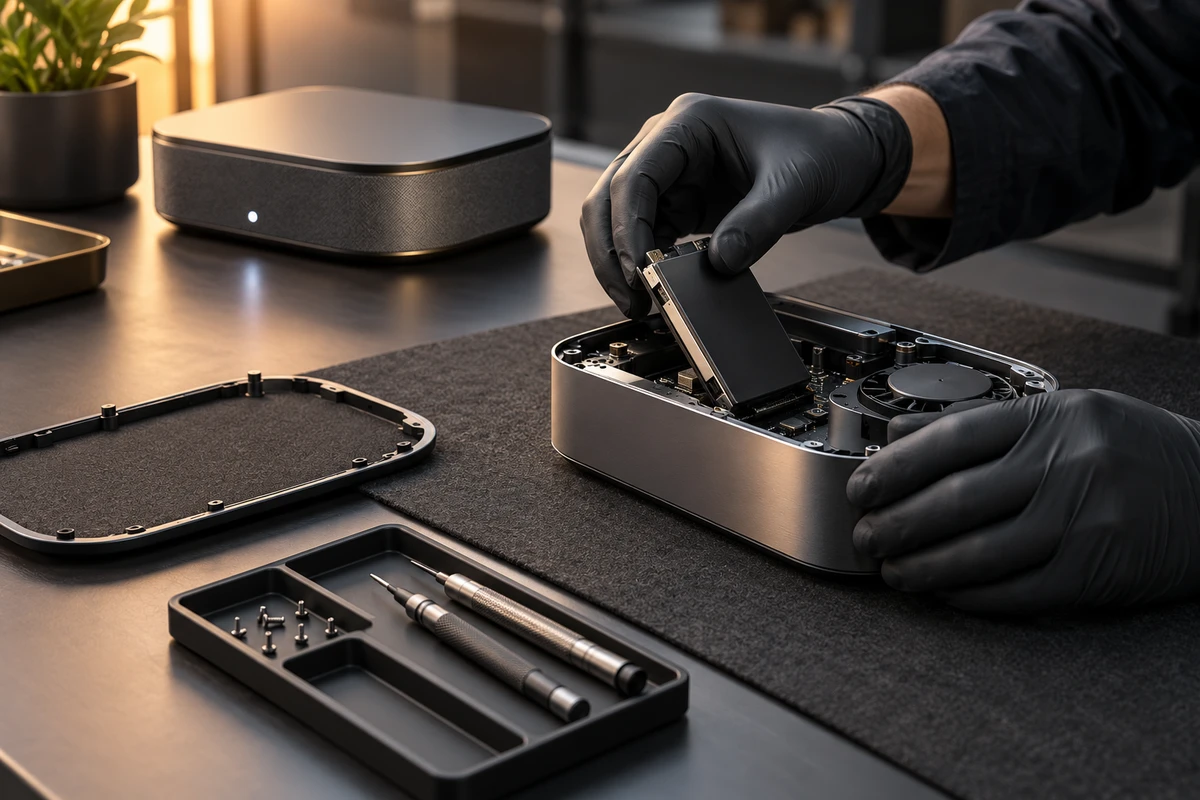
A launch shoot usually ends when the product looks finished: clean surfaces, hero angles, feature demonstrations, packaging. For hardware brands selling into Europe, that stopping point is now too early.
If a product falls within the EU’s existing repairability requirements, the launch shoot should also capture how the product is accessed, which part is replaced, what order the work follows, and how the unit is tested afterwards. The goal is not a glossy “repair campaign.” It is to create service footage while the right sample, engineer, tools and controlled set are already in the same room.
What changed — and what did not
On 31 July 2026, the European Commission described the start of new consumer repair rights covering household and electronic products such as washing machines, vacuum cleaners, phones and tablets. Its notice says consumers can request repair of products that are technically repairable under EU law, with repair carried out free of charge or at a reasonable price and within a reasonable period. The Commission also highlighted a minimum 12-month extension of the legal guarantee when repair is chosen instead of replacement within the seller-liability period. The official summary is available in Right to repair: New consumer rights for easy and attractive repairs.
The scope needs precision. The consolidated text of Directive (EU) 2024/1799 says the main obligations in Articles 5 and 6 apply only to goods for which EU acts listed in Annex II already provide repairability requirements, and only to the relevant extent. For covered goods, the manufacturer’s obligation can pass to an authorised representative, importer or distributor when the manufacturer is outside the EU. The directive also addresses reasonably priced spare parts and tools, indicative prices for typical repairs, and unjustified contractual, hardware or software barriers to repair.
The directive does not require a repair video. The production implication is ONCE’s analysis: once repair responsibilities and information become more visible, brands need a consistent way to explain the same service path to consumers, importers, repairers, support teams and internal reviewers.
Before commissioning content, legal, product and service owners should confirm the exact SKU, component, member state and applicable product rules. This article is a production method, not legal advice.
The ONCE Four-Shot Service Proof Pack
Work backward from the moment a repaired unit must return to service. A useful sequence must show more than disassembly; it must connect access, identification, action and verification.
Shot 1: Access
Show the actual service entry point: cover, fastener, connector, latch or seal, plus the tool required to open it. Frame the safety boundary as carefully as the mechanism. A consumer-safe operation, an authorised-service task and a high-risk operation should not look interchangeable.
Shot 2: Part identity
Use overhead and macro coverage to establish the replacement part’s shape, orientation, connection and installed position. Product version, part number and compatibility should come from controlled technical records. Do not turn a visually similar component into a claim of universal compatibility.
Shot 3: Procedure
Record the steps in correct order, including actions that are easy to lose in an edit: disconnecting power, releasing a hidden tab, applying a specified torque, restoring a seal, discharging a component or running calibration. A marketing cut may be short. The service master should not create a magical jump between “open” and “fixed.”
Shot 4: Retest
End with the acceptance test defined by engineering: functional check, leak test, self-test, calibration or another product-specific verification. Reassembly is not the end state. A visible retest gives support agents and repair partners a shared definition of “returned to service.”
One capture day, three output layers
The complete footage does not have to become public content. Plan three controlled layers:
- Consumer layer: explains repair options, booking routes and safety limits without encouraging unsafe self-service;
- Service layer: supports authorised partners, remote diagnosis or repair training with complete steps and retest criteria;
- Internal layer: keeps original footage, product revision, part version, shoot date, market scope and reviewer approvals for future updates.
All three layers use the same underlying facts but not the same disclosure. Public clarity does not require publishing trade secrets, high-risk procedures or unapproved engineering data.
Budget the increment, not a separate film
A practical procurement model is:
Repair-content increment = teardown samples and consumables + service-engineer time + macro/overhead camera and lighting + localisation and legal review − avoided reshoots and duplicated training production.
This is a decision model, not a promise of savings. The increment is usually easier to justify when the product design is near production lock, the service route is stable, and the same footage has genuine use across markets or teams. If the hardware revision is still moving or repair instructions are not approved, filming more can simply preserve the wrong process at higher resolution.
Use three gates before adding the shots
- Scope gate: Is this exact SKU and relevant component covered by an EU repairability requirement?
- Stability gate: Are the approved tools, parts, procedure, safety limits and retest criteria frozen?
- Reuse gate: Will the footage serve at least two real destinations — support, service portal, training, sales enablement or consumer education?
If all three gates pass, add the Four-Shot Service Proof Pack to the first product shoot. If scope is uncertain, confirm the legal and product position first. If the procedure is unstable, reserve the storyboard and capture interface but delay the final demonstration. If only reuse fails, treat the footage as an explicit cost choice rather than shooting “extra coverage” without an owner.
For brands coordinating samples and production in China, ONCE’s ecommerce product video production service can be briefed with five inputs from the start: target market, SKU revision, repair-responsibility owner, disclosure limits and retest standard. Right to repair does not turn every launch film into a manual. It does change which proof is expensive to recreate after the product has shipped.
Primary sources
- European Commission, “Right to repair: New consumer rights for easy and attractive repairs,” 31 July 2026.
- EUR-Lex, Directive (EU) 2024/1799, consolidated version current on 31 July 2026, especially Articles 1, 5, 15 and 16 and Annex II.