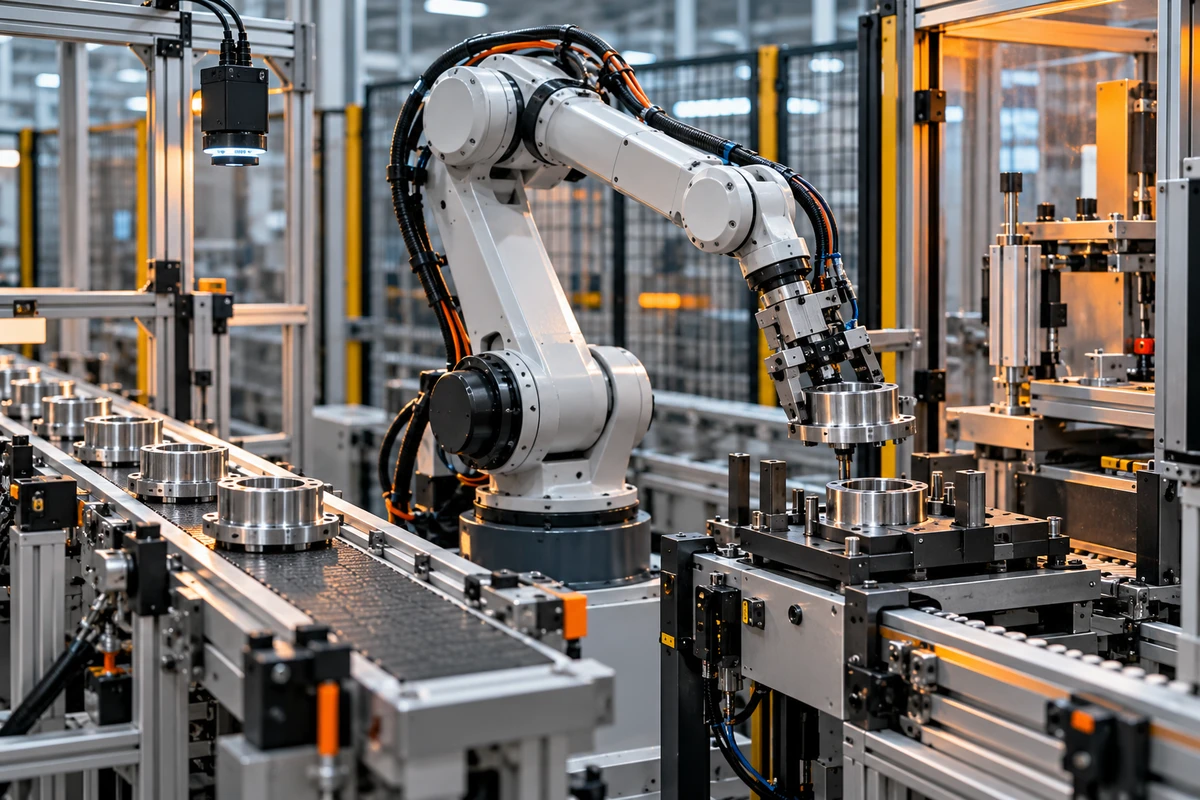
A robot arm completing a pick-and-place move in one second does not mean the line produces one good part per second. Line takt also includes part arrival, vision checks, safety interlocks, fixture motion, upstream and downstream release, abnormal waits, and return to ready. Filming only the fastest movement creates energy, but hides the line coordination a buyer actually needs to judge.
A more useful industrial robot video aligns three timelines within the same cycle: robot motion, workpiece flow, and control handoffs. Capture all three in one readable continuous master shot, then use close-ups to explain precision, payload, and changeover conditions. The result can still feel fast while answering a more important question: under what conditions is that speed true?
Separate robot cycle, station cycle, and line takt
Robot cycle time covers a defined sequence of robot movements. Station cycle adds fixtures, vision, process steps, and safety conditions. Line takt depends on the slowest constraint across upstream feeding, the current station, and downstream acceptance. The three may be close, but they should never be assumed to be identical.
DENSO WAVE's HSR technical story explicitly distinguishes cycles per minute from maximum instantaneous speed, and discusses vibration control, continuous operation, and conveyor tracking. Yamaha's controller documentation notes that acceleration set too high can shorten machine service life, while a setting that is too low reduces tact time; it also says acceleration and deceleration are optimized according to payload. Neither source proves a result for a specific production line. Together, they show why top speed is one shot and sustained output is another claim.
Before filming, do not ask engineering only for the fastest possible move. Ask whether the quoted time covers a single move, a continuous cycle, or line output; what payload and end effector are present; whether signal waits are included; and whether the cycle contains rejects or recovery.
How to film three synchronized timelines
The three timelines are not separate storyboards. They are three readings of the same production cycle.
| Timeline | What must be visible | Useful shot |
|---|---|---|
| Robot motion | Start, approach, grip, transfer, process or place, return to ready | One uninterrupted wide master plus end-effector close-ups |
| Workpiece flow | Upstream arrival, location, pickup, release, movement into the next station | Side or overhead relationship shot that keeps the part in view |
| Control handoff | Upstream ready, safety clear, vision result, robot complete, downstream accepted | Approved control-panel or indicator details, limited to public fields |
Protect cycle completeness before collecting beauty shots. If the edit cuts to a macro shot when the gripper closes and resumes only after the part appears downstream, viewers see the outcome but cannot tell whether a wait, retry, or manual correction occurred in between. Keep one continuous master shot, then collect close-ups under the same operating conditions. The campaign edit can move quickly; the technical and sales edits should preserve the uninterrupted segment.
Control handoffs do not require exposing PLC code, customer data, or confidential screens. The product team can pre-approve public fields such as part present, vision pass, and downstream release. When a live interface cannot be shown, use an approved simplified status graphic and label it as explanatory graphics rather than presenting it as a real-time system display.
Slow motion does not prove precision
Accuracy, pose repeatability, and path performance are often compressed into the single marketing word precise. ISO 9283 is the international standard for performance criteria and related test methods for manipulating industrial robots; the 1998 edition was reviewed and confirmed in 2021 and remains current. A video may cite an approved product specification, but one attractive placement shot is not a test result.
To make precision legible, first define the claim:
- For repeatability, retain repeated arrivals at the same fixture or measurement point and state the measurement conditions.
- For path performance, show the continuous path, process result, or gauge output instead of only the endpoint.
- For assembly quality, connect the pass result, torque, vision, or dimensional output to the corresponding part.
- For brand communication only, use bounded language such as stable motion or compact path instead of implying a measured result.
The frame should include both a reference and an outcome. A compelling macro shot can explain how a gripper meets the part, while the actual support for a claim may be the fixture datum, measurement output, first-piece approval, or a run of accepted parts. They do not need to occupy one frame, but they should belong to the same narrative chain.
Payload includes the tool, cabling, and reach condition
A 5 kg payload demonstration that accounts only for a 5 kg workpiece may omit the gripper, suction system, tool changer, sensors, and dress pack. Total moving mass, inertia, pose, and reach can all affect available acceleration and cycle time.
Place a condition card beside every cycle-time claim: robot model, end effector, workpiece, total payload, relevant reach, continuous or single cycle, and the start and end signals used for timing. A catalog cycle time should remain attached to its test payload and motion conditions, not be lifted out as a line-output promise.
Use two levels of detail. The main film can show the conditions a buyer needs to understand, while a technical appendix records tool and workpiece components, pose, and program version. This keeps the hero film readable and gives sales teams a reliable answer when a buyer asks what was actually moving.
Line coordination happens at the handoffs
Industrial robots rarely deliver commercial value alone. They wait for conveyors, vision, machine tools, fixtures, packaging, or warehouse systems. In Oriental Motor's robot and conveyor demo, a successful gripper action produces a confirmation signal; if the expected signal does not appear, the programmed operation stops. That signal is not cinematic, but it is central to proving that coordination exists.
The film does not need to list every I/O point, but it should preserve at least one complete handoff: upstream delivers the part, the station verifies its conditions, the robot completes its work, and downstream accepts the result. If the conveyor remains in motion, state whether conveyor tracking is involved. DENSO WAVE describes conveyor tracking as the robot moving in concert with conveyor motion, rather than assuming that each part stops at an identical static point.
Do not remove a designed wait merely because it looks slow. Do not let a commissioning delay, temporary stop, or misconfiguration represent stable production either. In the shot log, classify each pause as designed wait, upstream wait, abnormal wait, or human stop, then decide whether it belongs in the hero edit, the evidence edit, or nowhere.
High-mix lines need a changeover and recovery segment
If flexibility matters to the buyer, repeating the same part is not enough. Add a transition from product A to product B: select the recipe, change the tool or fixture, adjust vision or workholding, complete the safety check, run the first piece, and show its release. Changeover does not have to occupy a 60-second hero film, but it should exist as a separate sales asset or acceptance segment.
This prevents another common misunderstanding. A robot controller may call a new program quickly, while feeding, tooling, inspection, packaging, and traceability each require their own preparation. Showing those dependencies helps buyers decide whether the solution fits their actual product mix.
Choose live action, CGI, or a hybrid by the claim
Real takt, waits, handoffs, and part outcomes should come from real equipment running a locked version. CGI is better for guarded interiors, impossible camera positions, work envelopes, end-effector structure, and signal relationships. AIGC can support mood boards, previs, and conceptual transitions, but should not generate product-performance evidence.
Industrial animation case studies often use CAD to isolate joints, reveal internal structures, and move from a single component to the full cell. This is useful before the machine is complete or when production access is impossible. Once a film claims real output, return to a continuous live cycle and recorded conditions. A sound hybrid rule is simple: CGI explains why the system moves this way; live action shows that it does so under the stated conditions.
For a broader method covering space, people, and equipment relationships, see ONCE's product-feature video guide. The same principle applies here: connect each feature to a visible action and consequence rather than leaving it as a floating label.
Six questions before release
- Does the time shown describe robot motion, station cycle, or line takt?
- Are payload, end effector, reach, and timing signals stated?
- Is there one complete cycle without a hidden jump cut?
- Does each precision statement point to a specification, measured result, or bounded visual description?
- Are upstream arrival, station completion, and downstream acceptance part of one logical chain?
- For high-mix production, are changeover, recovery, and first-piece approval visible somewhere in the deliverables?
If two of these questions cannot be answered, do not solve the problem with another speed ramp or caption. Return to the shot plan and add the missing conditions. The most useful industrial robot video does not merely make a movement look faster. It shows where speed begins, where waiting interrupts it, and how the motion becomes sustainable production output.
If you are preparing a video for an industrial robot, machine-vision system, or automation cell, share the equipment model, process flow, upstream and downstream interfaces, publishable parameters, and the three capabilities the film must prove with ONCE. We will define the three timelines and condition cards before deciding what should be filmed live, explained with CGI, or retained only in the technical appendix.