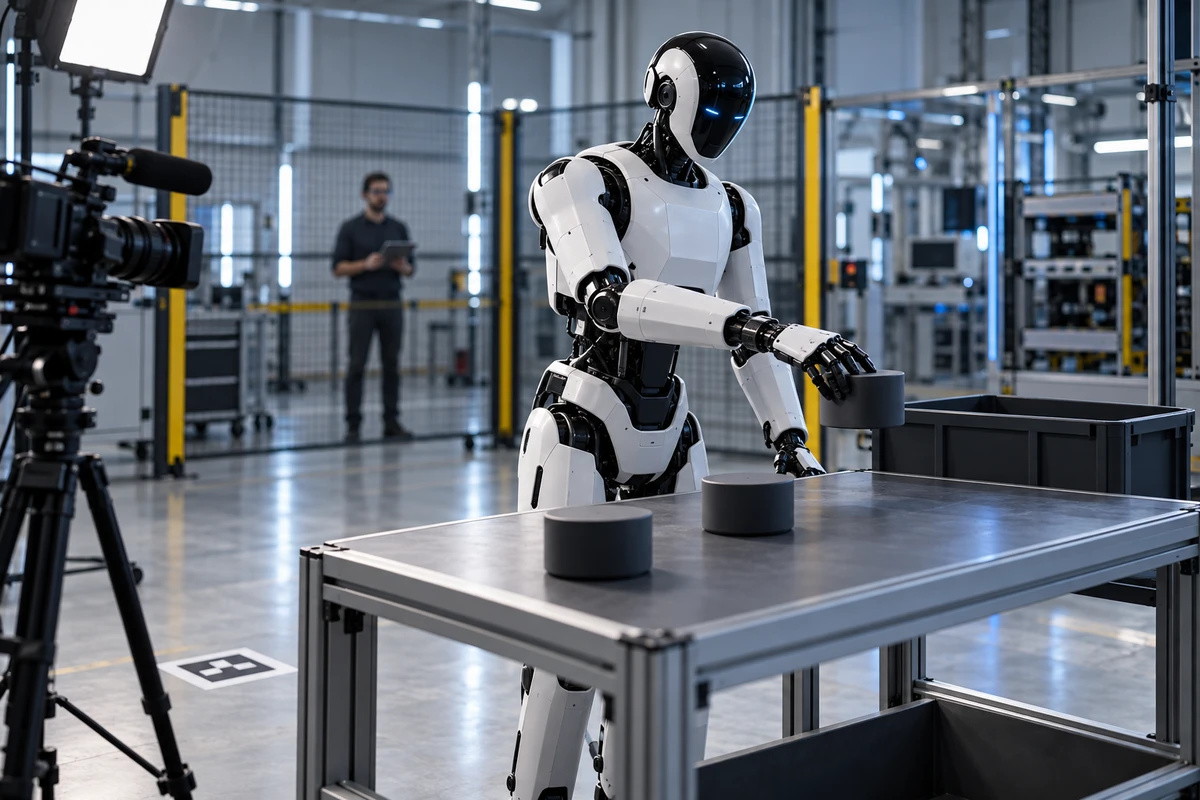
Imagine recording twelve takes on set. Take seven is the cleanest: the robot grasps the object on the first attempt, turns, walks and places it without a pause. The editor compresses the sequence into eight seconds and adds two close-ups of the joints. It looks excellent.
A buyer will still ask different questions. Can it do the same thing on the next run? What happens if the object moves slightly? After a failure, does the robot recover, or does a crew member step in and rebuild the scene?
The biggest risk in a humanoid robot video is not editing. It is asking one selected success to prove more than it can. A campaign film should have pace, but a product that needs to communicate stability to customers, investors or partners also needs a second layer of evidence: the first run, a repeat under the same conditions and another run after a reset, with control mode and human intervention logged.
One success proves that the task happened at least once
A robot video is not a laboratory report, and a brand film should not pretend to be one. However, test design offers a useful principle: isolate the capability being discussed and observe it repeatedly under comparable conditions.
NIST's standard robot test methods describe objective measures, repeatable procedures, continuous repetitions and fault logging. That framework does not certify a marketing film. It does clarify the evidence ladder. A complete run may support the claim that a robot can perform a task. A stability claim needs repeat runs. A claim about sustained field work also needs evidence about reset, recovery, maintenance and the human operator's role.
Official product demonstrations increasingly define those boundaries. Figure describes a Helix 02 demonstration as a continuous four-minute task using onboard sensors with no human intervention. Boston Dynamics describes an Atlas task as part sequencing in automotive manufacturing. One statement defines continuity and control; the other defines the task. Both are more useful to a buyer than a broad claim that embodied intelligence has arrived.
The three-run shooting method
Three runs are not an industry-standard sample size, and they do not replace success-rate testing. This is a minimum production method for preserving three different kinds of information instead of selecting the best moment from a dozen attempts.
Run one: preserve the first execution
Begin from the agreed initial state. Once the robot, object, workstation, lighting and safety equipment are ready, record a complete master angle. Do not move the object immediately because the motion looks hesitant, and do not skip waiting time to improve the rhythm.
This run shows how the system enters the task for the first time under the approved conditions, how far it gets and where it pauses. It may never appear in the campaign edit, but it becomes the baseline for deciding whether a later run is genuinely comparable.
Run two: repeat without quietly changing the hard part
Keep the object, position, instruction and control mode as consistent as possible. If the team changes a battery, recalibrates the system, edits a script, adjusts a grasp point or moves a fixture, the take is no longer a same-condition repeat. Log it as a new condition.
Continue recording the full process from the master angle, then add side, overhead and joint details. These beauty shots explain the action; they do not replace the complete run. The campaign film can cross-cut the views, while the evidence cut should preserve the visible relationship between the start and end of the task.
Run three: reset, then show the cost of recovery
Before the third run, apply the agreed reset: return the object to its start point, bring the robot to its safe posture, restore the workstation and trigger the task again. The goal is not to pretend that no reset happened. The goal is to record who performed it, what changed and how long it took.
If the robot detects an error and retries on its own, let the master camera capture that recovery. If a crew member must upright the robot, reposition an object, recharge it or recalibrate it, record that too. Human work is normal in engineering. Hiding it is what pushes a marketing claim beyond the evidence.
| Run | Conditions to hold | Changes to log | Question it answers |
|---|---|---|---|
| First execution | Initial workstation, instruction, control mode | Start delay, pauses, incomplete steps | How does it perform on the first approved setup? |
| Same-condition repeat | Object, position, task and operator rules | Any hardware, script or calibration change | Can it complete the same task again? |
| Post-reset run | Reset standard and trigger method | Uprighting, repositioning, charging, calibration | How does the next cycle become ready? |
Add an intervention track to every take
A shot log normally records the camera, lens and file name. A robot production should add two more fields: what controlled the action, and what human intervention occurred during the take.
Separate preset scripts, teleoperation, autonomous policy and shared control. Teleoperation is not automatically a deception. It can be a legitimate method for training-data collection, remote work or safety takeover. The real issue is whether its role in the footage is disclosed. An Association for Advancing Automation analysis reaches the same practical conclusion: context and transparency matter.
The intervention track can be simple: time, operator action, reason, whether the task condition changed and whether the next take must start a new run. “00:37: crew uprights the tipped bin; scene changed; next take starts a new run” is more useful than “minor adjustment on set.”
This record protects both engineering and marketing teams. Engineers can see that assisted actions will not be presented as autonomous capability. Marketers can decide which footage belongs in the campaign film and which belongs in a behind-the-scenes piece, technical appendix or sales demonstration.
The campaign edit and the evidence cut have different jobs
A launch film or social video needs rhythm, emotion and product texture. It does not need to show every pause and reset. Credibility does not mean turning all the footage into one long take. It means separating the communication edit from the supporting evidence.
A useful delivery set contains four items:
- Campaign film: builds the story around application value and can use multiple angles and rhythmic editing without creating claims beyond the footage.
- Continuous evidence cut: preserves the start, finish, timing and control disclosure for a key task, with one to three uncut runs where relevant.
- Shot log: connects source files with robot version, task conditions, control mode, intervention and reset.
- Acceptance sheet: maps every intended claim to visible evidence, applicable conditions and conclusions the footage does not support.
If you are still comparing production approaches, our article on showing product features clearly in an ecommerce video explains how to turn claims into visible actions. For broader production planning, visit the ONCE VISUAL English site.
When a brand film does not need to become a test report
If the purpose is to introduce industrial design, a team vision or a concept direction, there is no reason to force a repeatability claim into the film. An early research prototype can also be filmed honestly when it is described as an engineering demonstration rather than stable deployment.
If teleoperation is part of the product itself, do not hide the operator. Show the relationship between the remote console, takeover trigger and robot on site. The real value may be low-latency control, risk separation or human-robot collaboration, not zero-human autonomy.
If the project needs to compare success rates, operating duration or fault recovery, the three-run method is not enough. Product and test teams must define sample size, success criteria, environmental distribution and statistical method. The production team's job is to make that process visible, not to create the technical conclusion.
Replace one vague line in the call sheet with four questions
Do not write only “show the robot completing the task reliably” in the PPM or call sheet. Replace it with four questions: Where does the task start and what counts as complete? What is the control mode? How many runs must be recorded? Which human actions must be logged?
This prevents a crew from chasing the smoothest performance all day and discovering after wrap that none of the footage can answer questions about repetition, reset or intervention. The best-looking run can still lead the campaign film, but it should sit on top of conditions and records that the team can explain.
If you are planning a video for a humanoid robot, drone or low-altitude product, contact ONCE for a robot or low-altitude product video assessment. We will first evaluate the task claim, control mode, production conditions and delivery versions, then decide which capabilities deserve the spotlight and which boundaries must remain visible.