How much does it cost to rent a product studio in Shenzhen? Asking only for the daily room rate rarely produces a comparable number. A better question is: for the same shot list, from equipment load-in to full reset and load-out, what is the total payable cost—and what is still missing before the crew can actually roll camera?
As of September 28, 2026, the public Shenzhen listings reviewed for this article vary widely. Some smaller-team studios quote by the hour, while larger spaces quote a 14-hour day. The reviewed examples include hourly rates around RMB 220–300 and different large studios listed around RMB 1,500–4,000 per day. These are specific public examples under different conditions, not a Shenzhen market average and not a substitute for a project quotation.
The real difference is usually not floor area alone. It is what the room rate includes.
Rewrite every quote as one formula
For product video or commercial photography, compare a shoot-ready total:
Shoot-ready total = space + lighting and grip + camera and specialty equipment + set and props + on-site personnel + power and transport + overtime and cleanup + tax and deposit exposure
This is not an accounting formula. It is a scope checklist. Two studios can display similar room rates, yet the final totals can diverge when one excludes fixtures, electricity or a studio assistant.
For example, one public Shenzhen large-studio listing quotes several stages by a 14-hour day while listing the studio assistant and electricity separately. Another Shenzhen green-screen listing includes basic electricity and in-studio props in the displayed rate but adds fixtures by the hour. Either structure can be reasonable, provided the client knows what is being compared.
The hidden cost inside the room rate is the usage clock
Many teams assume studio time begins at the call sheet's camera-roll time. The contract may start the clock much earlier.
Common public terms include:
- Time starts at equipment load-in, lighting setup or makeup;
- Lunch, technical pauses and waiting for a product do not automatically stop the clock;
- The clock ends only after equipment removal, set reset and waste clearance;
- Late arrival may still count from the booked start, while early access counts from actual entry;
- Overtime may be rounded to a half hour or full hour.
Break the day into load-in, set construction, lighting tests, product cleaning, principal photography, pickups, strike, cleanup and inspection. The largest schedule risk is often not the camera work; it is a set change, a product-state problem or the final reset.
When several SKUs are involved, use a sample and consumables checklist before load-in so the whole crew does not wait for one device, accessory or firmware state.
“Lights available” does not mean your lighting plan is included
If a listing says that lighting equipment is available, still confirm four things:
- Exact brands, models, quantities and modifiers;
- Whether fixtures are included, or billed per fixture, hour or day;
- Whether softboxes, flags, diffusion, C-stands, sandbags and cables are available;
- Whether power capacity, circuits or high-load equipment require approval.
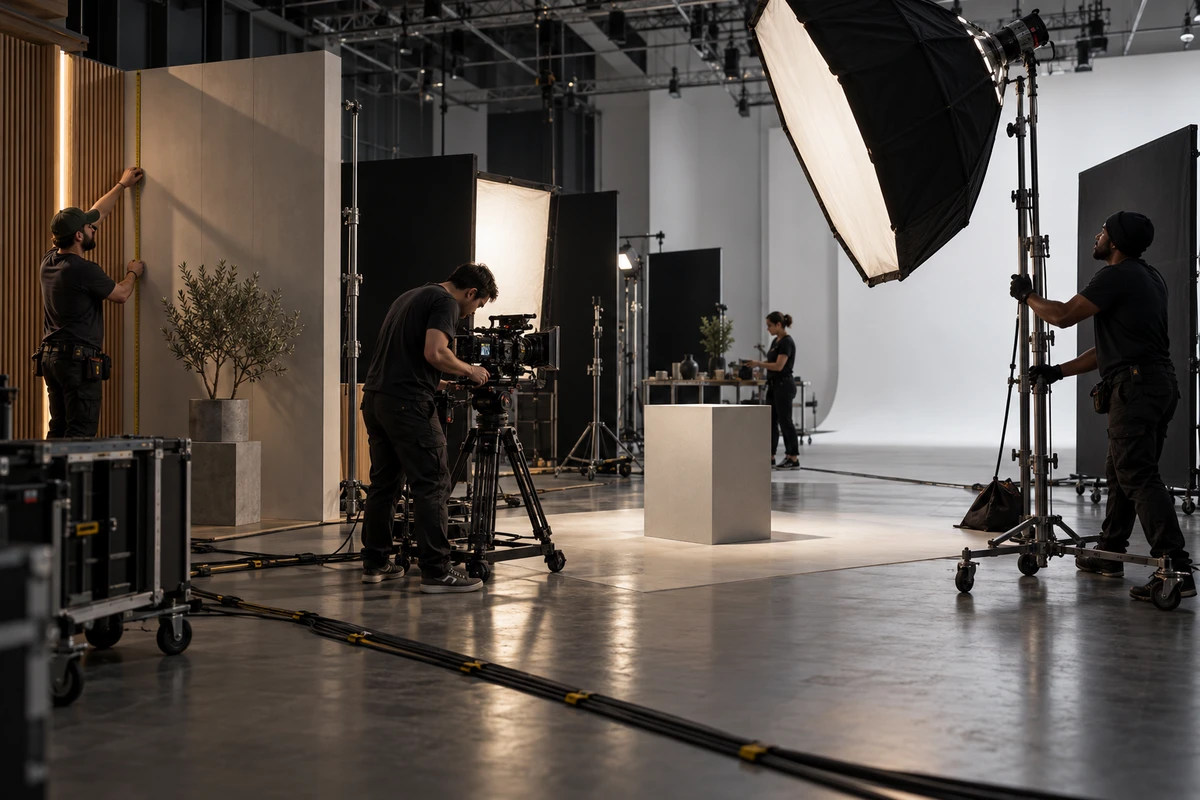
Product shoots often underestimate grip and light-control materials. Metal, glass, glossy plastic and screens need diffusion surfaces, negative fill, flags and reflection control—not merely brighter fixtures. Enough lamp heads with the wrong modifiers can still create an emergency rental.
Translate every shot into equipment responsibility: does a standard white-background setup need only conventional lighting; does a large soft source require a bigger frame; are macro lenses, a 360-degree turntable, high-speed capture or motion control separate; and who provides prompting, sound, monitoring and backup? ONCE's Shenzhen equipment rental reference estimates by daily reference rate, quantity and days, while making clear that transport, personnel, tax, overtime and kit contents require a final quotation.
Set construction also occupies studio time
If the production needs a repainted wall, product plinth, kitchen counter, suspended background or special installation, the cost has at least three parts: materials and labor, studio occupancy during construction, and strike/reset.
Some studios allow the set crew to enter the previous day at a reduced occupancy rate. Others prohibit on-site alterations and require advance approval even for moving furniture. A white cyc may carry a repainting fee after the shoot. Smoke, liquids, paint, food, animals, large machinery or any action that can mark the space should be approved in writing before booking.
Also ask whether a complete set is necessary. If the task is to prove surface, lighting behavior and product functions, a controlled white studio with modular props may be more useful than a full scenic build. For the production logic behind that choice, see ONCE's 3C product-studio field guide.
Three cheap-looking quotes that often overrun
Space only, no shoot-ready package
The room rate looks attractive, but camera, lighting, modifiers, monitoring, assistants and transport are all separate. That is not automatically expensive; it simply should not be compared directly with a package that includes basic lighting and support.
Low hourly rate, unclear minimum and overtime rules
A two-hour minimum, four-hour minimum and full-day buyout fit different jobs. Products that need repeated cleaning, styling, screen resets or lighting tests can turn a low hourly rate into a high total while the crew waits.
Cheap set build, no allowance for occupancy and reset
An art-department quote may include fabrication but exclude the setup day, transport, waste removal and restoration. Those omitted items often return at the end of the budget.
Send the same scope sheet to every studio
To make quotations comparable, provide:
- Shoot date, load-in time and expected clear-out time;
- Crew size, vehicles and equipment footprint;
- Product dimensions, weight, materials and water/power needs;
- Photography, video, sound, livestream, high-speed or macro tasks;
- Required set, cyc dimensions, construction and rigging needs;
- Equipment you will bring and lighting, grip or personnel the studio should provide;
- Invoice, deposit, rescheduling and cancellation requirements;
- Overtime, electricity, cleanup, damage and restoration terms.
Ask the studio to mark each line as included, additional or unavailable. You are then comparing a complete shoot-ready solution—not the most eye-catching room rate.
The cost-effective studio is the one that lets the shoot finish
There is no single fixed Shenzhen product-studio price for every project. Small tabletop products, presenter videos, 3C commercials, large scenic builds and motion-control shoots require different space, power, lighting, people and time.
If you are planning a product shoot in Shenzhen, prepare product photos, maximum dimensions, shot tasks, equipment list, crew size and expected duration. Then use the U-STUDIO Shenzhen studio page to arrange a scout or request a specialty-production plan. The space, equipment, set, personnel and overtime basis can then be confirmed on one scope sheet.