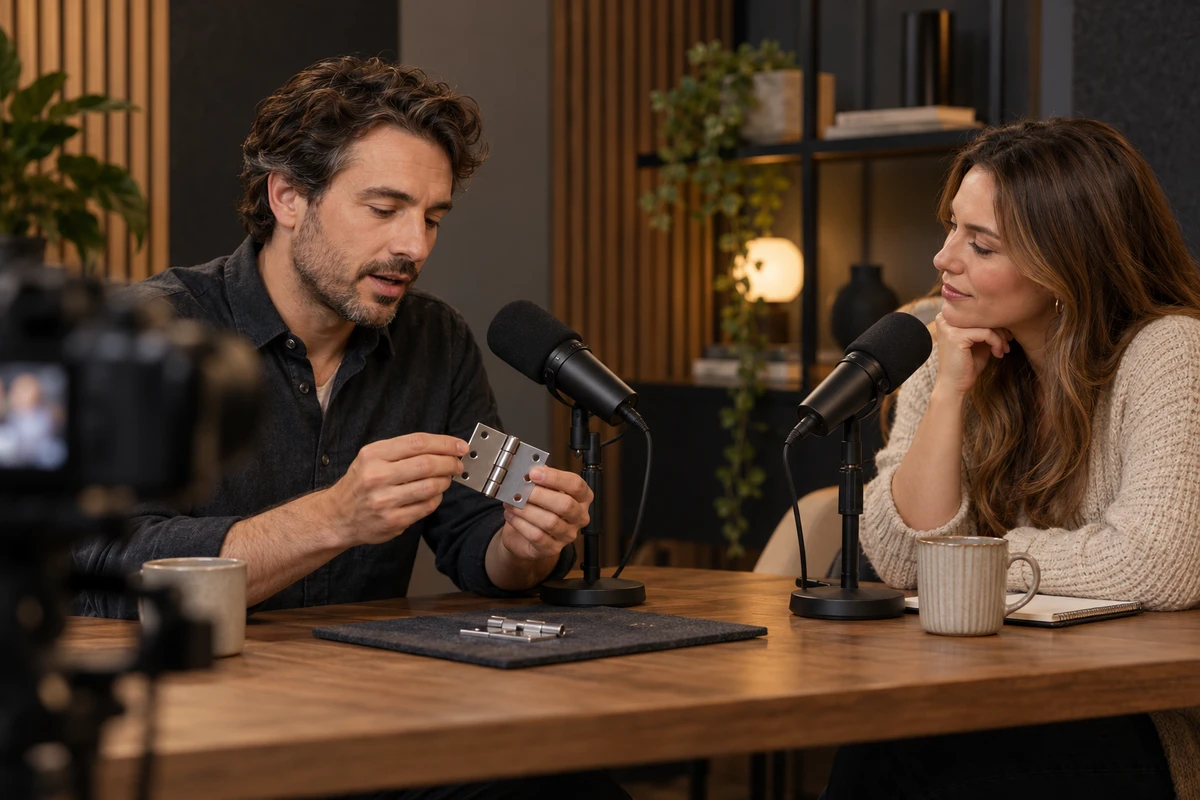
A supplier interview can turn into an assembly lesson without anyone deciding to make one. A guest reaches for a sample, the host asks a follow-up, and the next section depends on seeing hands, components and adjustments. The footage may be useful. That does not automatically make it a useful part of the conversation.
For overseas brands recording experts or suppliers in China, the production decision comes before camera coverage: should the demonstration remain in the discussion, become a clearly introduced segment, or become a separate instructional film? Each choice changes the preparation and deliverables you should commission.
A separate audio export is not the whole answer
Apple's current How to publish video on Apple Podcasts says audiences can switch between video and audio-only during supported HLS episodes. Delivery depends on a supporting host and availability for the show, and HLS video is not available in every country or region. The page has no publication date; we checked it on October 20, 2026. This describes a supported experience, not universal video availability.
The editorial implication matters even when you produce separate files: someone playing the video may stop watching partway through. A video episode still needs an intelligible spoken argument.
Libsyn's October 1, 2026 article, Does Your Podcast Need Video? What to Consider in 2026, distinguishes clips, selected video episodes and full video production. It also discusses the capacity those choices consume. That is a hosting company's guidance, not proof that one format wins. Our concern here is narrower: once a brand has chosen a filmed conversation, where should a particular demonstration live?
ONCE's demonstration routing method
Write down what the audience should be able to do after each product appearance. Then choose the format. This is an ONCE editorial proposal, not a tested performance model or platform requirement.
| Audience task | Editorial treatment | What to prepare |
|---|---|---|
| Understand a reason for choosing something | Keep the object in the conversation | Name the object and connect its relevant difference to the decision |
| Observe a difference, then continue the discussion | Create a distinct demonstration segment | Introduce the observation, show it, and return with an explicit conclusion |
| Follow a procedure or complete a setup | Usually make a standalone instructional film | Establish prerequisites, the sequence, checks and limitations independently |
Duration is not the dividing line. A brief adjustment may need replay; a long discussion may work without close-ups. Safety-critical procedures should not lose necessary instructions merely to preserve the pace of an interview.
A fictional lighting-product interview
Imagine an overseas lighting brand interviewing its manufacturing partner about a replaceable mounting system. This is a fictional editorial exercise, not an ONCE case study or a claim about a real product.
If a guest holds the bracket to explain why buyers must check the mounting surface, keep it conversational. The host's useful question is what the buyer needs to confirm before ordering.
If two approved samples illustrate different access to a release mechanism, give that observation a defined segment. Before handling them, state what is being compared and why it matters. Afterwards, say what the demonstration actually showed—and what it did not establish. A tabletop movement does not prove load capacity or long-term reliability.
If the guest begins teaching installation, treat that as another audience task. Commission a separate film based on the actual approved instructions and appropriate technical review. Keep the purchasing implications in the interview. The conversation should answer its own question; the instructional film should serve someone who needs to carry out the procedure.
Write the return to the conversation before filming
For every visual segment, draft the line that leads into it and the line that brings the audience back. The first identifies the object, observation and reason for looking. The second explains how the observation informs the episode's decision. If those lines do not connect, more angles will not repair the missing editorial purpose.
Do not place the episode's essential answer only in a picture or linked film. Audio-only audiences may miss the visual detail, but they should still receive the judgment the episode promised. Equally, there is no need to narrate a full installation inside an interview when the task genuinely requires a dedicated lesson.
A standalone film needs a new beginning. State the applicable product, conditions and starting point; restore any necessary warning that lived earlier in the conversation. An extracted middle section is not automatically an independent tutorial.
Check the real hosting and publishing route before promising different edits. A platform that switches an episode between watching and listening still requires the video's soundtrack to make sense. Do not assume every host accepts independently edited audio and video masters or preserves the relationship you intend.
Commission the editorial work, not just the camera count
For a China-based shoot, share a short demonstration outline with the production team: the episode's question, each product appearance, its audience task, the spoken conclusion and the person who approves technical claims. Ask whether the scope includes a rehearsal with the actual sample, hand visibility and reset planning, the host's bridging lines, and separate restructuring for any instructional film.
A three-camera recording gives the editor more angles. It does not automatically supply an uninterrupted usable procedure or a well-framed observation. A brief show-and-tell may need little extra equipment; detailed manipulation may need dedicated coverage and preparation. Establish which you are buying.
For ONCE, keeping client-authorized segment purposes and approval notes could support more reusable production planning over time. That is a proposed operating approach, not a claim of measured savings or existing client outcomes. Reuse begins by checking whether the next episode asks the same question—not by assuming an old demonstration remains suitable.
Before your next supplier interview, identify one planned product appearance and try all three treatments on paper. Then use ONCE's production planning and service options to scope the filming task. Bring the sample, the audience's question and the approved product information; the number of cameras comes later.