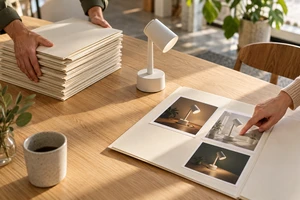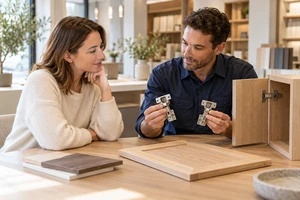
Your team has a China-sourced product, a live presenter and an approved demonstration. The producer adds a vertical output. Halfway through the demo, a new viewer arrives—and sees a result without knowing which sample produced it or under what conditions. The production has delivered another picture, but not necessarily another intelligible buying experience.
For overseas marketing teams commissioning product livestreams, ONCE recommends treating mid-demo arrival as a briefing requirement. Before buying additional cameras or layouts, identify what a newcomer must understand from the segment they actually encounter. This is a production diagnosis, not a claim about audience behavior or conversion gains.
Distribution can restart the viewing experience without restarting the show
YouTube's April 13, 2026 announcement, Four ways to level up your YouTube Live engagement, described simultaneous horizontal and vertical live delivery with a shared chat. The current live-streaming help guide, checked October 18, 2026, documents dual-format production. Neither establishes that every brand needs it.
The official vertical viewing guide describes discovering live streams while browsing Shorts and swiping through the vertical feed. That makes an arrival without the opening context a sensible design scenario; it does not guarantee Shorts distribution for a particular broadcast.
ONCE's inference is straightforward: a shared chat cannot supply a shared memory. Someone who watched the introduction may know that two similar-looking samples represent different models. A newcomer may interpret the visible result as applying to the entire range. Showing the product more prominently does not resolve that ambiguity.
Brief for a complete demonstration, not a permanent introduction
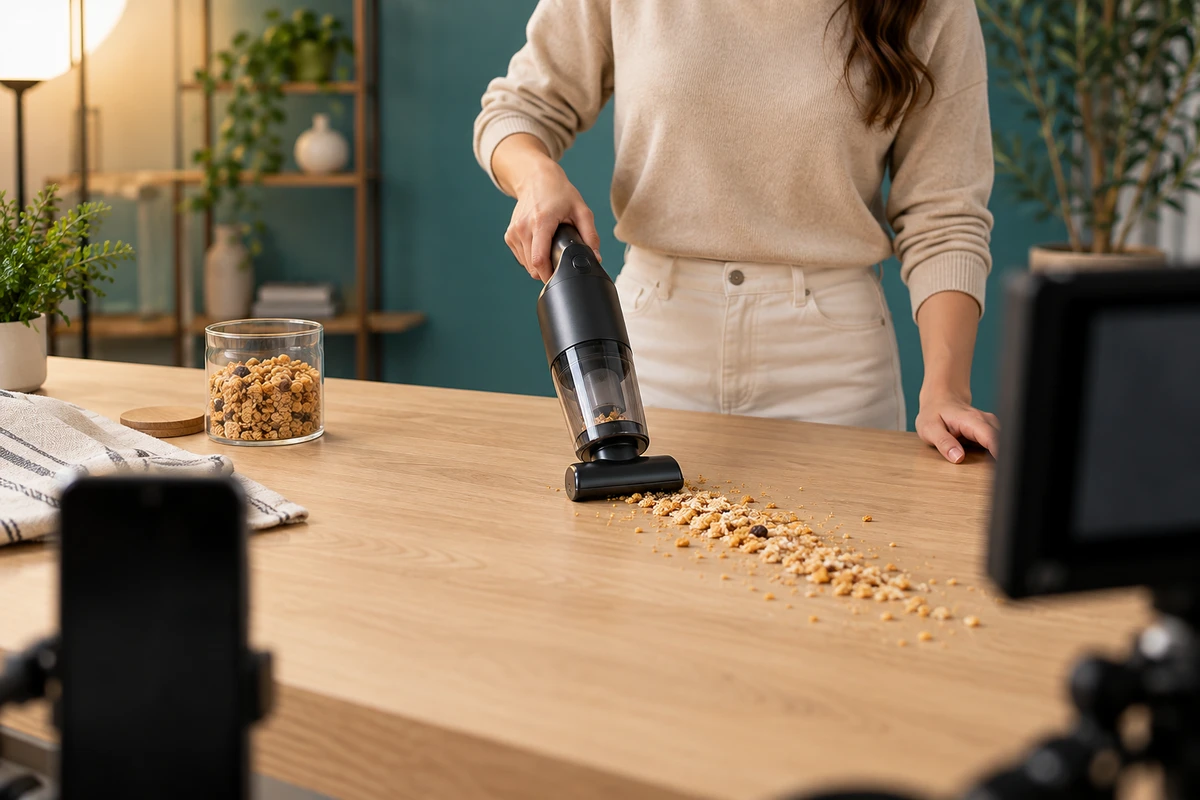
Consider a hypothetical vacuum demonstration for a brand working with a Chinese supplier. Several samples are on the table. One is approved for the planned demonstration, while another is there only for a later comparison. The crew may recognize them instantly; a new viewer cannot be expected to do the same.
At a natural reset—before changing the task or starting a fresh pass—the presenter can identify the sample, the question being demonstrated and the relevant conditions. The action then runs continuously, followed by a conclusion limited to what that action supports. Exact model names, settings, materials and claims must come from the real samples and the brand's approved information. This example is not evidence of any product's performance.
There is no universal interval at which the host should repeat the setup. Constant resets can disrupt the very causal sequence the viewer needs to see. Build the reminder into an existing transition, rather than breaking a consequential action to greet arrivals. The commissioning question is: where can the program restore context without destroying the demonstration?
ONCE's Mid-Entry Check
Use the rehearsal recording, not an idealized storyboard. Pick several actual entry points across preparation, action and explanation. Ask someone who did not write the script to start there without watching the opening. These are diagnostic starting points, not a statistically representative audience sample.
Ask them to describe:
- The product and question: which sample is on screen, and what is being demonstrated?
- The conditions: what does this result depend on, and what important information is still missing?
- The next step: where could they actually go now, and would they find the same model?
Compare their answers with the approved demonstration brief. Then assign the smallest intervention that addresses the actual problem. Unclear sample identity may need a better transition or more distinct sample handling. Missing setup may require a different camera position or a revised demonstration area. A clear product with no usable destination is an operations problem, not a reason to add another close-up.
Repeat the check from different points after revisions. A successful internal review can identify fewer obvious production gaps; it cannot be reported as an audience comprehension rate, a sales test or proof that dual-format delivery performs better.
Frame the conditions—and verify the destination
When reviewing the vertical output, look beyond whether the product fits. Can viewers also see the working surface, the relevant action and the result? A tightly framed outcome may look persuasive while omitting the setup that limits its meaning. If the demonstration depends on a wide apparatus, the solution may be a redesigned setup or a separate composition—not a tighter center crop.
The destination needs equally careful treatment. As checked on October 18, YouTube's live help lists clickable chat and channel-description links as unavailable in the vertical live feed. Yet its vertical viewing guide also lists Shopping. A limitation on ordinary links is not proof that shopping is absent.
YouTube's Buy products on YouTube guide makes clear that shopping access depends on eligibility and viewer location, among other conditions. Have the project team check the actual viewer-facing route for the intended device, location and account setup, including the relevant product variant. No purchase is required merely to inspect a route. ONCE has not performed that account-specific check for your broadcast.
If a planned shopping route is unavailable, revise the call to action and operating plan before approving the host's language. “Click below” is not a completed production decision when no one has confirmed what the intended viewer can see.
Pay for the missing capability, not the format label
Ask a production proposal to name the additional work: the transitions that need context, the demonstrations that need reframing, the product destinations that need operational verification, and the person who approves sample-specific language. This creates a reviewable scope across the brand, supplier, producer and commerce operator.
For a team coordinating from overseas, sample handover deserves particular attention. Send an approved sample-to-claim list with the products, rather than expecting the studio to infer which similar-looking unit can support which statement. When a sample changes, revisit the relevant segment and destination together. This is a recommended handover practice, not a claim that ONCE has implemented it for a named customer.
If the existing production already passes the context and framing checks, extra equipment may not solve an actual problem. If a wide demonstration cannot be made understandable vertically within the available scope, a well-designed single-format broadcast can be the more defensible choice.
ONCE's judgment: buy dual-format production when you can support a coherent experience through the additional entry point. Start with a rehearsal diagnosis; then commission the specific missing work. More delivery formats should not quietly mean less context.
Sources and limits
The four linked sources above are YouTube primary materials. The dated announcement was published April 13, 2026; the help pages are living documentation checked October 18, 2026, not new announcements from that date. Platform capabilities are factual inputs. The Mid-Entry Check, sample handover and procurement recommendations are ONCE's original analysis, with no forecast of reach, revenue or conversion.