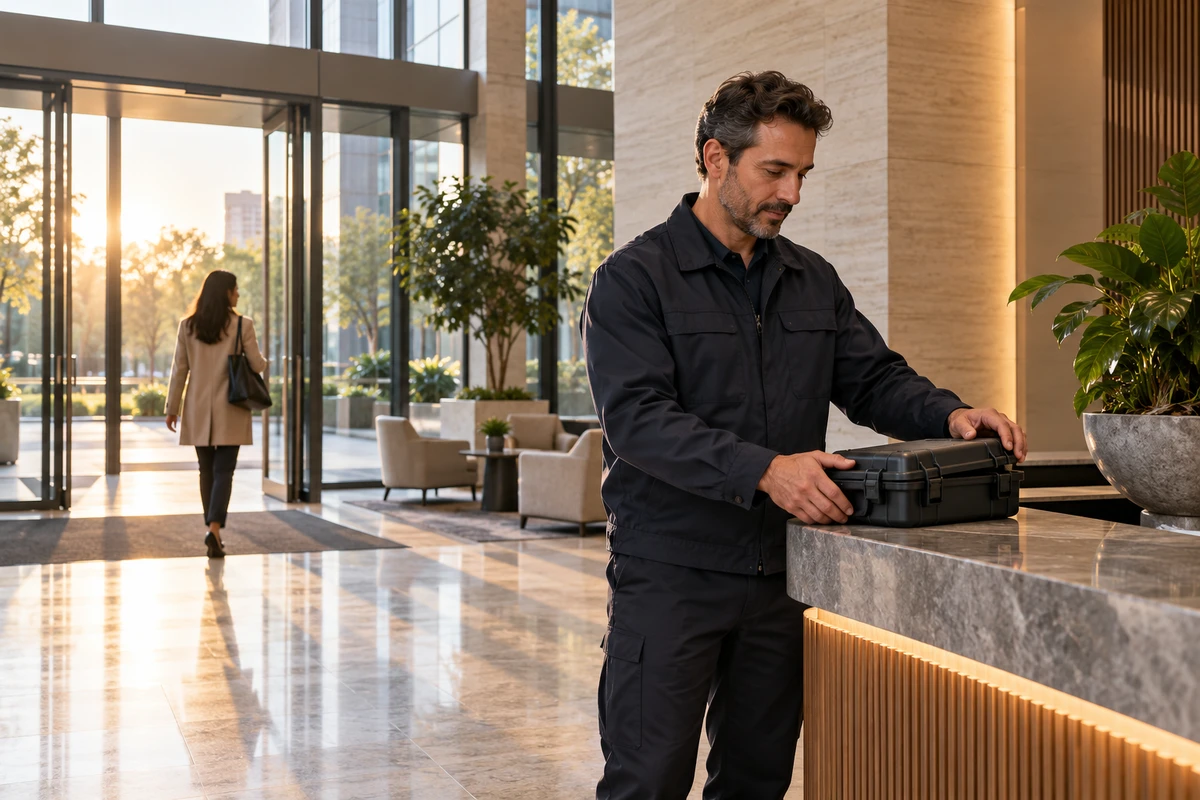
A B2B brand film does not always need a crisis followed by a team rushing to the rescue. Some services succeed precisely when customers are not interrupted: people arrive at work as usual, a shop opens on time, and staff can concentrate on their own tasks. Ordinary continuity can carry a story. The challenge is making the work supporting it specific.
Running equipment, focused faces, and a voiceover about trust may still leave viewers unsure who is doing what for whom. Rather than adding a grander statement, find two connected strands: what the service professional is handling, and what someone at the other end is getting on with.
Begin with the customer's uninterrupted moment
Schindler's official article A new era of elevator and escalator maintenance, dated April 5, 2023, places connected equipment alongside the people behind the service: people monitor information, and field technicians have remote expert support. We draw on the roles described in that public text, not a shot-by-shot viewing of a complete film or independent testing of its service claims.
This is a more useful starting point than saying many people work behind the scenes. Several people doing separate jobs do not automatically make a story. The connection between one person's work and another person's situation needs to become understandable. A film can begin with a customer's day rather than a corporate entrance, equipment inventory, or organization chart.
Consider an explicitly fictional office-building film. Early in the morning, a tenant prepares to welcome a first-time visitor, adjusts the chairs, and watches the entrance. In another strand, a service coordinator confirms the day's work arrangements with the building representative. Both are preparing for an ordinary morning, but they are concerned with different things. This is not a real company project or a set of equipment-maintenance instructions.
Giving the tenant an agenda of their own gives service value somewhere to land. They need not turn to the camera with a testimonial or know everything happening out of sight. The film establishes a division of attention: the customer can concentrate on the visitor while the service team takes its own work seriously.
Give the professional a judgment, not just an activity
Carrying tools, walking along a corridor, and looking at a screen easily become generic images of work. They may supply atmosphere without explaining expertise. Ask instead: what has this person noticed that changes what they decide to do next?
In the fictional story, the coordinator finds an unresolved item and asks the responsible person to clarify it rather than simply marking it complete. That pause offers more character than several close-ups of typing: there is something to judge and a responsibility that cannot be waved away. What a real company must clarify, and who should handle it, must come from the actual business rather than a screenwriter's invention.
SE Studio's account of Volvo Penta Promoting A Premium-Level Service describes organizing imagery from industrial context through medium shots to working details, with a reportage-style aesthetic. The page has no confirmed publication date; we consulted it on October 18, 2026. It is the creative team's description of its approach, not a universal finding that monochrome earns trust or proof of business growth caused by the advertising.
There is no need to copy its palette, slow motion, or tool close-ups. A more useful adaptation gives different shot sizes different questions: a wider view establishes the world around the work; a closer view helps explain why someone pauses; a detail shows what holds their attention. Without that connection to judgment, a larger detail merely makes activity more attractive.
Connect the strands without inventing causality
Cutting from the coordinator's completed confirmation to the tenant greeting the visitor can create an emotional relationship: someone prepares behind the scenes while someone else's day continues. That is not technical proof. Adjacent shots cannot establish that the earlier action prevented a failure that would otherwise certainly have happened.
This distinction shapes the script. Without supporting material, there is no need for a countdown implying that the visitor narrowly avoided being trapped. Nor should an AI-generated emergency be added to make the team indispensable. The drama can remain within an existing task: whether a confirmation is handled carefully, whether a question reaches someone able to answer it, and whether work clearly reconnects with the ordinary day.
Documentary-style corporate work also needs honest chronology. A morning inspection and an afternoon crowd should not become a supposedly simultaneous response. Similar-looking footage from different projects cannot silently turn into one service visit. Where a scenario is staged for illustration, viewers should understand that it is a dramatization rather than an on-site record.
Smooth operation can help explain why a service matters. On its own, it cannot prove uptime, response speed, or safety performance. Specific promises still need corresponding information that can be publicly substantiated. Brand storytelling makes value understandable; it should not manufacture evidence for business claims.
Return the day to the customer
The fictional film could end as the visitor sits down and the tenant starts their introduction. The coordinator need not enter the meeting room for applause or become an all-powerful hero in the final scene. Completing their part while the customer's day continues is the relationship the film wants viewers to understand.
This approach cannot answer every question. A first-time viewer may still need to know exactly what the company provides; someone comparing options may need service scope and response conditions. Establish identity and give a concise explanation where needed, with related content handling more direct questions. Restraint should not mean hiding useful information.
Nor does a smooth day require permanent quiet or the absence of difficulty. Genuine questions, coordination, and trade-offs can remain. If everyone merely nods through a process, expertise again becomes an empty pose. Look for the point in ordinary work that genuinely requires human judgment, not an additional dramatic accident.
Bring a specific everyday situation to ONCE's corporate and brand film production solutions and discuss who is carefully handling which task, and where that allows someone else to place their attention. That question gives a film more substance to grow from than an opening declaration of professionalism.
This is original narrative-method analysis, not a service-performance or advertising-effectiveness test. The office-building story and AI cover are independent fictional concepts. Sources checked October 18, 2026. Mainland China access to the overseas sources was not tested; the Chinese edition retains accurate source names, titles, and available dates without unverified overseas links.