A request for upholstery swatches can arrive after a buyer has watched every product clip. Before commissioning a reshoot, find out what remains uncertain. “I cannot see the weave” is a visual problem. “Will I enjoy touching this every day?” is a different buying decision.
For overseas brands working with Chinese furniture and textile suppliers, fabric product video should help narrow the shortlist, then make a useful handoff to physical evaluation. Trying to eliminate that handoff can turn a production brief into an impossible promise.
A swatch request is not automatically a content failure
Baymard Institute’s furniture and home decor research article, published December 12, 2024, records qualitative observations of shoppers wanting material samples or tactile reassurance. That is evidence of a buying need in the research, not a percentage describing every market.
Joybird’s current Free Fabric Swatch Samples page, checked October 15, 2026, offers a way to see and feel fabrics in the buyer’s own living space. This establishes one retailer’s offer, not a universal sampling policy or an industry-wide shift. Its shipping arrangements should not be copied into another brand’s promises.
ONCE’s interpretation is that motion content and swatches can do complementary jobs. Neither source establishes a guaranteed conversion uplift from combining them.
Replace “show the quality” with a question the camera can answer
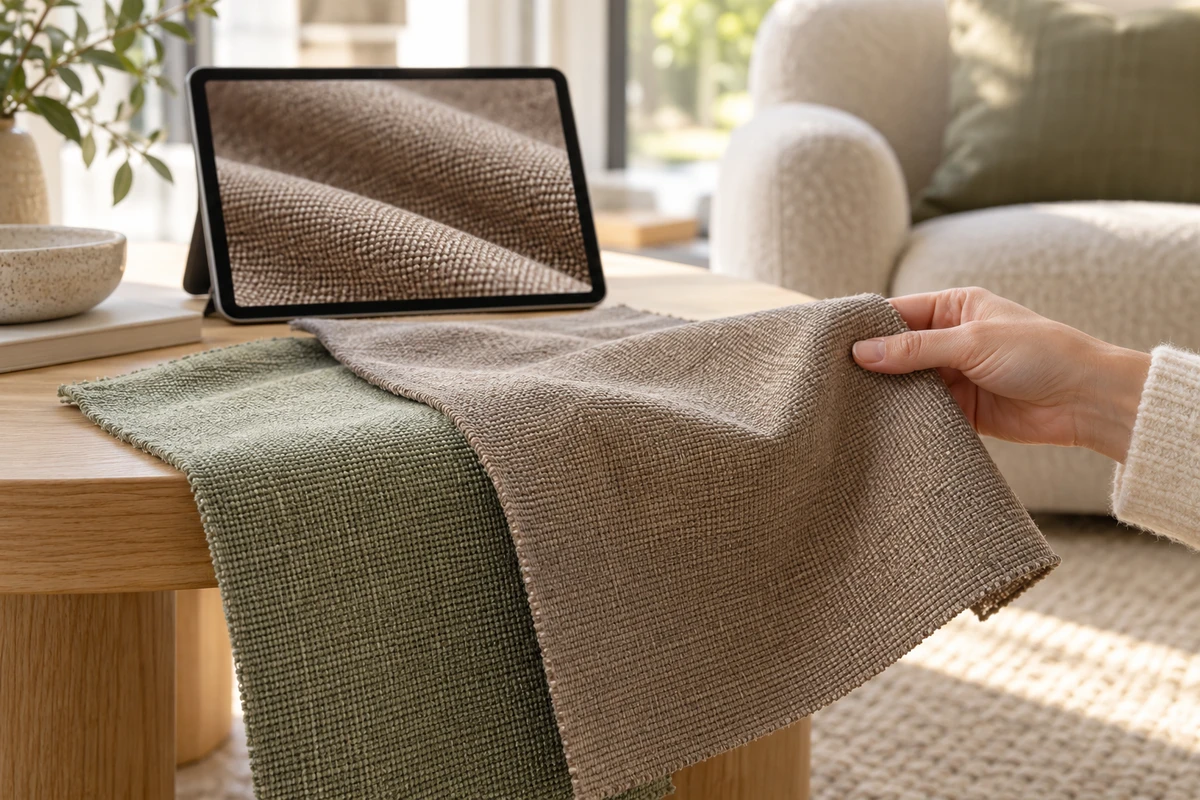
A film can reveal a visible weave, show cloth moving under a specified action, or show how its surface appears as the viewing angle changes. When comparing options, keep presentation conditions sufficiently consistent for the comparison to mean something. Disclose meaningful changes in lighting or angle instead of allowing them to masquerade as material differences.
Those shots cannot tell a viewer whether a fabric will feel scratchy to them. An actor pressing a cushion is not a personal comfort assessment of the finished sofa. A controlled production also cannot guarantee identical color appearance on every screen and in every room.
Physical samples have limits too. A small swatch offers a personal touch and décor comparison, not the support and comfort of an assembled seat. It is not, by itself, a guarantee of batch color consistency. Composition, care instructions and performance requirements need appropriate confirmed product information and evidence; a rubbing demonstration is not a substitute for testing.
ONCE’s Swatch Question Follow-up
Use this proposed diagnostic exercise to decide what to commission next. It is not a reported ONCE experiment or a validated sales model. A small group of willing, relevant buyers can help uncover questions; their answers should not be presented as market-wide statistics.
Start before showing the video: “What specifically stops you choosing?” Record the buyer’s own wording. Do not prompt them to worry about softness or color.
After showing the actual proposed product clip, ask what it clarified and what remains unresolved. Then provide the corresponding physical samples, with confirmed material names, option identifiers and versions. A sample that merely resembles the filmed fabric breaks the comparison. After the buyer considers it in their intended environment, ask what the sample answered and what it still could not answer.
Route the remaining work accordingly:
| Unresolved question | Appropriate next work | What it cannot establish |
|---|---|---|
| Weave or angle-dependent appearance remains unclear | A targeted visual explanation | Brighter footage means better fabric |
| Personal touch preference is unknown | Swatch or suitable physical experience | A performer’s reaction predicts everyone’s comfort |
| Composition, care or durability is uncertain | Confirmed documentation and applicable evidence | A close-up proves performance |
The output is not a “tactility score.” It is a reason for spending, or not spending, on another shoot.
Build the handoff around real supplier options
Consider a hypothetical overseas sofa brand choosing between fabrics A and B from its Chinese supply partner. This is a planning example, not a client case.
The initial content could pair overall appearance with visible detail and a consistent movement demonstration. Keep the sales option identifiable. A flattering campaign shot can coexist with that explanation, but should not be the only basis for comparing two materials lit very differently.
The sampling guide has another job: help buyers compare the correct swatches in the intended location, including the daylight and ordinary artificial lighting they actually use. This is personal evaluation, not laboratory color measurement. The brand must confirm sample availability and application terms; the production team should not invent delivery promises.
If buyers repeatedly report that a surface looked smooth on screen but clearly textured in hand, investigate the imagery and consider a targeted addition. If someone simply prefers B after touching both, preserve the opportunity to choose. More footage may not resolve a personal preference, nor should it have to.
Commission a bounded scope, then learn from the unanswered questions
Separate the initial visual explanation, any sample-use guide and conditional follow-up production. Not every brand needs all three. Agree what question would justify an additional shot before adding a standing stream of content.
The brand and supplier confirm materials, versions, sampling arrangements and product information. The production partner turns the confirmed information into clear visuals and maintains the mapping between footage and the relevant option. A material revision should trigger an applicability review, not automatic reuse of every old asset.
For an ONCE product video brief, bring the actual candidate materials, confirmed product information and the unresolved buyer questions—not just a moodboard. Keep follow-up records proportionate, consented and free of unnecessary personal details. Repeated questions can inform future scopes without being dressed up as performance results.
A useful fabric film does not pretend the viewer has touched the product. It helps them know what they have seen, what they should sample, and what still requires a different kind of evidence.