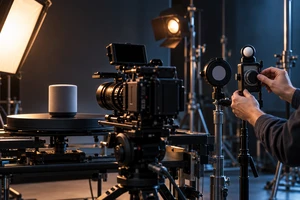
Put the same desk lamp into three conversations. One shopper wants to know whether it fits a dorm desk. Another is comparing a dial with touch controls. A third is worried about installation and cable management. A polished hero image may look excellent, yet it is unlikely to answer all three jobs.
That is the production problem created by visual advertising inside ChatGPT. This is not simply another image placement. The conversation creates the context, and the image has to perform a useful role inside that context. Brands should therefore buy a system of visual modules tied to buying tasks, substantiated product facts and relevant destinations—not one universal key visual.
What has changed—and what has not
On October 5, 2026, OpenAI announced a new visual ad format for ChatGPT. The initial test will appear during image generation for Free and Go users in the United States, beginning with a limited group of advertisers. OpenAI says the ads will be labeled, separated from the image being generated and unable to influence ChatGPT's answers.
The company describes a specific creative role for images: show product inspiration, use or the experience an offering makes possible so people can discover a brand, understand differentiation and make a decision. Current advertiser guidance also recommends multiple distinct titles and copy angles for each offering, simple relevant imagery, and a landing destination that continues the same promise rather than defaulting to a generic homepage.
Adobe's October 5 beta documentation adds an important operating detail. Search, Social, & Commerce can create and manage ChatGPT Ads accounts, campaigns, ad groups and ads, and show impressions, clicks and cost. The same document says that this interface does not currently show ChatGPT Ads-tracked conversions and does not support Adobe or third-party tracking, first-party audience targeting, optimization or bulk-sheet management for this inventory. Adobe describes the inventory as private and publisher-managed rather than biddable.
These facts show what OpenAI and Adobe offer now; they do not prove that conversational advertising is already a mature, widely available channel. OpenAI says incrementality work remains early and brand-suitability evaluation with DoubleVerify and Integral Ad Science is still in pilot. The recommendations below are a production and procurement interpretation, not a claim about market adoption or guaranteed performance.
Why the traditional hero-image model breaks down
A conventional key visual starts with one brand proposition and gets resized across placements. A conversational placement reverses that sequence: the user's current job defines what the image must help them do.
For a single product, that job may require at least four different visual roles:
- Orient: help someone judge fit for a space, scenario or type of user.
- Demonstrate: make the operation of a feature legible, not merely show the result.
- Differentiate: reveal a meaningful difference between models, structures or use modes.
- Reassure: make installation, maintenance, storage, accessories or support easier to evaluate.
One hero image can usually do one of these jobs well. Loading it with more claims, badges and copy turns it into a miniature product page while making the shopper's actual question harder to see.
Context is also not the same as an audience segment. “Women aged 25–34” does not tell a producer whether someone is comparing dimensions, shopping for a gift or checking whether a part can be replaced. A brief that begins and ends with demographics may produce plenty of assets without covering the decisions people are trying to make.
The ONCE CUE map: plan the context before the shot list
Before scripting or production, ONCE recommends a CUE context-coverage map. It has three parts.
C: Conversation job
Replace broad labels such as “young professionals” with observable tasks:
- determine whether the product fits a small room;
- compare how two models are controlled;
- evaluate installation, maintenance or storage;
- imagine the product inside a specific routine.
The first pilot does not need to anticipate every conversation. Select four to six high-value jobs from site search, support tickets, reviews and sales objections. This uses the brand's own evidence; it does not pretend that the advertiser can see private conversations.
U: Useful visual role
Assign one primary role—orient, demonstrate, differentiate or reassure—to each job. If one cell tries to do three or four things, split it. OpenAI's current guidance asks advertisers to build coverage with distinct creative angles. The production implication is that variation should come from the question being answered, not just a new crop or background color.
For a desk lamp, a small-space job might use an overhead view to show footprint and cable routing. A controls comparison can hold the camera angle constant while changing the interaction. Installation reassurance can use a three-state component sequence. These images share the same product truth, but they are not one image with three headlines.
E: Evidence and exit
Every cell needs two records:
- Evidence: the approved specification, captured state or repeatable demonstration that supports the image—and any claim the image cannot substantiate on its own.
- Exit: the product page, comparison page, installation guide or collection that continues the same decision after the click.
If an ad says “made for small spaces” but the destination contains no measurements or placement guidance, even a strong image cannot complete the task. Conversational advertising does not require cramming the whole answer into one asset; it requires continuity between the visual cue and the next source of information.
Put suitability into the brief, not just the media plan
OpenAI says its placement safeguards assess whether a conversation is suitable for advertising, offers Negative Phrases to qualifying advertisers and is piloting independent brand-suitability evaluation. Platform controls are one layer. A brand's narrower policies still need to become concrete creative instructions.
Add three lists to the production brief:
- Excluded adjacency: topics, tones or situations the brand does not want near its assets.
- Excluded claims: health, financial, performance or comparison language that cannot enter the ad.
- Misleading visual cues: props, actions or environments that could overstate intended use.
These lists should not duplicate the platform policy. Their value is to turn a brand decision into something a producer, legal reviewer and media buyer can inspect at the level of one context cell.
Buy a coverage system, not “six images”
A production package that can enter a learning loop should contain:
- a context map with job, visual role, claim, market and asset ID;
- a clean product-evidence library covering angles, states, accessories and scale references;
- at least two genuinely different visual directions for each priority job;
- a substantiation and rights register with approver, market and expiry;
- a destination map connecting each asset to page, SKU, language and tracking parameters;
- reporting fields that return impressions, clicks, cost and available conversion evidence to the same asset ID.
For teams already turning intent data into production decisions, ONCE's related guide on using search terms, ad assets and landing pages to build a proof-led video brief shows the same discipline from a search-ad perspective. The difference here is the unit of planning: the conversation job, not the keyword.
Divide cost by validated contexts, not image count
A hero-image proposal often looks cheaper because later adaptation, reshoots, landing-page changes and inconclusive tests sit in other budgets. A modular programme should put the full work into one comparable denominator:
Fully loaded cost per validated conversation context = (intent mapping + master production + context variants + rights and compliance + destination alignment + measurement setup) ÷ context cells that produced decision-quality evidence.
“Validated” does not mean the highest CTR wins. It means a cell generated enough information to support the next decision: retain it, rewrite it, reshoot it or stop it. This is not an industry price benchmark, and it does not promise modular production will always be cheaper. It prevents a brand from treating one exported image as though it answered one buying question.
Who should pilot now—and who should wait
A small pilot makes sense when four conditions are present: the advertiser has access in an eligible market; the product has several clear and filmable use contexts; destinations can continue each context; and the team can return at least basic conversion or qualified-lead events.
Wait when access is unavailable, the value proposition depends mainly on sensory qualities an image cannot reproduce, specifications or inventory change faster than assets can be governed, every click lands on an information-poor homepage, or the team cannot distinguish versions in reporting.
Where the conditions are met, a disciplined 30-day pilot is enough to learn without overclaiming. In week one, select four to six jobs and build the CUE map. In week two, make two visual directions for each job. In week three, deploy with offer and destination conditions held stable. In week four, review which contexts produced usable evidence and decide what to reshoot, consolidate or retire. Do not forecast long-term ROAS from the first test, and do not turn one high-click image into a universal rule.
If visual ads eventually expand to more conversational surfaces, creative procurement is likely to shift from “how many sizes?” toward “how many decision contexts?” That is an ONCE forecast, not a completed industry fact. The durable asset to build now is not a futuristic-looking ad. It is a context map that tells the brand why the next image deserves to exist.
Sources
- OpenAI, “Building advertising for the way people use AI,” October 5, 2026.
- OpenAI Help Center, “Create Ads for ChatGPT Ads” and “Ads in ChatGPT: The Basics”, updated September–October 2026.
- Adobe Experience League, “What's new in Search, Social, & Commerce,” October 5, 2026 entry.
- The Verge, Emma Roth, “OpenAI is sticking more ads in ChatGPT,” October 5, 2026. Used to compare external coverage of the test scope, not as the primary source for product capabilities.