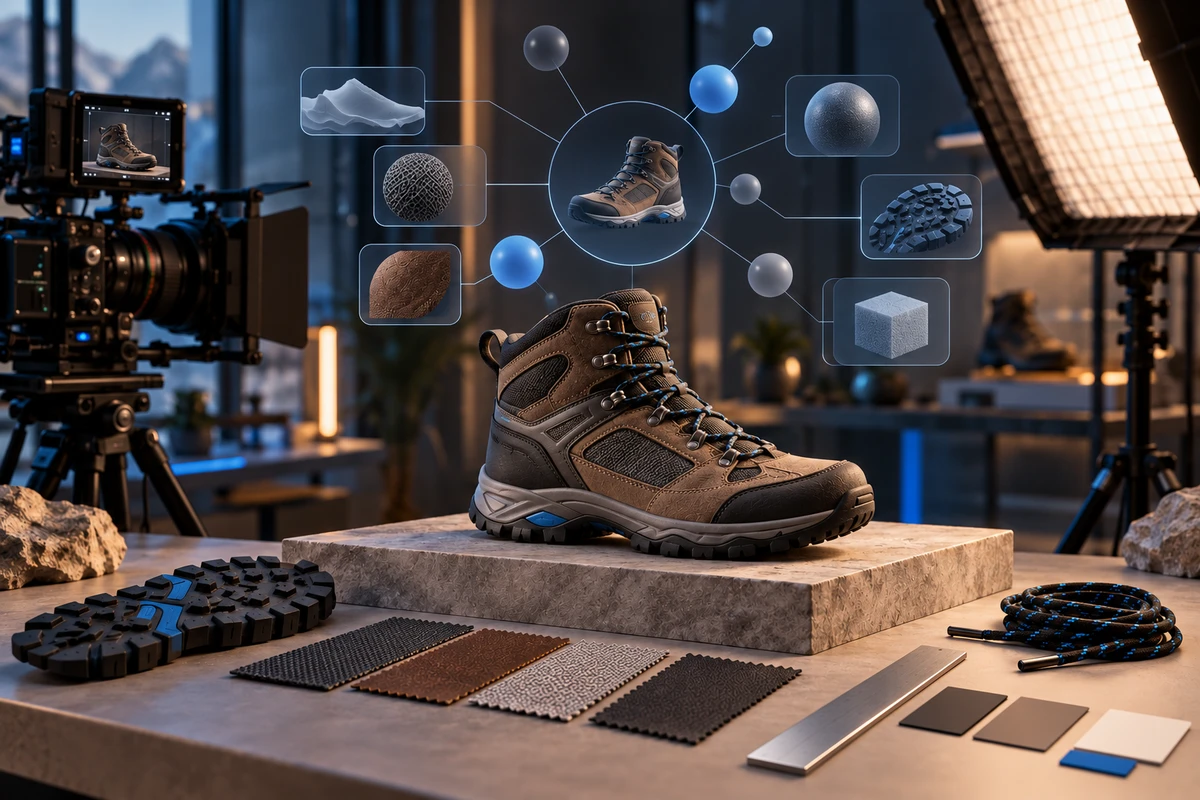
A typical product-video shot list has an unboxing, a hero close-up, a lifestyle scene and a final call to action. It rarely has a row for “Will this boot hold up on granite?”, “Does the fit run narrow?” or “Which conditions are excluded from the water-resistance claim?” Those questions used to sit downstream with customer service. When a shopper can ask them inside the ad environment, they belong upstream in content planning.
On October 5, 2026, TikTok announced Shopping Assistant, Buy Direct and Lead Agent. Shopping Assistant is designed to answer questions on a merchant product page inside TikTok’s in-app browser using information supplied by the merchant. Lead Agent starts from a customizable, advertiser-approved knowledge base and can answer questions, qualify prospects and collect contact details with consent. Buy Direct connects a native checkout flow through the Universal Commerce Protocol.
There is an important limit: TikTok says these solutions are available through eligibility-based testing opportunities. This is evidence of a direction and a testable workflow, not evidence that every advertiser—or the entire industry—has already moved to agentic commerce.
For brands tied to Chinese manufacturing and fast-moving SKU portfolios, the operational lesson is already useful. A persuasive video is no longer enough. The content system must make high-intent questions answerable without inventing facts, confusing variants or freezing volatile commerce data into a long-lived edit.
The interface changed; responsibility for the answer did not
An assistant can only be as reliable as the information a merchant gives it. Size, inventory, price, shipping and availability usually belong in commerce systems. Durability, compatibility, setup, performance and usage limits often require a coordinated answer from product, legal and production teams.
That is why “make more videos for AI” is the wrong brief. Break each customer question into three layers:
- Source of truth: the SKU record, specification, approved policy or substantiation file behind the answer.
- Visual proof: a shot that lets a buyer inspect scale, material, interface, operation or test conditions.
- Claim boundary: the conditions in which the answer applies, the exclusions, and the point at which a human should take over.
TikTok has not said that Shopping Assistant directly interprets every video asset. The practical inference is narrower: video can become reusable proof for product pages, ads, sales and support, while merchant systems remain responsible for current transactional facts.
The ONCE Answer Load Matrix
Before the shoot, map the questions that can carry—or collapse—a purchase decision. Every row should also name the applicable SKU, market, language, owner and expiry date.
| Question class | Primary source of truth | Useful proof shot | Boundary to record |
|---|---|---|---|
| Identity and variant | SKU, model, color, box contents | Model mark, accessory layout, color comparison | Market-specific packaging or bundles |
| Size and fit | Measurements, size chart, compatibility list | Scale reference, fit position, connector close-up | Measurement method and exceptions |
| Use and setup | Manual, required tools, ordered steps | Continuous operation, critical action, common mistake | Prerequisites, maintenance and safety |
| Performance and limits | Test record and approved wording | Reproducible demo with visible conditions | Excluded use cases and prohibited extrapolation |
| Price and fulfillment | Live pricing, inventory, shipping and returns systems | Usually not a durable video claim | Region, timing, fees and stock change |
| Trust and responsibility | Warranty, certification, permissioned reviews | Certification location, support flow, real-use detail | Certification scope, warranty exclusions, disclosures |
The matrix does not turn every answer into a shot. It assigns responsibility. Live inventory should update from the merchant system. Tread pattern, seam construction and installation steps can be captured on set. “Suitable for every rocky trail” should not appear just because a conversational interface prefers a short answer; if the claim is not supported, the answer needs a limit or an escalation.
The U.S. Federal Trade Commission’s small-business guidance says express and implied advertising claims need evidence, and material omissions can also mislead consumers. That makes an agent response part of the governed advertising surface, not a free-form customer-service script. Claims involving performance, safety, effectiveness or price deserve particular scrutiny and market-specific review. FTC guidance
Turn the product shoot into an answer-capture day
You do not need a separate “AI production” to begin. Add four controls to the shoot you already buy.
Collect decision questions before writing shots
Use support tickets, returns, reviews, search terms, distributor questions and sales calls to find questions that change a purchase decision. Rewrite vague prompts into verifiable ones. “Is it durable?” is not a production instruction. “Which approved durability statement applies at this load, surface and usage frequency?” can become one.
Capture one locatable proof unit for each priority answer
Link the slate or file name to the SKU, question ID and version. A size shot needs a recognizable reference. A connector shot must show orientation and locked state. An installation shot should preserve continuity. A performance demo needs its test conditions recorded. Beautiful B-roll that cannot be mapped back to a question is still weak evidence.
Deliver proof units separately from persuasion edits
The campaign cut is optimized for pace and conversion. Proof units are optimized for verification, recutting and localization. A stronger handoff includes the short master, clean plates, question-linked clips, approved copy, and a list of rejected or restricted claims. The ad, PDP, sales team and support operation can then share truth without sharing one fixed edit.
Give volatile answers an owner
Price, stock, shipping, returns and sellable regions need a live system and a named owner. Material, dimensions, compatibility and instructions need a review trigger when a product changes. Google’s documentation for product structured data provides a useful outside example: price, availability, size, shipping and returns are modeled as explicit product or offer fields, and some policies have a defined order of precedence. That does not prove TikTok uses the same schema; it illustrates why commerce answers need structured, updateable sources. Google product data guidance
Measure cost per verified answer, not cost per video
Use this internal model to compare a reshoot, data cleanup and localization:
Cost per verified answer = (fact preparation + capture and post + claim review + localization + maintenance) ÷ the number of approved questions that can be reused in the target market
Do not count clips, minutes or language versions in the denominator. Count an answer only when the SKU is correct, the market is valid, the wording is approved, the visual can be checked and an owner will keep it current.
This exposes two expensive patterns. One is a library full of atmosphere that does not resolve any purchase objection. The other is repeatedly translating the same product fact because the approved source answer and its proof clip were never preserved. For products with high return rates, complex compatibility or heavy pre-sale support, lowering cost per verified answer may matter more than shaving another percentage off the edit rate.
Act now—or wait—with a clear condition
Build the full matrix now if you manage many variants, complicated sizing or compatibility, repeated “not as expected” returns, high support volume, or an eligible TikTok test. The same assets remain useful on PDPs, for distributors, sales enablement and human support even if the platform test changes.
For a simple, low-consideration product with few pre-sale questions, start with the top 20 real questions rather than rebuilding the whole library. What you should not do is commission a large “agentic commerce” reshoot before identifying the questions, source records and owners.
If your team already maintains a visual-search asset plan, use the visual attribute coverage framework as an input, not a substitute. Visual search asks whether a system can see color, material and context. A shopping assistant must also handle conditions, exceptions, freshness and responsibility.
The production takeaway
Shopping assistants are still an eligibility-based test, but they make an old weakness visible: when a customer asks a precise question, does the brand return marketing language—or an answer with a source, a proof image, a valid scope and an owner?
Your next shoot does not need to bet on one platform feature. It should leave a record for the questions that matter. Put the Answer Load Matrix beside the shot list and the production day starts creating reusable decision infrastructure, not just more watch time.
Core sources
- TikTok Newsroom, “TikTok Unveils AI-Powered Updates for Advertisers,” October 5, 2026.
- TikTok for Business, “From Discovery to Decision: How Agentic Solutions Guide Intent and Drive Action,” October 5, 2026.
- Google Developers Blog, “Under the Hood: Universal Commerce Protocol (UCP),” January 11, 2026.
- U.S. Federal Trade Commission, “Advertising FAQ’s: A Guide for Small Business,” verified October 2026.