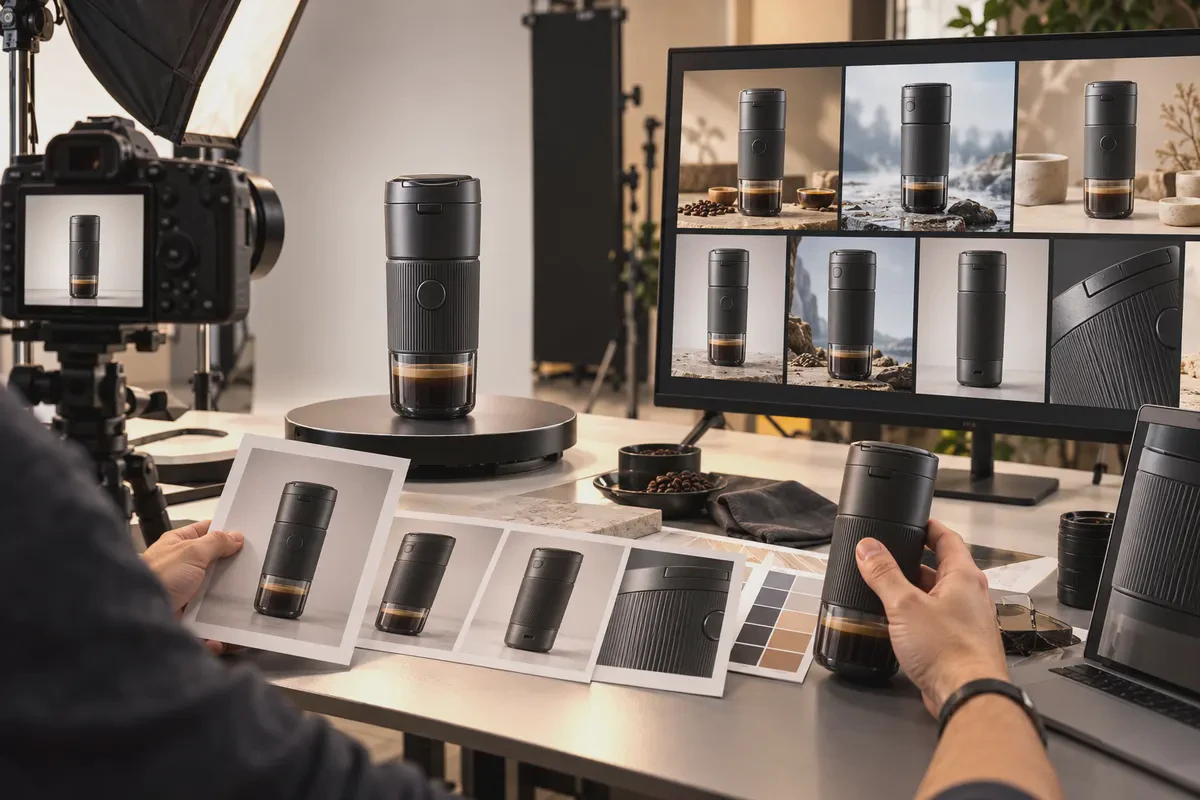
If an ad platform can animate a product image into a short video, does the brand still need a product shoot? Yes—but the valuable deliverable is changing.
The old order form counted final edits and aspect ratios. The next one should also specify reusable inputs that a generation system can act on without inventing the product: verified views, real mechanisms, approved claims, separable sound and copy, and clear rules for what may change.
Meta's October 6, 2026 advertising update makes that procurement question immediate. It does not justify rebuilding an entire library around one platform. It does justify changing what the next production is expected to leave behind.
Separate broad availability from limited access
Meta's announcement describes three related capabilities at different stages.
- Video generation from existing static assets in Advantage+ creative is described as generally available.
- Ads Creative Studio can generate video concepts and variations, then change hooks, audio, clip length, text, captions and ending scenes; the studio itself is rolling out to more advertisers.
- Catalog advertisers can turn product images into product videos at scale, but access is described as a beta for eligible advertisers—not a universal account feature.
Meta also says that, over the coming months, it plans to expand recommendations that analyze an ad's image, text and landing page, identify the featured product, and suggest related or best-selling items. That is Meta's roadmap. It does not establish an industry-wide transition, and a beta should not be written into a production plan before the relevant account confirms access.
The structural signal is narrower and more useful: platforms are beginning to do both the versioning and part of the product selection. Brands therefore need stronger control over the product truth that exists before generation begins.
A good catalog image is not automatically a good video input
A still only has to look correct for one moment. Motion forces the system to infer information outside the frame: the back of a bottle, the number of ports, how a lid opens, how fabric behaves under tension, what appears on the next interface screen, or how a hand should contact the object.
Those gaps are not reliably solved by a longer prompt. Generative tools can invent motion and context. Product facts should come from verified source material. Packaging copy, model differences, compatibility, safety actions, performance proof, included accessories and operational sequence are especially poor candidates for machine guesswork.
This is distinct from ONCE's earlier framework for a recomposable cross-media asset system. That system asks how one claim survives video, display and audio. This article asks what must be locked before a model is allowed to make a real product move.
The ONCE Product Truth Kit
Instead of starting with a list of final exports, structure the next product shoot around three layers.
Layer 1: truth-locked evidence
This layer contains what the model is not allowed to rewrite:
- front, back, side, top and critical-detail views for every relevant SKU, color and packaging version;
- dimensions, proportions, ports, controls, labels, included items and visible version differences;
- claims and limitations approved by the product or compliance owner;
- real proof actions such as connecting, locking, folding, installing, cleaning or replacing;
- footage showing how the material reflects, bends, transmits light or contacts a hand.
If a claim will be difficult to reconstruct without the sample, engineer or production line, capture it while those resources are available. ONCE's proof-asset method for Digital Product Passports offers a related way to prioritize hard-to-repeat product states.
Layer 2: generation-safe material
This layer creates room for variation without asking the model to rebuild the product itself.
Useful inputs include clean compositions with safe space, replaceable backgrounds, isolated shadows or transparent product cutouts, images without baked-in prices or language, one-action clips, separated voice and music, and editable captions and end cards. The season, scene, motion treatment or opening rhythm may change. Silhouette, labels and operating logic may not.
Clean inputs make format and concept variation easier. Ambiguous inputs automate ambiguity.
Layer 3: version governance
Every input needs a minimum record: SKU and color, capture date, source ID, market, rights status, permitted transformations, protected elements, expiry date and approver.
Meta's current generative-ad transparency policy says that significant edits made with its generative tools, or the inclusion of an AI-generated photorealistic person, may trigger AI information labels. A label helps explain how an ad was made. It does not certify product accuracy, rights or claim compliance. The brand still needs its own input, generation and approval record.
Route each shot by factual risk
Do not govern the whole campaign with a single “AI allowed” switch. Route shots into three risk classes.
Low factual risk: abstract backgrounds, lighting changes, simple pushes, format adaptation and atmospheric motion without product contact. These are usually the best first candidates for generation once the product subject is locked.
Medium factual risk: lifestyle placement, handheld interaction, limited-angle rotation, material close-ups and people sharing the frame with the product. Review proportion, contact physics, text and structural continuity across frames.
High factual risk: safety procedures, installation steps, load or protection proof, health claims, compatibility, exact interfaces, packaging instructions and accessory counts. Prefer live capture or a controlled composite grounded in verified footage. Do not ask a model to complete unknown product behavior.
This routing is not anti-automation. It spends generation on the parts where variation creates value. A background can support twenty treatments; one false installation action can invalidate all twenty.
Measure accepted inputs and usable outputs
Two internal denominators make the procurement conversation more honest.
Cost per approved generation input = (fact review + reference capture + asset preparation + rights clearance + QA + version registration) / inputs that pass the truth and rights gates
Generation acceptance rate = outputs that pass product, brand, channel and rights review / total generated outputs
If a system produces 100 clips and eight can run, the scale claim should not use 100 as its meaningful denominator. If one well-prepared input supports repeated approved generation, a higher initial capture cost may still reduce future sample retrieval, masking, structural correction and briefing work.
These are not ROAS metrics. They do not replace sales or incrementality testing. They answer an earlier question: how many reusable inputs did production create, and how much of the automated output was actually fit to publish?
Google Cloud's January 2026 brand-consistency workflow illustrates the same operational dependency from another angle: automated review works only after vague brand preferences are translated into precise, measurable criteria, and video checks must continue across keyframes. That example addresses brand rules rather than product compliance, but the input lesson is relevant.
Change the completion criteria in the next brief
For a one-off campaign with few SKUs and no confirmed account access, conventional final-edit delivery may remain the efficient choice. There is no need to buy an elaborate system for a hypothetical workflow.
For multi-SKU, multilingual, always-on or seasonal programs, add four completion criteria: verified reference coverage for each SKU; a list of facts that cannot change; separable visual and audio layers that may be generated; and a version trail from source input to approved output. Final edits still matter, but they are no longer the only asset the project creates.
Meta's update shows that the cost of moving from static imagery to video is falling. It does not show that one image can fully describe a physical product, and it does not transfer responsibility for product truth to the platform. The durable production purchase is a set of inputs that automation can use, boundaries it can respect, and records that reveal where a bad output came from.
Source scope
Changing platform facts were checked against Meta's October 6, 2026 Advertising Week New York announcement, the current Meta Blueprint page on product media, Meta's generative-ad transparency update revised in June 2026, and Google Cloud's January 2026 technical example for machine-readable brand review. These sources establish their respective tools and approaches; they do not prove universal availability or performance. The Product Truth Kit, risk routing and cost denominators are ONCE's analysis.