TikTok announced on October 5, 2026 that Search Ads Campaign is being integrated with Smart+, adding automation across keywords and creative. For media buyers, that is a campaign workflow change. For brands and production partners, the more consequential shift is that the content of a video can help shape how the system understands and expands search coverage.
That changes the brief. A batch described as “ten vertical videos” says nothing about which buyer questions the footage can answer. When creative content, keyword themes, ad text and product information all inform matching, generic short-form volume becomes an ambiguous input. Brands should instead commission recognizable, verifiable proof modules organized around search-intent clusters.
What TikTok has actually confirmed
Four current first-party documents establish the mechanics without requiring any performance promises.
- On October 5, 2026, TikTok Newsroom announced that Smart+ would bring automation to Search Ads Campaign across keywords and creative while advertisers retain controls over their setup.
- TikTok’s Search Ads creative guidance, updated in January 2026, says selection considers the relationship among the account query, ad keyword and creative content. It also says relevance is evaluated for each keyword–creative pairing rather than averaged across an ad group.
- Its Automated Keywords documentation, updated in March 2026, says the system analyzes video, images, text and product information alongside manually supplied keywords to identify additional search opportunities.
- The campaign setup guide, updated in August 2026, lists Traffic, Sales, Lead Generation and App Promotion objectives, with video, carousel and catalog formats subject to availability.
These documents prove what TikTok offers. They do not prove that every advertiser will gain incremental sales, or that every market and account has identical access. A July 28, 2025 Digiday report based on agency interviews still described TikTok search advertising as an emerging area with mixed early results. The defensible procurement decision is therefore about input quality and learning value, not a promised return.
Why a generic short can become a weak search input
In a feed, a fast hook and attractive product reveal may be enough to earn attention. Search adds another constraint: the viewer arrives with a question.
“Will it fit a small apartment?”, “Can I take it on a flight?”, “How is model A different from model B?” and “Does installation require drilling?” are not variations of the same intent. A polished montage can identify the product category yet remain unclear about the decision it resolves. If the landing page answers a different question, the chain becomes weaker still.
For search-led creative, the minimum useful unit has three linked parts:
- Intent cue: the opening frame, voiceover or on-screen language identifies the decision.
- Observable proof: a product action, construction detail or controlled comparison demonstrates the claim.
- Qualification: the asset states the relevant model, use condition, limitation or next step, then hands off to a matching destination.
This is adjacent to, but distinct from, a creative memory ledger. A ledger records what each deployed version tested. The framework here determines what each version must answer before production begins.
The ONCE Intent–Proof Matrix
Before storyboards, build a matrix with four intent families. These are production categories, not TikTok campaign settings.
1. Problem recognition
The audience is still deciding whether the problem is relevant. Show the situation in which the need becomes visible, then place the product inside that cause-and-effect chain. Detailed specifications can wait.
2. Capability verification
The audience knows the category and wants to know whether a feature works. Capture one observable action: connection, installation, opening, cleaning, stabilization, fit or a status transition. A claim that cannot be demonstrated on camera should be supported by an approved manual, test document or landing-page statement instead of simulated visually.
3. Comparison and fit
The buyer is choosing between models, contexts or user types. The proof must expose the qualifying difference. The same headphones might need separate modules for portability, meeting pickup and motion stability. Combining all three into one universal montage can weaken all three questions.
4. Purchase-risk reduction
The buyer is close to action and is checking compatibility, packaging, setup, returns or support. Use short confirmation shots, and keep durable product facts separate from market-specific policy text that may change.
For each row, record five fields: query language, first-frame cue, proof shot, qualifying condition and destination handoff. Then apply one practical acceptance test: if the title is hidden, can a reviewer still name the buyer question and the visual proof supplied by the footage?
Quote the shared core and the intent modules separately
A modular production budget can be expressed as:
Batch cost = shared production core + intent-specific proof modules + hook/close variants + localization + factual review and search-term readback.
This is a scope model, not an industry benchmark. It shows where work is genuinely shared. Lighting, set construction and hero product footage may serve several clusters. A proof action that needs a different prop, hand model, test condition or landing page cannot honestly be priced as “just another caption.”
A production order should specify the number of intent clusters, proof task per cluster, actions that must be filmed, reusable common footage, language versions, first-frame and thumbnail needs, destination owner, claim approver and the cadence for reviewing search terms. If your team already has a mature media workflow, add those fields to the production brief. If it does not yet review search-term reports, start with two or three clusters instead of covering every keyword at once.
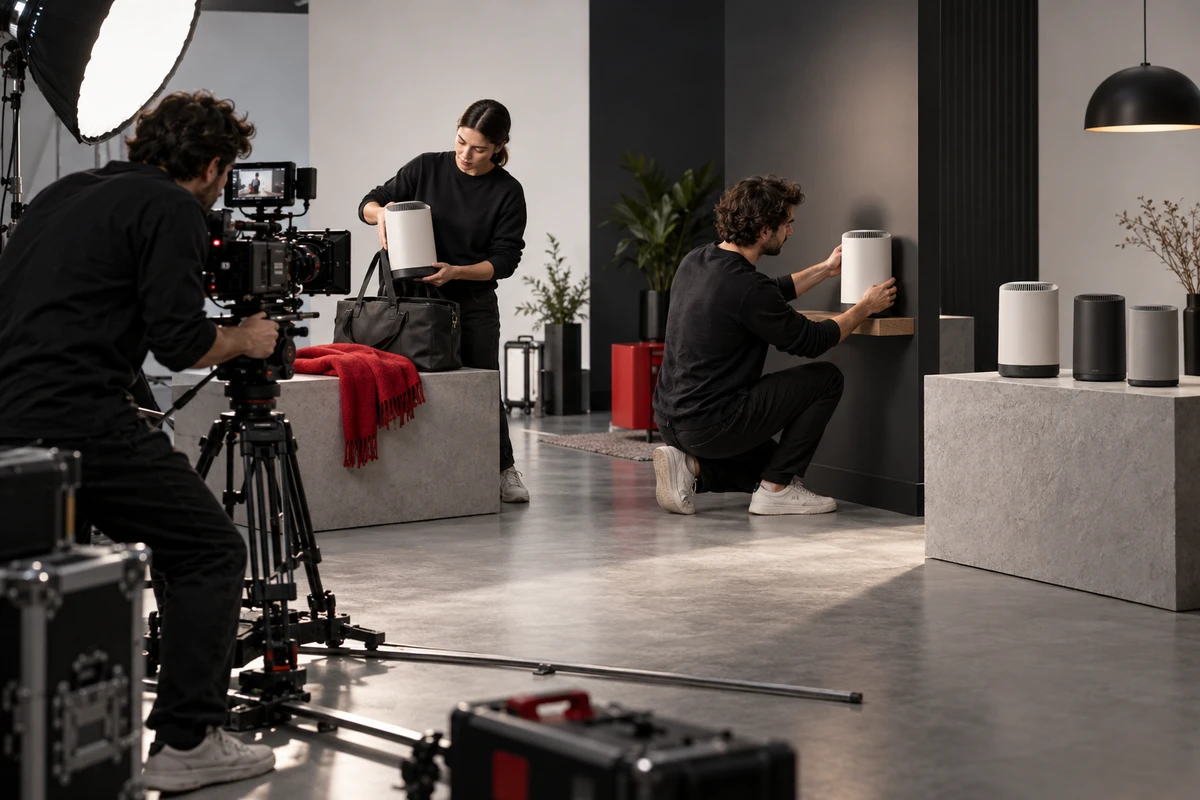
For brands coordinating overseas marketing with Chinese suppliers, the operational gain is straightforward: product teams can approve proof actions at the source, while market teams localize the query cue and qualification. ONCE’s cross-border short-form production work can then be scoped around evidence modules and account-ready handoffs rather than a folder of undifferentiated exports.
When not to modularize
Three situations still favor a self-contained narrative film.
- The brand must establish a new category or emotional world rather than resolve an existing query.
- The proof depends on elapsed time, a human relationship or an uninterrupted experience that loses credibility when fragmented.
- Search Ads Campaign, Automated Keywords or the relevant objective is not available for the market or account, or query volume is too low to produce useful learning.
In those cases, keep the brand film intact and create a small set of intent-led search assets around it. Modularity is a production architecture, not a reason to turn every shot into an interchangeable ad component.
The procurement decision
When a platform only selects among finished ads, a brand can keep the production brief at the asset level. When the platform reads creative content to expand keywords, judge relevance and combine inputs, the brief must name the question each piece of footage is built to answer.
Before commissioning the next TikTok batch, complete four rows of the Intent–Proof Matrix. That short exercise forces the script, shoot, media plan and destination page to solve the same problem. Teams can then ask ONCE to translate approved product facts, search themes and filmable proof into a production map—deciding what can share a shoot and what requires an independent module.
Source and inference boundary
The feature facts in this article were checked against TikTok Newsroom and TikTok Business Help Center documents updated between January and October 2026. TikTok’s publications establish its product capabilities only; they do not demonstrate an industry-wide transition or guarantee advertiser outcomes. The Intent–Proof Matrix and scope equation are ONCE’s analytical tools, not TikTok requirements or industry standards.