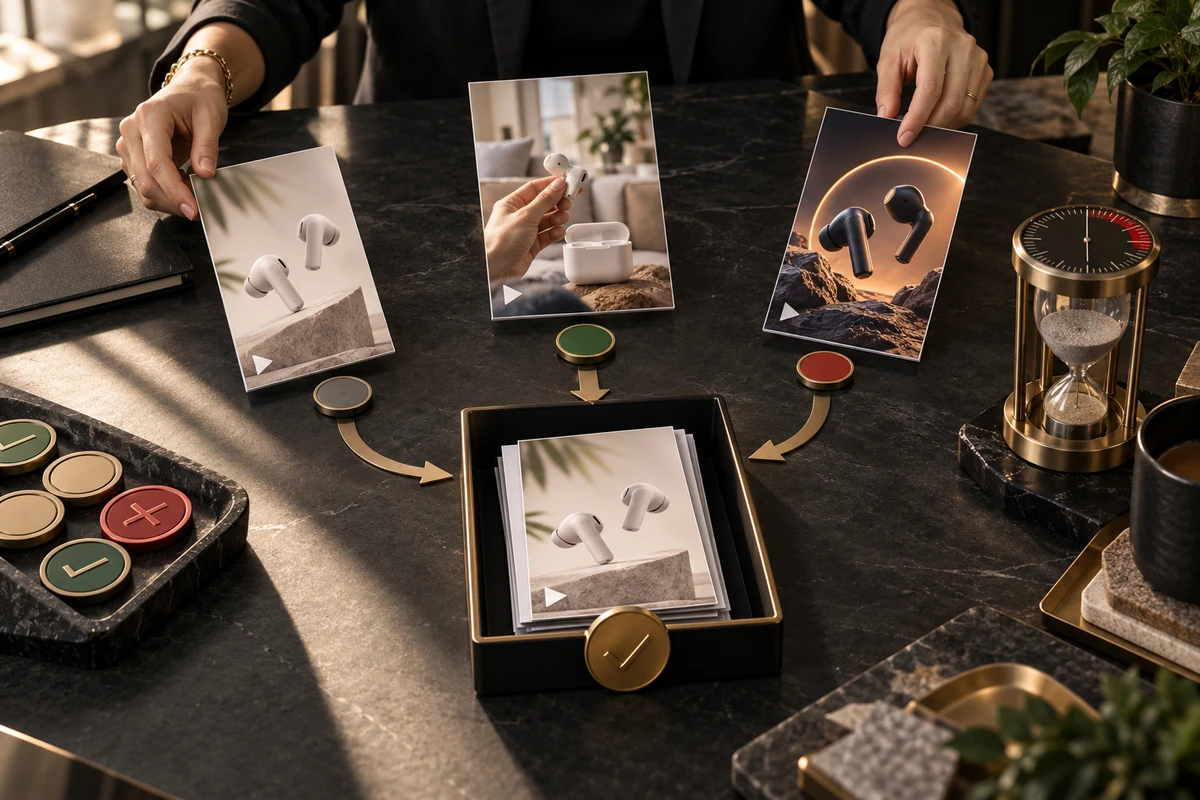
Most brand approval systems were built for a file that stops changing. Legal checks the claims. Brand reviews the edit. Marketing confirms the caption. The approved export goes live.
That model becomes fragile when the delivery system can keep adding candidates after launch.
On October 5, 2026, TikTok announced Smart+ Creative Selection, describing one approval workflow that can bring together advertiser-owned assets, Symphony-generated creative and creator content. TikTok's existing Recommended Creatives documentation already describes a pool containing historical videos, AI-generated variations and authorized TikTok posts. With auto-add enabled, recommendations or generated assets can be refreshed during delivery.
Those are product capabilities, not proof that automation will improve every campaign. The procurement implication is narrower and more useful: once the creative pool can change, approving the final cut is no longer the same as approving what may run.
Three sources enter the pool, but they do not carry the same obligations
Brand-owned footage usually has the clearest chain of control, yet it can still contain expired offers, discontinued packaging or an old product demonstration.
Creator content carries identity, context and a clock. TikTok's Smart+ Spark Ads documentation lets a creator authorize a post for 7, 30, 60 or 365 days. Content Suite authorization requests default to 365 days. A post being available inside a library therefore does not make it a perpetual brand asset.
AI-generated and automatically enhanced variants create a different question: what was changed? TikTok's upgraded Smart+ documentation describes resizing, quality improvements, translation and dubbing, while noting that availability may vary by account. A crop is not the same approval event as a new voice, a translated claim or a newly assembled product demonstration.
For overseas brands sourcing content or products from China, this distinction is especially important. The original footage, product facts, creator permission and market copy may be owned by four different teams. A single green check on the final video cannot represent all four.
The ONCE Creative Pool Admission Card
Instead of treating approval as a comment on one export, attach an admission card to every master, creator post and generated variant. It has six fields.
1. Source and parentage
Identify whether the candidate is brand-shot, creator-originated or AI-generated. If it is a variant, record its parent asset and the transformation that produced it. Without parentage, one corrected product error cannot be traced to all affected descendants.
2. Product-fact snapshot
Bind the asset to a SKU, destination-page version, approved name, claim set, offer window and market. Recommended Creatives can use a destination URL and historical assets as inputs. The landing page has therefore become part of creative production, not merely the place a click ends.
3. Transformation permission
State whether the asset may be cropped, translated, dubbed, rescored, given a new hook, recombined with other footage or used to generate a new performance. Permission to promote an original creator post should not be interpreted as permission to manufacture new words or actions for that creator.
4. Rights clock
Record start and end dates, territories, placements, paid amplification, identity, music and likeness restrictions. Expiring assets should enter a sunset queue before the permission ends, not after a platform rejection or creator complaint.
5. Disclosure and claim status
Track commercial-content disclosure, AI disclosure, required qualifiers and the evidence version supporting each claim. Platform approval is not a substitute for substantiation, and one market's approval is not a passport for every region.
6. Activation and withdrawal owner
Name who may admit the asset, who approves auto-add, how often the pool is reviewed, and who can stop delivery after a recall, offer change or rights expiry. If no one owns withdrawal, a larger pool only makes mistakes harder to stop.
Use three permission tiers, not one automation switch
Tier A — eligible for automatic admission. Use this for brand-owned assets with stable facts, complete rights and narrowly bounded transformations, such as approved reframing or technical caption formatting.
Tier B — generate automatically, approve individually. Use this for new hooks, dubbing, translated claims and new shot combinations. Automation may produce candidates, but a human reviews the actual output before activation.
Tier C — human activation only. Use this for creator identity, time-limited permissions, sensitive categories, strong performance claims, or regenerated human likeness and voice. Recommendation can help discover the asset; it cannot decide whether the brand has the authority to use it.
These tiers belong in the production brief. Otherwise, the studio delivers files while the media team receives an unclassified set of operational risks.
Price the pool by safe activation, not file count
A 30-file delivery is not a 30-asset media pool if half the files cannot be activated legally or accurately.
Cost per safely activatable asset = (production + licensing + variant creation + admission review + expiry maintenance) / assets that pass every admission condition for the intended campaign window.
The denominator should include only assets with correct product facts, valid rights, traceable origins, complete disclosures and a named withdrawal owner. Mechanical exports that cannot go live should not inflate the deliverable count.
This changes what a production partner can sell. The valuable package is no longer just more edits. It is a usable system: a master-asset manifest, admission cards, a rights calendar, a variant lineage map, and a withdrawal log.
When this system is worth building
If a campaign is short, every asset is fully brand-owned, no AI adaptation is allowed and auto-add stays off, individual final-cut approval is enough. Do not build infrastructure for a folder that will not change.
Build the admission system when one SKU will run continuously, the pool mixes brand, creator and AI sources, content will cross markets, or the platform may add candidates during delivery. In that situation, the admission card is not administrative overhead. It is what lets a brand increase creative supply without losing control of facts and rights.
Before commissioning the next wave of TikTok creative, have production, media and legal classify the three permission tiers together. Then decide how many masters to shoot and which variables may be generated. For a related measurement handoff before boosting creator content, see Before You Boost a Creator Video, Freeze the Baseline. ONCE's broader perspective on governed scaling is in The Next Creative Deliverable Is the Workflow, Not Just the Asset.
Sources
- TikTok Newsroom, “TikTok Unveils AI-Powered Updates for Advertisers: Driving Discovery, Action, and Measurable Business Outcomes,” October 5, 2026
- TikTok for Business, “About Recommended Creatives in TikTok Ads Manager”
- TikTok for Business, “About upgrades to Smart+”
- TikTok for Business, “How to create Spark Ads for Smart+ Campaigns”
- TikTok for Business, “How to use Content Suite to create and launch Spark Ads”