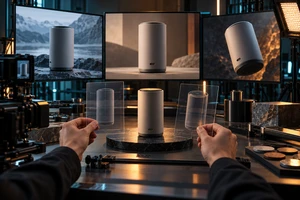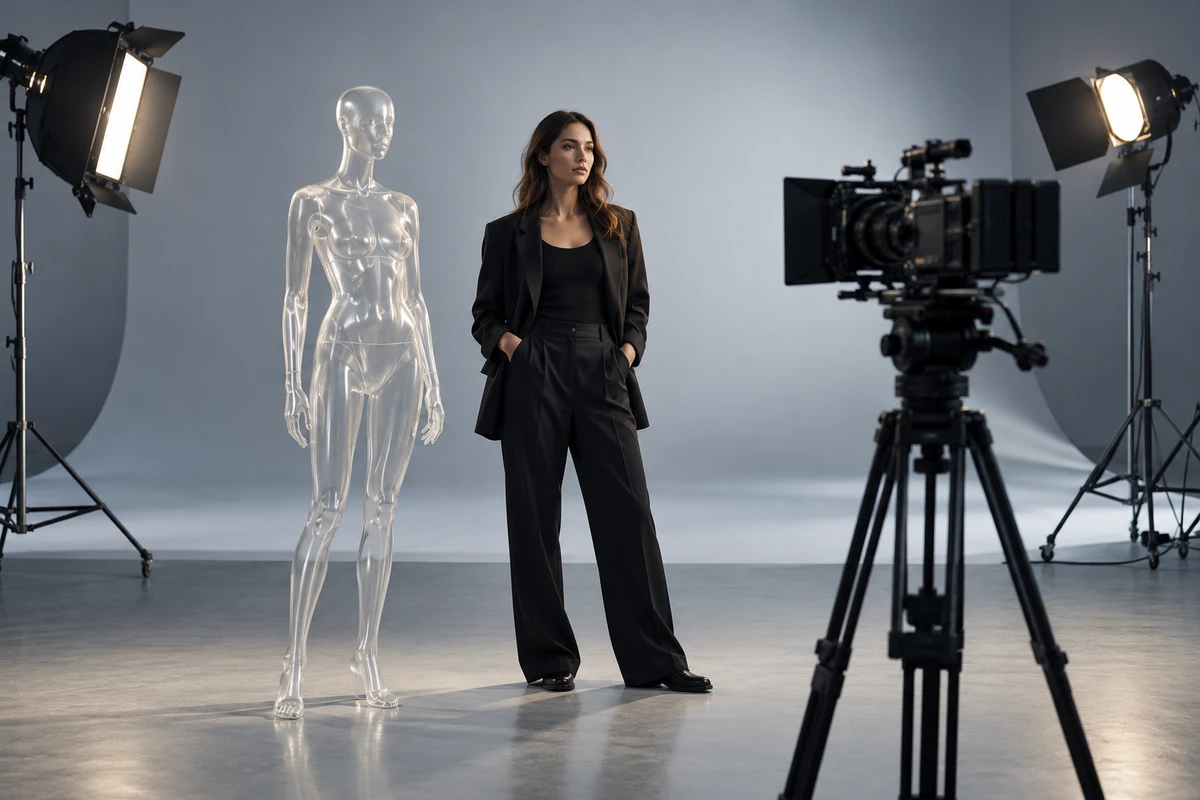
An AI-generated person in an ad can mean two very different things. One is a human-like performer who does not correspond to any identifiable person. The other is a new performance generated from a real actor's face, voice or recorded work. The first creates a consumer-disclosure question. The second creates a talent consent, compensation and retention question. A generic “made with AI” checkbox does not solve both.
California's new gate is not a universal AI label
On September 16, 2026, California Governor Gavin Newsom signed SB 1050. The state's announcement says the law requires disclosure when audio or video advertising uses AI-generated performers to sell goods or services, and enables continued distribution of a violating ad to be stopped. The law is due to take effect on January 1, 2027.
The boundary matters. A synthetic performer under the California framework is a digital figure, voice or representation created wholly or partly with generative AI that gives a realistic impression of a human performance but is not recognizable as an identifiable natural person. New York's current General Business Law Section 396-b draws a similar line.
That is different from taking a recognizable actor, creator, employee or customer and using AI to make that person deliver a line, expression, movement or language performance they did not actually record. Disclosure does not replace permission for that use; permission does not automatically satisfy a disclosure rule.
Three outputs, three release paths
| Output | Working test | Primary control | Common mistake |
|---|---|---|---|
| Conventional or AI-assisted post | No new human performance is generated | Source rights, edit scope and claim review | Treating every AI-enabled tool as a digital-replica event |
| Digital replica of an identifiable person | Viewers can recognize a real person and the system generates a new performance | Creation consent, use consent, pay, approval, retention and deletion | Assuming a broad model release grants unlimited generation rights |
| Synthetic performer not tied to an identifiable person | The figure appears human but is not a specific natural person | Market-specific disclosure, provenance and vendor warranty | Assuming “no real talent” means no release obligation |
This is a production-procurement framework, not legal advice. Counsel still needs to apply the relevant law, collective-bargaining terms and platform rules to the actual talent, market and media plan.
ONCE's five-question routing test
Before casting or generation begins, ask:
- Can the finished performer be recognized as a specific natural person? If yes, open the talent-rights track.
- Did the system create words, voice, motion or expression that person did not actually perform? If yes, do not approve it as ordinary post-production.
- Does a human-like but non-identifiable synthetic figure perform a prominent selling role? If yes, open the synthetic-performer disclosure track.
- Where will each version run? Market, state, medium and language determine the disclosure specification before the master is locked.
- Who can produce the evidence trail? Source files, consent, script versions, generation logs, talent approvals, disclosure renders and deletion records all need owners.
If any answer lacks an accountable owner, the ad is not yet a release-ready asset.
Price a digital replica as three transactions
The 2025 SAG-AFTRA Commercials Contracts provide a concrete operating reference. Performer consent is required before a digital replica is created. Use requires a reasonably specific description of the intended generated performance. A generated performance triggers a 1.5-times session fee plus applicable holding and use fees. Access must be limited, and retention beyond the last commercial's maximum period of use requires further consent; otherwise the replica must be destroyed.
Those terms apply to covered productions, not to every performer or jurisdiction. Their wider procurement lesson is that brands should not collapse three different purchases:
- Live performance: work the person actually performs on set or in a recording session.
- Replica creation: scanning, face mapping, voice modeling or dedicated capture used to build the asset.
- Generated-performance use: the value created when the replica delivers a new line, movement, language or ad version.
Use this budget structure:
Release-ready cost = live performance + replica creation + generated use and holding + localization + disclosure versioning + evidence administration + risk reserve
This is an ONCE procurement formula, not an industry average. It prevents a cheap generation quote from hiding the cost of renewed consent, disclosure rework, replacement media or a reshoot.
Nine fields belong in the brief and contract
1. Person and product category
Name the person, brand, product and prohibited categories. “Marketing use” is not a sufficiently operational scope.
2. Separate creation and use consent
Permission to build a replica is not blanket permission to generate any future performance. Capture both approvals separately.
3. Script and output approval
Specify who approves new lines, languages, mouth movement, actions, emotional tone and the final render. Material changes trigger a new approval.
4. Media, territory and term
List paid social, commerce pages, CTV, retail media and in-store screens, alongside countries, states and end dates.
5. Training boundaries
State whether files may train a foundation model, a client-isolated model or no model beyond producing the commissioned output. Generating one ad should not silently become permission to improve a general system.
6. Retention, access and deletion
Record who holds the replica, who can download it, when access freezes, when deletion occurs and who supplies proof.
7. Subprocessor chain
Agencies, production partners, dubbing vendors and AI providers must inherit the same restrictions.
8. Disclosure specification
Put required wording, placement, duration, language and audio treatment in the deliverables list. Archive the released version, not just the clean master.
9. Renewal and withdrawal
Define renewal pricing, reapproval triggers, takedown timing and how cached or historical ad placements are handled.
Build a human-performance evidence pack
The ICC's March 2026 Responsible AI in Marketing guidance says permission should ordinarily be obtained when AI generates or materially repurposes the likeness of a real, identifiable person in marketing communications, and the permission's scope should be respected.
Turn that principle into six release artifacts:
- identity and source provenance for every human-like performer;
- the base talent agreement plus separate AI creation and use consents;
- approved scripts, languages and product categories;
- vendor, model-purpose and subprocessor records;
- talent approval tied to the final file hash or version ID;
- market-specific disclosure renders and a retention/deletion schedule.
The brand owns the prohibited-use boundary. The agency or production company translates it into scripts, versions and delivery gates. The AI vendor proves isolation, model purpose, access control and deletion. Tool permission is never a substitute for talent permission or advertising compliance.
The practical decision for global brands
If a project uses noise reduction, cleanup, color work or another edit that does not generate a new human performance, conventional source-rights and edit review may be enough. If a recognizable person will speak an unrecorded line, appear to perform in another language, or receive newly generated mouth or body movement, open the digital-replica rights track before production. If the selling character is entirely synthetic and not an identifiable person, open the market-disclosure track before the master is finished.
For brands that want one shoot to scale across markets, the safest commercial structure is not an indefinite “AI buyout.” It is an expandable rights package: one product category, defined markets, a fixed term and approved scripts, with new language, media and performances added through documented consent and pricing. That preserves scale without building the next version on rights nobody can prove.
ONCE can incorporate this routing test into talent paperwork, generation controls and multi-market delivery through its cross-border video production workflow, so the evidence ships with the campaign rather than being reconstructed after launch.