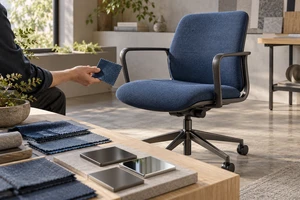
If the books, clothes and people in an ad can all float, why does this particular product need to be there? Weightless CGI ads can deliver beautiful images without finding an idea that belongs to the brand. A bottle, a chair or a shoe might occupy the same suspended position. If replacing the item barely changes the story, the relationship between spectacle and brand is still unwritten.
The useful starting point is not how high things fly, but what has changed in this world and what deliberately stays the same. Weightlessness can suggest freedom, loss of control, waiting or an inability to hold on to anything. Choosing who floats and who still bears weight is a creative decision, not a preset mood.
Weightlessness does not have one emotional meaning
Burberry's Open Spaces offers an existing approach. In its first-party project description on Creativepool, The Mill describes a dreamlike flight through the British countryside, driven by weightless, twisting choreography. The 2022 D&AD archive entry, Burberry 'Open Spaces', explains that two key sequences used photogrammetry and CG scenery to allow the cast and garments to float through the countryside and into the sky. These texts were checked again on October 19, 2026. They are not a substitute for a shot-by-shot viewing, nor evidence of sales or campaign performance.
That creative premise raises a useful question: once bodies leave the ground, how do their relationships with clothing, companions and surroundings change? The opportunity is not that a particular effect inherently means freedom. It is that the spectacle can accommodate specific actions. Someone repeatedly reaching for things they cannot grasp could make the same weightlessness feel unsettling instead.
A reference is therefore most useful for the creative question it opens up, rather than as a set of flying poses to transplant. Giving furniture, drinks or electronics the same suspended movement does not automatically carry another brand's meaning across. Define what the character wants to leave behind or move towards, and the digital world has something specific to serve.
Let the chair stay on the floor
Consider an original, fictional furniture ad, with no client, finished film or test behind it. An adult returns to a reading corner carrying a closed book and a piece of cloth waiting to be put away. They are still busy. After they sit down, the book and cloth slowly hover nearby. The chair does not rise, and the person does not fly away. The thought is not that every task is finished, but that some things can be left hanging for a moment.
The chair's refusal to float is how it participates in the idea. Nearby objects have left their ordinary positions, while the body still has somewhere to settle. The product does not have to spin with everything else or suddenly grow larger to reclaim attention. Its different state can provide the composition's centre of gravity.
Making the chair float too would not necessarily be a worse idea, but it would change the meaning. The story might become an escape from reality or an imagined journey. The person's reaction, the destination and the ending would then need reconsidering. Sending the whole room away while still asking viewers to read it as “stay here for a while” pulls the concept in different directions.
Grounded and suspended states are storytelling choices here, not proof of a chair's comfort, stability, load capacity or lightness. Any account of its actual construction or use needs its own accurate treatment. A dream cannot answer those product questions.
Change one rule, but let the actions connect
This furniture concept could change just one thing: objects that have been put aside do not fall. Walls, floor, chair and person otherwise behave ordinarily. The restriction is not about making the effect smaller. It makes the change legible. If every surface transforms and every object tumbles, viewers may be left simply trying to keep up.
How the book leaves the hand deserves its own action. The palm might become still, the fingers slowly release, the book remain in place and the hand then withdraw. What needs comparing is whether release and suspension create a readable surprise, not merely whether a floating still looks attractive. If the book is already in the air before the hand approaches, the action might instead become an encounter with an unfamiliar object. That is a different scene.
The objects need not share one animation pattern either. A closed book could turn only slightly, while cloth retains soft folds. Their individual forms should remain recognisable for this concept. That is not a demand for a scientifically strict simulation of weightlessness; it avoids turning every object into the same smooth particle. Eyelines and the timing of the hand's withdrawal should be discussed alongside the final object positions.
Divide live action and digital work by the action
A production discussion can begin with sitting, releasing and withdrawing the hand, then consider which parts benefit from real performance and objects and which require digital work. What does physical contact establish? At what moment does the hovering object take over? Does the camera need to keep moving? Those questions belong to one continuous action. Writing “live-action person, post-produced background” does not resolve the relationship.
AI imagery could help explore whether “the person stays, the unfinished tasks hover” communicates the intended atmosphere. A concept image does not establish that the release works in motion, however, and it cannot directly replace accurate product appearance or real-use footage. If the idea ultimately needs only a static surreal image, there is no obligation to add complex movement merely to exhibit a production method.
This is not a guide to suspending people or building practical rigs. Decisions about physical supports, separate passes or digital replacement require suitably qualified production personnel and a location-specific assessment. A concept image is not a basis for inferring a safe method.
Give the spectacle a reason to end
The furniture concept could end with the person taking the book back and opening it, while the cloth remains suspended. It would not claim that life has been sorted out. The person simply chooses one thing they want to do now. Alternatively, objects could return to their places. If the ending sends the character straight back into frantic tidying, though, the meaning of the preceding pause changes.
For a shorter edit, the most useful material may not be the shot containing the most floating objects. It may be one clear release, contrasted with the person remaining in the chair. Crop away person and product until only the floating book remains, and the result might be another attractive image with little to say about whose ad it is. There is no universal timing formula here. The edit should preserve the relationship this particular idea depends on.
When developing a surreal brand film, bring real product information and a specific action to ONCE's hybrid video production discussion. What can fly in this world, and what needs to stay? A precise answer gives spectacle a better chance of becoming an expression the brand can own.
This is original creative analysis. The furniture story and AI-generated concept cover are fictional, not a recreation of Burberry footage, a physical product shoot or a product test.