Suppose an approved product shot needs three changes six weeks later: daylight instead of night, a vertical composition instead of landscape, and two extra seconds before the product reveal. If the brand only received the final MP4, “controllable AI video” existed only on generation day. The reference frames, model version, camera instruction, rejected product details and approval logic have disappeared. The revision is effectively a remake.
By October 2026, leading tools are moving beyond one prompt and one result. Google DeepMind’s current Veo page presents reference images, camera controls, first-and-last-frame transitions and outpainting. Adobe Firefly’s composition-reference guide says a 5–10 second video can guide composition and that the same seed, prompt and control settings can produce similar clips. These are vendor-documented capabilities, not proof that every commercial shot is now deterministic. But they are enough to change what a brand should buy.
Our position is simple: an AI-assisted production should deliver a working shot system, not only a finished film. The master still matters, but it is one approved arrangement of that system for one date and channel.
Control changes the unit of value
Conventional production preserves a trail of camera originals, scene and take metadata, edit projects and review notes. An editor can usually trace a close-up back to its source and see which voiceover was approved. AI video can be more fragile. A downloaded clip may have no durable connection to the prompt, reference, model release or human repair that made it usable.
A prompt alone is not the asset. The valuable asset is the answer to two questions: why did this shot pass, and how can the team make another acceptable version? That requires product truth, control inputs, generation records and channel versions to stay connected.
A reusable delivery has four layers
1. A fact-locked product source
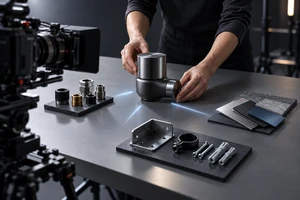
Product geometry, ports, button positions, material response and real operating sequences should not drift with a generation. For overseas brands manufacturing in China, one practical approach is to capture turntables, macro details, hand interactions and lighting plates near the factory or a local studio while the prototype is still there. An approved CAD or 3D asset can serve the same role. AI can then change the environment, atmosphere, transitions or concept imagery around that verified product layer.
This is not an argument that AI can never depict products well. It is an accountability decision. Viewers may read a visible port, hinge motion or operating step as a real feature. If a detail could affect purchase, safety or compliance, the shot needs a source that leads back to the physical product or an approved digital model.
2. Editable shot capsules
A shot capsule is more than a five-second file. It includes the shot’s job in the story: stop attention, explain structure, demonstrate use, create desire or close on the brand. It keeps the approved start and end frames, subject action, camera movement, composition safe zones, product layer, environment layer and audio layer. Four to eight seconds is a useful editorial range for many short ads, not a platform rule.
Once shots are defined this way, a background can change without rebuilding the product action. A vertical version can preserve the intended focal relationship. A new 15-second cut can recombine approved units instead of cropping the old master and hoping it still communicates.
3. A generation ledger
For every approved shot, record the model and version, generation date, prompt, negative constraints, seed or equivalent controls, reference assets and their rights status, human fixes and the approved output. Adobe’s August 2026 Firefly documentation describes Content Credentials as tamper-evident metadata that can include the issuer, date, application, AI tool and processing actions. C2PA defines provenance more broadly as the recorded history of content from creation through later modification and use.
Those standards are useful, but they do not replace a production ledger. Not every platform exposes every field, and metadata can be lost during export, transcode or publishing. The internal ledger answers, “How can our team continue this production?” Content Credentials answer, “What verifiable history can travel with this file?” Brands need both where the risk justifies it.
4. A channel version map
Landscape, vertical and square are not three filenames. They are three viewing relationships. Google Ads currently recommends 16:9, 9:16 and 1:1 assets for video and app campaigns, and notes that overlays, calls to action and controls can change the safe area in vertical placements. That means the production must decide early where the face looks, whether the product can remain central, and whether a claim survives the crop.
The version map should name the shots, opening, information order, mute-viewing requirement, language and CTA for each placement. Then one source system can produce different narratives, rather than one narrative being mechanically resized.
A shot passport is more useful than a prompt dump
| Shot-passport field | Why it matters |
|---|---|
| Narrative job and approval reason | A future editor understands why the shot stayed, not merely that it looked polished |
| Source of product truth | The team can distinguish live action, approved 3D, verified reference and explicit visual hypothesis |
| Start frame, end frame and motion | The shot can be extended, connected or moved to another generation tool |
| Model, version, date and controls | A model update does not erase the explanation of an earlier result |
| References and rights status | A new variation does not accidentally reuse a person, image or track without permission |
| Human repairs and approved output | The brand can distinguish raw generation, post-production work and the accepted frame |
| Ratio, safe zones and audio layers | The asset remains usable for 16:9, 9:16, 1:1, mute viewing and localisation |
This does not require a heavy enterprise platform. A small team can start with a structured sheet and a disciplined folder system. The important part is that one shot ID remains consistent across the storyboard, generated clips, review notes, edit timeline and delivery package.
Where live action should remain the factual layer
Live action is usually the stronger factual layer when a shot must prove the product exists, show an exact interface or mechanical movement, or carry a founder’s or expert’s credible performance. AI can extend the space, change the time of day and build an impossible environment, but it should not silently rewrite the product.
Consider a desktop device that needs both an exact button response and a minimal futuristic world. We would capture the button travel, finger contact, status light and surface reflections first, then place that approved product layer into the generated environment. The creative can be bold while the product claim keeps a traceable source. If the scene only expresses an abstract idea such as quietness or lightness, a fully generated shot has more freedom and may not need a physical plate at all.
What to add to the brief, contract and acceptance review
Beyond “deliver one 30-second film,” a brand can specify:
- which product facts are locked by live action or an approved model, and which elements may vary;
- whether independent shot capsules, clean plates, editable projects and separated audio are included;
- whether model versions, references, key controls and approval decisions are retained;
- whether landscape, vertical and square are genuinely recomposed or merely auto-cropped;
- what counts as an adjustment versus a remake when a model changes, a reference expires or the product specification moves;
- how product files, human references and rejected generations are archived or deleted after the project.
The package should scale with the work. A disposable social post may only need a lightweight record. A global launch, a long-life product or a campaign expected to iterate for months deserves the complete system.
Better models will keep arriving, and today’s preferred tool may be replaced quickly. The durable brand asset is not one spectacular generation inside a vendor account. It is the set of approved product facts, visual relationships and creative choices that can survive the next brief, format and model. Deliver those as editable, traceable shot assets, and AI video becomes a production capability rather than a sequence of experiments.
For the earlier planning layer, see ONCE’s guide to building a brand AI video workflow from brief to delivery.
Sources and scope
- Google DeepMind, Veo 3.1, accessed October 3, 2026, for documented reference-image, camera-control, first-and-last-frame and outpainting capabilities.
- Adobe Firefly, Use video as composition reference, updated June 16, 2026, for composition references, supported ratios, seed and control-setting guidance.
- Adobe Firefly, Content Credentials overview, updated August 25, 2026, for the fields and storage described for Firefly Content Credentials.
- C2PA FAQ, accessed October 3, 2026, for the definitions of provenance and Content Credentials.
- Google Ads Help, Use square and vertical video to engage mobile customers, accessed October 3, 2026, for ratio and safe-area recommendations.
The four-layer delivery model and shot passport are ONCE’s editorial recommendations, not a standard jointly issued by these platforms. The exact fields should be adjusted to the project’s tools, risks and contract.