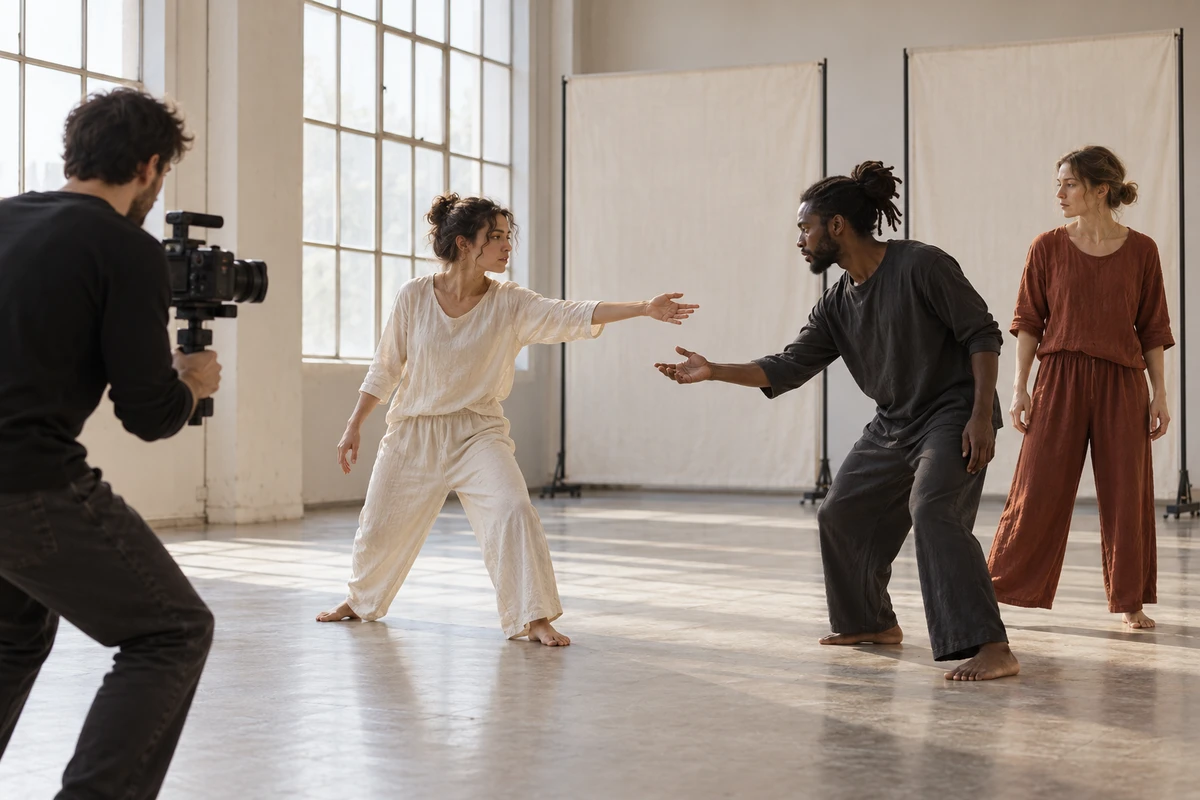
A casting quote can tell a brand how many dancers will attend. It cannot, on its own, tell the brand whether their interaction will survive the camera angle or a vertical edit. For an overseas marketing team commissioning a film in China, that distinction should be settled before the set and equipment package are committed—not discovered while reviewing footage from another time zone.
When a concept depends on one performer initiating, another responding and a third completing a pattern, buy development of that relationship as well as the performance. A simple product pickup may need no separate choreography package. An ensemble whose changing relationship carries the brand idea is a different production problem.
A real launch signal, not a claim about advertising results
On October 6, 2026, Figma’s official article “3 ways product designers use the Figma agent for craft, speed, and creative expression” announced the agent’s move out of beta. The company’s “Find your flow(state)” post credits IVERSON, director David Dinetz and choreographers Tony Testa and Charissa Kroeger. The post displays a relative date, so we are not assigning it an exact premiere date; it was checked on October 17, 2026.
Those primary materials establish the release context and credited creative functions. They do not establish that a dance-led film converts better than a software demonstration. This article is based on public text, not a viewing or shot-by-shot analysis of the film. We have not verified its rehearsal schedule, production spend or campaign performance.
A useful peer comparison is UNBOUND STUDIO’s TERRANOVA BASIC project page. It identifies a 2025 commercial and lists casting, movement direction and choreography, with separate director and cinematography credits. The undated page was checked on October 17, 2026. That is evidence of how this project described its functions—not proof that every production needs a larger crew. One person may cover several functions; each function still needs an owner.
Decide whether movement is doing the right job
Bodies can express hesitation, interruption, coordination or release. They are not a measurement instrument for software response time or product performance. A stylized transition from friction to ease must not quietly become a claim that a tool completes every task instantly.
If buyers need to see a real interface or understand a physical operation, give them a clear demonstration. If the campaign is communicating a way of working to people who already understand the category, movement may be worth developing. These assets can have different jobs; the brand film does not have to explain every feature.
Consider a hypothetical collaboration-software campaign, not an ONCE client project: three adults initially interrupt each other, then learn to pass a movement across the group. The intended change is from competing for the next move to making room for someone else. A beautiful dance that does not reveal that change has missed this particular brief.
ONCE proposes a Movement Relationship Score for the treatment. It is a working method offered here, not an industry standard or a tested predictor of results.
| What to record | What the hypothetical brief would specify |
|---|---|
| Change | An interruption becomes an invitation. Replace “fluid and premium” with something observable. |
| Relationship | A pause by the first performer opens a move for the second; the second redirects attention toward the third. |
| Camera condition | The initiating and receiving performers must be visible at the handover. An impressive camera move must not hide the connection. |
| Version requirement | A shorter vertical film needs a complete interaction of its own. If three people cannot fit meaningfully, develop a two-person variation. |
The score protects the relationship, not an identical sequence of steps. That distinction gives a local team room to solve the scene while preserving what the remote brand team actually approved.
Rehearse three different questions
The following is a proposed process, not a test we have conducted. Simplified props and a lightweight camera setup can be useful starting points, provided their limitations are recorded. Unusual actions, equipment or sets require appropriate professional safety assessment; this is not stunt guidance.
Can the interaction speak without a live explanation?
Keep music or timing cues that the movement depends on, but remove the director’s running explanation. Ask colleagues who did not develop it to describe who initiates, who responds and what changes. “Everyone moves neatly” is not the same answer as “one person makes space for another.” If the latter is the brief, fix the relationship before elaborating the set.
This is an internal comprehension check. It is not target-market research and does not measure recall, preference or sales.
Does it still work from the intended camera position?
Bring the director, cinematographer and movement lead into the same rehearsal. Check overlap, depth, starts and finishes against the planned camera direction. A handover that reads from the front can become two overlapping arms from the side. A push-in can remove the person who makes the sequence intelligible.
Try changing positions, timing or camera holds before assuming more cuts will rescue the idea. Editing may create energy while removing the very connection the film needs. The movement lead shapes the handover, the cinematographer makes it visible and the director decides which relationship matters. Production can then cost the resources that serve it.
Does each commissioned version contain a complete idea?
Review the intended short duration and actual aspect ratio, not only a wide rehearsal recording. A relationship spread across the left and right edges may need depth staging or a separate sequence for vertical delivery. A crop guide alone does not show whether the initiating action and response remain in the finished frame.
If repeated revisions still require extensive explanation, reduce the ensemble or simplify the handover. A direct demonstration may be the better answer. Sunk enthusiasm for a dance sequence is not a reason to keep expanding the set.
Commission an approval package before the production scale
For a movement-dependent concept, consider two paid approval stages: development with camera rehearsal, then final production. The first package should include the score, a camera-position rehearsal recording, representative version studies and a short list of unresolved issues. Agree what these can establish before approving the corresponding cast, space and equipment.
The scope should state whether rehearsals use stand-ins or final performers, whether camera participation is included, how prop dimensions and costume restrictions are addressed, and how many direction changes are covered. Changes to the music, ensemble or core relationship may require a new estimate. A stand-in rehearsal does not guarantee that a different cast can reproduce it without further work.
For teams commissioning across borders, approval notes should point to visible moments in the recording, with the relevant version attached. “Keep the invitation before the response” gives the production team a decision they can preserve. “Make it feel more effortless” leaves them to guess. Agree who can approve changes if availability or location constraints alter the staging.
This is not a promise of a particular saving, and it is not a request for unpaid speculative filming. It moves a consequential decision ahead of larger commitments. For a longer-term ONCE content offer, the useful asset could be an approved movement language and the reasons behind its adaptations—not simply another finished file. That is a proposed direction, not a claim of an existing product, proprietary dataset or revenue stream.
Bring the intended relationship and real delivery formats to the next creative brief. Before asking how many dancers to hire, ask what the camera must allow the viewer to understand.