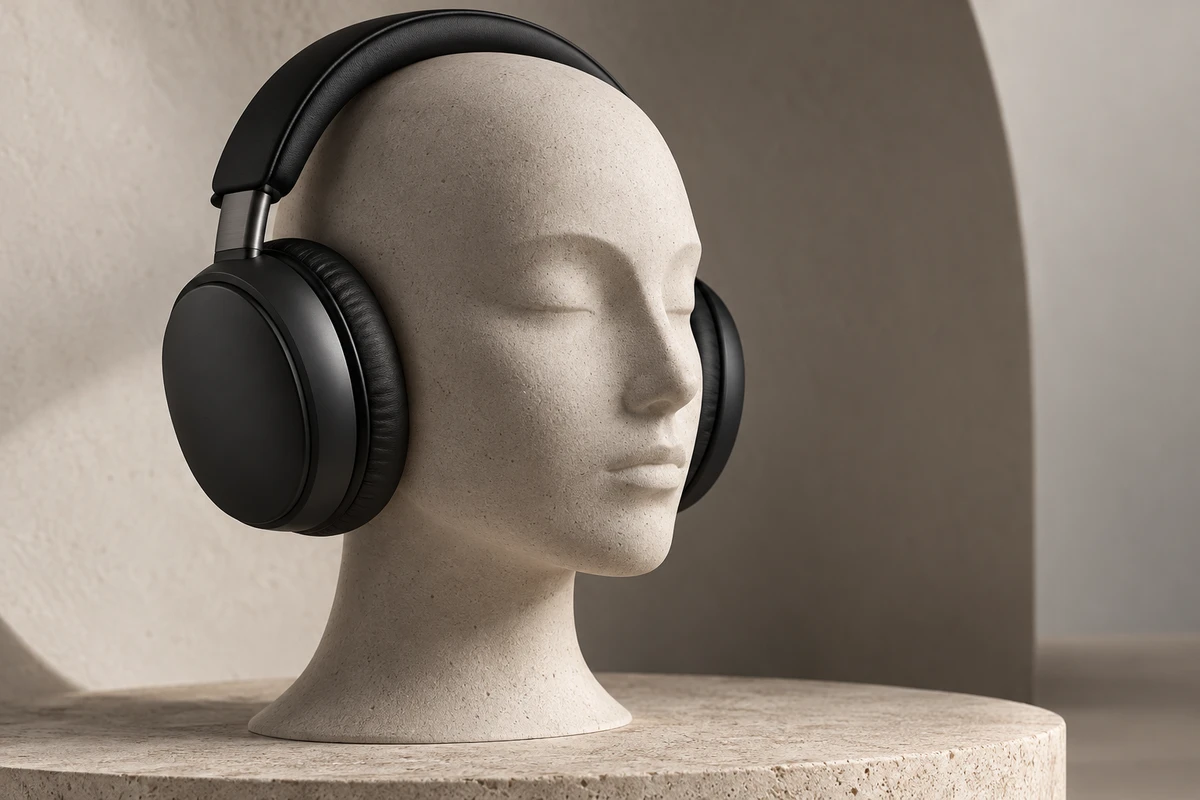
When a headphone film drops the sound of a train, office or aircraft cabin to near silence, viewers immediately understand that noise cancellation has been switched on. For a buyer, however, that edit proves only that the creative team can shape a soundtrack. It does not prove that the product produces the same attenuation when worn.
The practical answer is not to abandon drama. It is to separate the film into three layers: a visible and repeatable operation, test evidence already approved by the brand, and experiential sound design that is clearly presented as a creative interpretation. Each layer answers a different question and needs a different acceptance standard.
Lock three inputs before the shoot
The first input is the product state. Confirm the exact model, firmware, app build, default mode, switching method and whether the production samples can reproduce those states reliably. Depending on the product, the user may switch modes with a button, touch control, app or operating-system control centre. A generic script should not hard-code one action before this has been checked. Apple’s current support page separates controls on the headphones from controls on a phone, watch or computer, and also notes that fit affects active noise cancellation performance. See Active Noise Cancellation and Transparency modes for AirPods.
The second input is the performance material that may be published. This may be a brand-approved attenuation chart, a conclusion from a test report or simply qualitative language cleared by legal. The aim is not to collect the largest possible data pack. It is to decide which numbers, conditions and comparisons may appear in the advertising. For work distributed in the United States, objective express and implied claims need a reasonable basis before publication under the FTC Policy Statement Regarding Advertising Substantiation. Other markets still require their own legal review.
The third input is the communication job. A launch-screen film, a product-page feature clip and a six-second feed ad do not need the same balance of operation, evidence and experience. Map the hero film, cutdowns and stills before production so the evidence shots are not removed later simply because the edit needs more pace.
For a real reference on how wearing actions and lifestyle scenes can support an earbud film without turning expressions into performance claims, review the Serena Hear+Hi earbud case. This article goes one step further and focuses on the evidence boundary for active noise cancellation.
Layer one: film the mode change as one continuous action
The first job of a feature shot is not to make the world disappear. It is to show that the user completed a repeatable action. One continuous sequence can show the person putting on the headphones, pressing or touching the correct control and then confirming the mode through a real product cue, indicator or app state. Keep the performer, environment and camera direction consistent across the change so the audience does not confuse a scene change with a performance change.
If the app state matters to the sales page, capture the real interface separately and synchronise it with the live-action gesture in post. This is usually clearer than filming an unreadable phone screen on set. The screen recording, production sample and headphone state should all use the same build. Placeholder interface elements should be gone before delivery.
A performer’s expression can support the story, but it is not a measurement. Relaxing, returning to work or becoming absorbed in music shows the intended experience. It cannot replace evidence for a product claim. Once this boundary is agreed, the director can make the scene emotional without forcing one exaggerated reaction to carry the entire proof.
Layer two: why the camera microphone cannot speak for the wearer
Active noise cancellation operates inside the acoustic system formed by the headphones and the wearer. Bose explains that microphones detect surrounding noise and digital processing produces an opposing signal. Passive sealing, fit and the type of noise all affect the result; steady background noise is generally easier to address than sudden sounds. Lowering a microphone track recorded beside the camera does not capture what happened inside the earcup or near the ear canal. See How do noise cancelling headphones work?
Objective measurement follows a different workflow. Listen describes a setup using a head-and-torso simulator or alternative fixture, an audio measurement system and a physical background-noise source. The process compares an unoccluded measurement, passive attenuation with the headphones fitted and ANC switched off, and an active measurement with ANC on. Attenuation is then assessed by frequency. A normal location recording has neither the same fixture nor the same measurement position, so a polished waveform animation should not be labelled as measured proof. See Headphone Active Noise Cancellation Measurement.
This does not mean every commercial shoot must rebuild an acoustic laboratory. There are two workable routes. If approved test material exists, state its conditions accurately and translate it into legible graphics. If no publishable test material exists, show the operation and the scenario value without adding specific decibel reductions, frequency claims or promises of complete isolation.
Layer three: experiential sound can be dramatic if its role is clear
A commercial still needs feeling. The rumble of a train can recede; an open-plan office can give way to music. These are effective storytelling choices. The problem is not that sound was designed. The problem begins when designed sound is presented as a measurement.
Build the soundtrack in four groups: an untreated location reference, the environmental layer used for the story, music and genuine product cues, and the experiential ANC treatment. The hero film can use the last group, but captions, adjacent product copy or the legal review record should identify its role. A practical note might say: “Sound design illustrates the listening experience. Actual results vary with fit, environment and device settings.” If a long note would disrupt the hero edit, keep the same meaning in the surrounding product copy and approval record.
Visual metaphor can do some of the same work. The space around the wearer may become calmer, camera movement may shift from crowded to stable, or the private listening world may contrast with the unchanged public environment. Metaphor is allowed to carry imagination. It should not quietly inherit the role of a laboratory result.
Do not approve the film by listening only to the final mix
A reusable ANC product film should answer six questions at handover:
- Does the mode-switching action match the current product and firmware?
- Do the app interface, product cue and headphone state belong to the same version?
- Does every number, curve and comparison have brand-approved source material and test conditions?
- Is experiential sound clearly separated from test evidence, with the necessary qualification retained?
- Does the handover include the location reference, mix stems, clean screen capture and a claim sheet for future versions?
- With sound muted, can viewers still understand what the user did; when the film is heard on headphones, does the experience avoid overpromising?
The same approach applies to other products for which sound is part of the value, although the evidence sits in a different place. An appliance film records machine sound in the external room. ANC is produced inside the wearing system, which makes an outside location track even less suitable as a substitute for the wearer’s experience.
A strong headphone feature film does not have to choose between truth and impact. It gives repeatable operation to the camera, objective claims to traceable evidence and immersion to clearly framed creative expression. The trade-off is one more product-state and claim review before production. The return is a hero film, cutdowns and product-page assets that can be reused with fewer hidden approval risks.
If you are preparing a headphone launch or cross-border product page, start with the product state, publishable evidence and channel versions. ONCE can turn those inputs into a feature-evidence and shot-layering plan before deciding what should be filmed, visualised from approved data or expressed through sound design. Review our product video production approach or share the brief with ONCE VISUAL.