Imagine one product that needs six markets, four finishes, three commerce environments and a year of social content. Another shoot feels safe. A product digital twin sounds scalable. But the investment decision is not “Can 3D look real?” It is: which parts of the product can become governed, reusable truth; how many approved outputs will reuse that truth; and who is accountable when the digital version no longer matches the item leaving the factory?
On March 16, 2026, Adobe and NVIDIA announced a public beta for a cloud-native, identity-preserving 3D digital twin solution built for marketing. The stated use cases include packshots, lifestyle imagery, configurable product experiences and virtual try-on, with OpenUSD providing a common scene foundation. Adobe’s enterprise workflow documentation, updated April 20, lists three starter templates: standardized packshots, 360-degree spin video and composite imagery.
That is meaningful infrastructure progress. It is not evidence that every brand should replace photography.
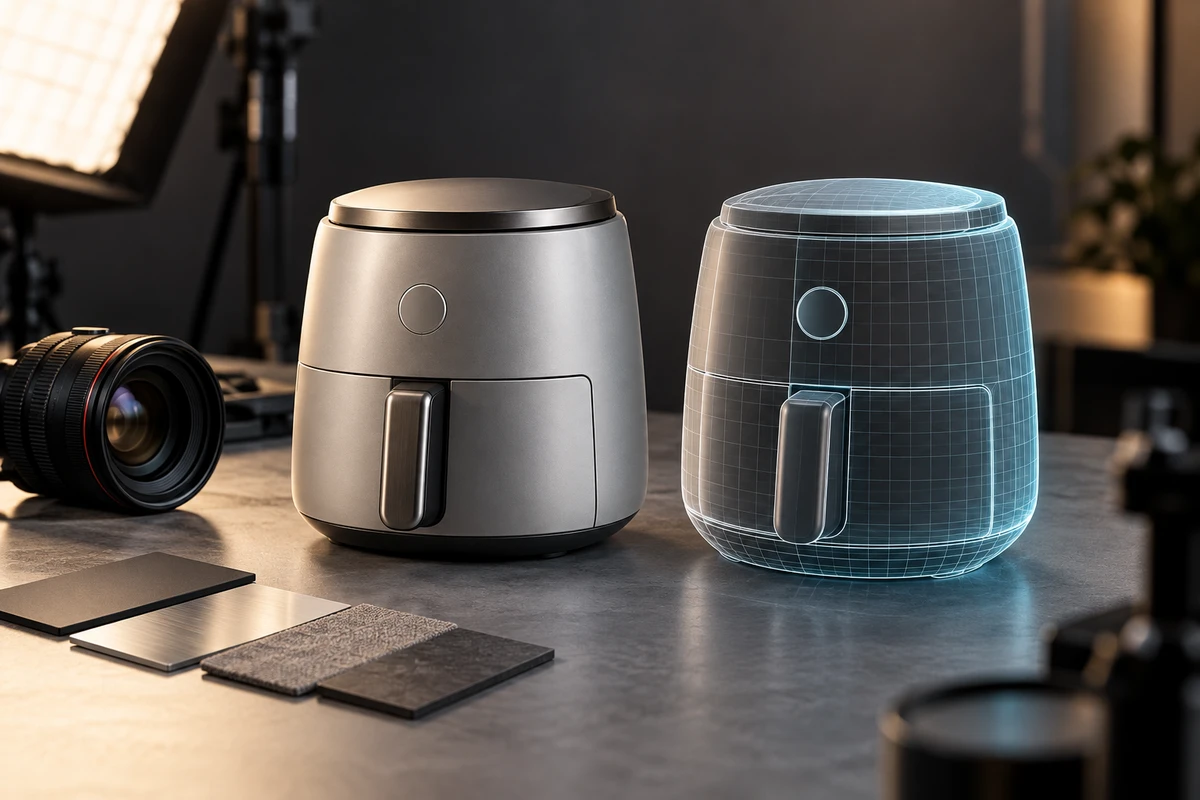
Our view is more specific: a product digital twin is not a cheaper one-off asset. It is content infrastructure with an upfront build, a validation burden, version governance and a future reuse obligation. It earns its place only when product change is parameterizable, reuse is substantial, and someone owns the relationship between engineering truth and marketing output.
Product truth has four layers
The weakest procurement brief asks for a model that “looks exactly like the product.” The phrase collapses four different validation jobs into one subjective approval.
| Truth layer | The question | Required inputs | Likely approver |
|---|---|---|---|
| Geometry truth | Are silhouette, dimensions and component positions correct? | CAD, engineering drawings, physical measurements | Industrial design or engineering |
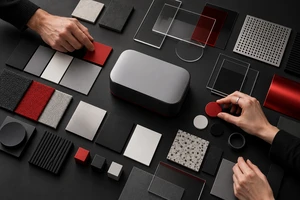
| Surface truth | Do metal, plastic, glass, coating and labels respond credibly to light? | Material definitions, textures, color samples, reference photography | Product, brand and 3D artists |
| Configuration truth | Are colors, accessories, market labels and combinations actually sold? | SKU, BOM, packaging and regional rules | Product operations and regional teams |
| Physical proof | Does the product really pour, heat, flex, wear or interact with a person this way? | Physical testing, live-action capture and substantiation | Product, legal and production |
OpenUSD documentation describes a platform for constructing and interchanging complex 3D scenes, including geometry, shading, lighting and physics schemas. Adobe’s July 21 Substance 3D update expanded OpenPBR support and end-to-end digital twin workflows; the OpenPBR model is intended to make material behavior more consistent across tools and renderers.
Interoperability helps teams preserve scene and material intent. It does not prove a performance claim.
The first three truth layers can often become reusable assets. The fourth usually has to return to the physical world. An appliance’s body, finish and regional packaging can be twinned. Cooking results, noise, temperature and human use should not be inferred from a polished render. A cosmetics pack can be virtualized; texture on skin and efficacy claims require a different evidentiary standard.
High SKU count is not enough
The real predictor of value is not the size of the catalog. It is whether variation can be encoded without rebuilding the asset.
A strong pilot candidate tends to have stable core geometry, enumerable colors or trims, usable engineering data, repeated needs across markets and channels, and a named owner who can approve the master. A poor candidate is still changing shape, has uncontrolled material variation between suppliers, receives packaging data too late, or sells primarily through tactile and physical performance.
Adobe’s vendor-published case study of LG Household & Healthcare says the team built more than 200 twins for key products in four months. Its Trek case describes twins supporting design review, marketing, configurators and animation across a product lifecycle. These examples show why a long-lived, variant-rich product can support reuse. They do not establish an industry-average ROI, and they should not be copied into a business case without the buyer’s own inputs.
Compare cost per approved reuse
Do not compare the quote for one 3D render with the quote for one photograph. Both methods have costs that sit outside the final file.
Use two comparable equations:
Digital-twin cost per approved reuse = (master build + material calibration + configuration rules + version governance + current rendering and corrections) / approved usable outputs
Live-production cost per approved delivery = (preparation + crew, stage and equipment + sample logistics + post-production + expected reshoot exposure) / approved usable outputs
The denominator matters. It is not “images generated” or “frames captured.” It is the number of assets that pass product, brand and channel review. A thousand renders built from the wrong regional label still produce zero valid reuse.
Teams can also calculate a break-even reuse threshold without borrowing an industry benchmark:
Break-even reuses = upfront twin build and validation / (avoidable cost per repeat shoot − digital generation and review cost per reuse)
The equation is useful only when the denominator is positive. It also needs one commercial condition: the product must remain stable long enough to reach that number. If the enclosure changes after three months, a theoretical multi-year return is irrelevant.
Use three procurement gates
Keep live action when the work is a one-off hero film, the product changes quickly, there are few variants, or the selling idea depends on human performance, a real location or physical results. Live production’s advantage is not nostalgia. It resolves many non-parameterizable variables at once.
Build the twin first when geometry is stable, variants and markets are numerous, and the content roadmap includes repeated packshots, spin videos, configurable views and lightweight animation. The deliverable should include the master, materials, valid configurations, camera templates, version history and editable source—not only exported images.
Use a hybrid system when reuse is high but proof still depends on reality. Let the twin preserve product identity, colorways and packaging versions. Use live action for hands, texture, behavior, people and substantiated demonstrations. Combine the two downstream for market and channel variants.
Hybrid does not mean splitting the budget evenly. It means concentrating expensive physical production on what cannot be safely reproduced, while routing predictable variation through a governed asset.
A pilot should be small and complete
Do not start with the entire catalog. Choose one product family with stable geometry, several real variants and confirmed cross-market demand over the next six months. Ask for:
- one geometry master approved by engineering and brand;
- material and color definitions matched to physical references;
- a table of valid SKUs, packs, languages and accessory combinations;
- three repeatable outputs: a packshot, a 360-degree spin and one environment-ready lifestyle composition;
- a “must capture physically” list for behavior, human interaction and high-risk claims;
- version numbers, approvers, change history, source files and export specifications;
- a comparison with the current process covering cycle time, correction rounds, approved outputs and the marginal cost of one additional variant.
The first evaluation should not jump to click-through rate. Media, audience and creative treatment will confound the production question. First test whether the product is accurate, local teams can select the correct configuration, an outdated label can be retired, one change can propagate safely, and the same master can produce several formats. Performance testing becomes more meaningful after those controls work.
The supply-chain advantage is upstream
Many manufacturers connected to China already have CAD, engineering drawings, color specifications and packaging files. What they often lack is the translation layer between product development and global marketing: what data can be released, which details need simplification, which materials require physical references, which combinations must never be generated, and who can approve pre-launch visuals.
That translation layer is where a production partner can create durable value. A studio is no longer paid only to add another shoot day or another edit. It can help turn product data into a validated content master, preserve creative judgment around it, and keep real production available for the moments where the world—not the model—has to provide the proof.
Digital twins will reduce some repeat photography. They will not eliminate the studio. The twin should make sure the product remains the same product across every output. Live action should show what that product does in life. The procurement decision is not 3D versus camera; it is which truth deserves to be preserved as infrastructure, and which truth must be earned again in reality.